Recent Searches




As AI continues to revolutionise healthcare, hospitals that delay its adoption risk falling behind. This article explores the transformative potential of AI in enhancing diagnostics, personalising treatments, and improving operational efficiency, while highlighting the urgent need for healthcare organisations to act now to stay competitive.
In brief
- AI is revolutionising healthcare by enhancing diagnostic accuracy, personalising treatment and improving patient engagement, leading to better health outcomes and operational efficiency.
- Delaying AI adoption exacerbates existing challenges like rising healthcare costs, workforce shortages and inefficiencies, ultimately compromising patient care and increasing long-term costs.
- To successfully integrate AI, healthcare organisations must invest in data infrastructure, collaborate with AI experts, and develop a strategic roadmap, ensuring they are well-positioned to leverage AI's full potential.
Since ChatGPT’s release in 2022, the landscape of artificial intelligence (AI) has undergone a dramatic transformation. This technology —once an area of niche interest — has now permeated everyday life, influencing everything from children in school to leaders in the boardroom. The average person has gone from not knowing what AI is, to really sitting up and taking notice. Technology companies, meanwhile, have shifted from having vague AI strategies in PowerPoint to having a core focus on AI development and implementation. The AI trends graph1 below illustrates the scale of this change nicely, with the spike in 2022 aligned to the launch of ChatGPT.
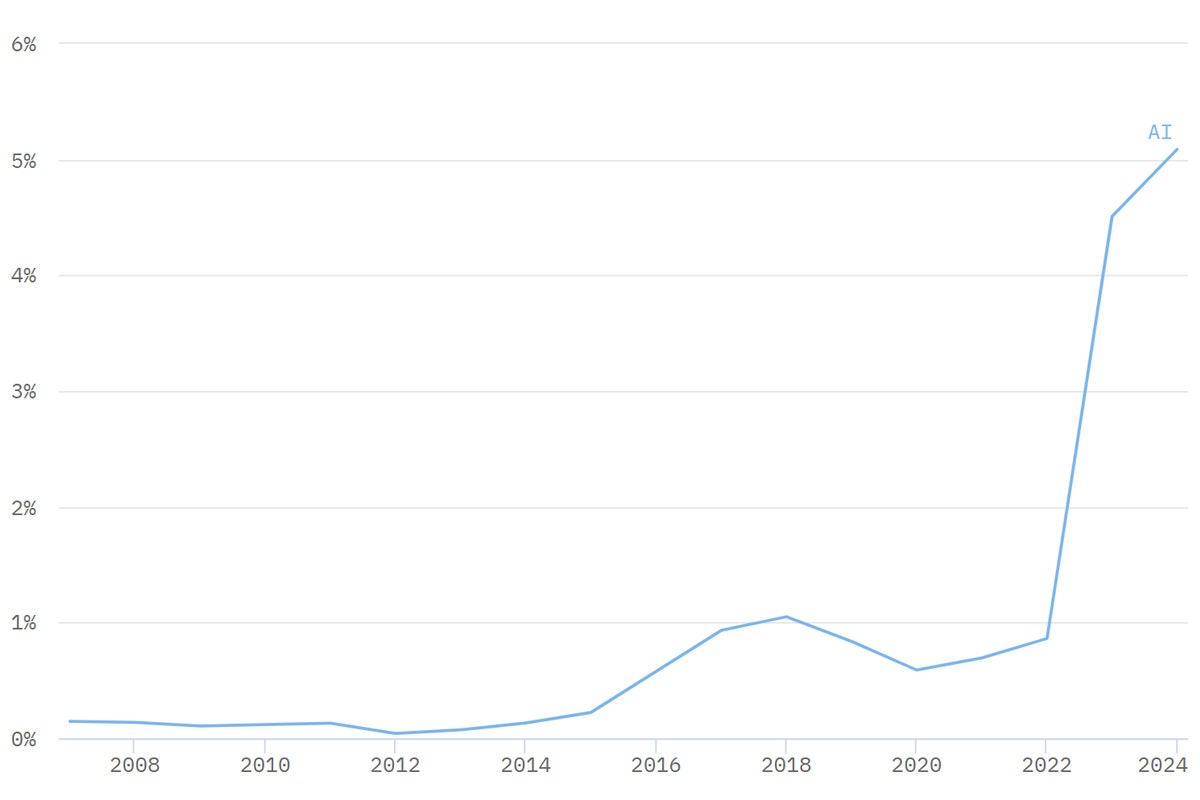
The graph depicts the increase of Hacker News front page items mentioning AI between 2008 and 2024.
What does AI mean for healthcare providers?
Amidst this rapid evolution, the healthcare sector stands out for its complex relationship with AI. The industry oscillates between the enthusiastic anticipation of AI’s potential to improve patient outcomes and cautious scepticism — especially regarding the ethical, privacy, and regulatory implications involved.
While some hospitals and healthcare organisations — such as Mayo Clinic2 and Cleveland Clinic3— are aggressively adopting AI, many are not. According to chief information officers (CIOs) who answered the 2024 EY CIO Sentiment Survey4, 49% see GenAI technology as enhancing organisational value and driving 2x return on investment (ROI), but only 13% have implementation plans established.
Some are waiting for the technology to mature, for the hype cycle to normalise, or for expertise in AI to become more widely available. Other health leaders surveyed cite barriers to adoption including data infrastructure concerns, cybersecurity risks, lack of responsible AI standards, IP protection risks and compliance and ethical risk. As a general trend, healthcare organisations are waiting to see how other people are progressing before they buy in themselves. They want to see well-established references before investing substantially.
This approach may have worked in the past for other products or technologies, but will not address the historic pressures that healthcare organisations are currently facing across the globe, including:
- Rising cost of care - Global health benefit costs are expected to increase 9.9% in 20245
- Workforce scarcity - There is projected to be a shortage of 10 million health workers by 20306
- Rising demand for healthcare services - Only 54% of patients are happy with the level of communication received from their provider7
- Aging populations - The number of persons 80 years or above globally is projected to triple, from 143 million to 426 million, between 2019 and 20508.
- Quality of care - Millions of patients are subject to medical errors, including misdiagnosis and medication errors, every year9
- Health and care professional (HCP) time – HCPs face increasing “paperwork” demands and only 14% report having the time they need with their patients10
To address these challenges, healthcare organisations need to embrace the opportunity for change and use data and AI to transform the care delivery model and incentivise the right behaviours across their ecosystem. This demands innovative solutions, including:
- A shift from sickness to prevention to curb the cost of care - Using AI for diagnoses may reduce treatment costs by up to 50% and improve health outcomes by 40%.11
- Move from analogue to digital to empower the workforce - The use of virtual nursing assistants could save the industry $20 billion12
- Merge virtual and in-person care shifting demand from hospitals to the home - New care models that use AI to integrate virtual, home-based and in-person care to shift between 19% to 32% of care from the hospital to the home.13
- Personalised care plans and remote monitoring to support the aging population closer to home - AI and remote patient monitoring could reduce the 18 million avoidable A&E visits, reducing $32 billion in costs each year14.
- Improve quality of care through better quality data and reduced manual intervention - AI can be used to reduce errors in dosages which would save $16 billion12.
- Automate administrative tasks to free health and care professional (HCP) time – AI could automate up to 45% of administrative tasks in healthcare, freeing up $18 billion in annual costs12
The specific AI initiatives deployed within each healthcare organisation will vary based on local needs, but they can be broadly classified into three segments, as illustrated by the graphic below:
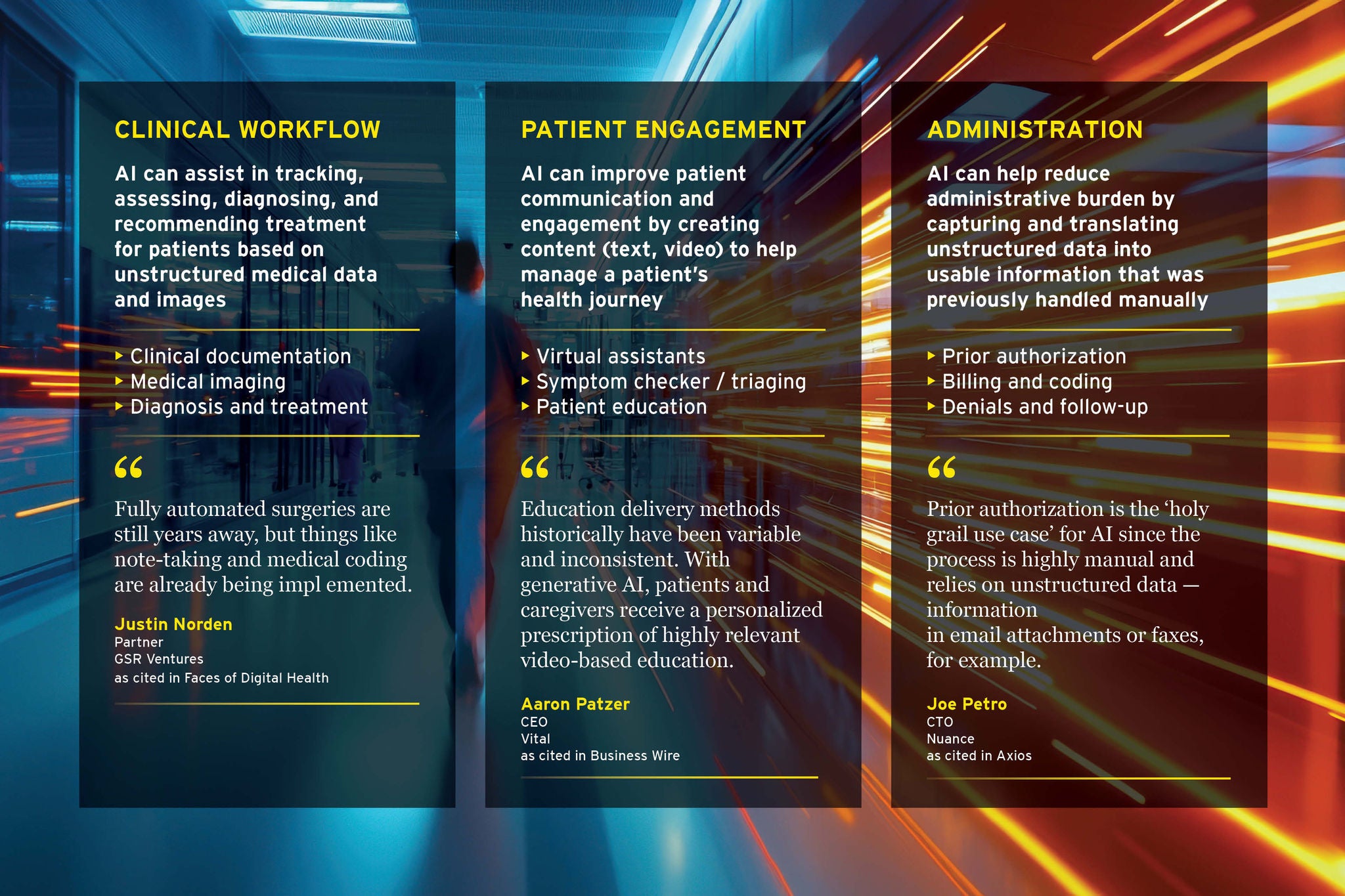
The image is an infographic divided into three sections, each highlighting different aspects of how AI can enhance healthcare, examining the areas of Clinical Workflow, Patient Engagement and Administration.
What are the benefits of adopting AI across these segments?
- Improved Clinical Workflow - AI has the potential to transform patient care by enhancing diagnostic accuracy, personalising treatment plans, and predicting patient interventions and outcomes. For instance, AI algorithms can analyse medical images with remarkable precision, identifying early signs of diseases such as cancer. Personalised treatment plans, driven by AI, can consider a patient's unique genetic makeup, lifestyle, and medical history, leading to more effective and pro-active care.
- Improved Patient Engagement and Care Experience - AI can improve patient engagement through personalised communication and support. Chatbots and virtual assistants can provide patients with timely information, answer their questions, and remind them of appointments and medication schedules. This not only enhances the patient experience but also improves adherence to treatment plans, leading to better health outcomes.
- Increased Operational Efficiency - AI can streamline administrative tasks, optimise resource allocation, and reduce operational costs. From automating appointment scheduling to managing patient records, AI can handle repetitive tasks, freeing up healthcare professionals to focus on patient care. Additionally, AI-driven predictive analytics can help hospitals manage their resources more efficiently, ensuring that staff, equipment, and facilities are utilised optimally.
In many cases, AI is not just an alternative solution, but the best solution. There are certain tasks that computers are inherently better at, such as analysing vast amounts of information, finding correlations between data, or monitoring large amounts of data from sensors. In these cases, the barriers will be less about compliance or risk, but more of mindset, as there are no better alternatives. Furthermore, by freeing clinicians from administrative burdens, AI enables them to spend more time with patients, fostering empathy, improving engagement and providing the human touch that AI cannot replicate. AI will not replace clinicians, but clinicians that use AI will have a significant advantage over those that don’t.
Why do healthcare organisations need to act now?
AI by itself will not address all the of the challenges outlined above, but it is a key enabler to support health organisations in their response. AI is not a fad that is going away, so the question for healthcare CxOs is not “if we will adopt AI”, but “when”.
While delaying the adoption of AI will continue to see the challenges outlined above grow, it will also delay the foundational groundwork that all organisations will ultimately need to deliver. This groundwork will vary based on the situation of each organisation, but is likely to include:
- Co-design with humans - Very few AI systems are fully autonomous but are rather focused on augmentation of and by human healthcare workers and patients. New AI systems typically mean new roles and skills for the humans who work alongside them, and it will typically require time to retrain healthcare workers on the new process and systems. From the beginning of this process, it is crucial to partner with patients and HCPs in AI design, decision-making and associated conversations.
- Establish data infrastructure and governance - Robust data infrastructure and governance frameworks are critical for AI success. Healthcare organisations should invest early in data management solutions, interoperability standards, and data governance policies to ensure that their AI initiatives are built on a solid foundation.
- Integration with the wider ecosystem - Even once AI systems have been built, they need to be integrated into the wider healthcare organisation. Unless you are only employing AI capabilities that are embedded within existing packaged applications that your organisation already uses (e.g., AI features within your EHR), the fit with your medical processes and IT architecture will require planning and time for adaptation.
Importantly, health systems that are less digitally mature stand to gain the most from AI adoption but also risk losing the most if they delay, making strategic decisions crucial. For these organisations, decisions regarding AI adoption must align with the organisation’s overall strategy to ensure success, while delivering early value to secure organisational buy-in.
The impact of not acting now may mean that hospitals and health providers who wait may fall behind.
Delaying AI adoption can have far-reaching consequences that extend beyond immediate operational challenges. Providers that hesitate to embrace AI risk falling behind in several critical areas:
- Risk to Equitable Access to Healthcare: There is a risk we see the emergence of a two-speed health system, where some providers adopt AI and others do not, posing a significant risk to equitable access to healthcare. This disparity can manifest between countries, between different healthcare providers, and between public and private sectors, potentially increasing existing inequalities in healthcare access and quality.
- Technology and Infrastructure Gaps: Providers that delay AI adoption may find the technology and infrastructure gap too big to retrofit existing systems to AI. This can lead to increased costs and complexity in future implementations.
- Delayed Improvement of Data Quality: Postponing AI adoption can result in delayed improvements in data quality, structure or availability. A “catch-22” situation can emerge here, where one of the key tools in understanding and addressing data quality issues is AI.
- Difficulty in Finding Skilled Professionals: As AI becomes more integrated into healthcare, skilled professionals will be in high demand. Providers that delay may struggle to find qualified AI experts or train existing staff, as they may already be hired by other, more proactive institutions.
- Widening Competitive Gap: There will be a widening competitive gap between providers that apply AI and those that don’t. This disparity can put even more pressure on hospitals that delay, as they may struggle to match the efficiency, accuracy, and patient outcomes of AI-enabled competitors.
How healthcare providers can adopt AI?
While some of this may appear daunting, there are many tried and tested approaches that allow organisations to address their most pressing challenges, while delivering value early, in small incremental chunks, including:
- Assess Readiness and Identify Opportunities - Healthcare organisations should start by assessing their readiness for AI adoption and identifying areas where AI can have the most impact. This involves evaluating existing data infrastructure, identifying potential use cases, and setting clear objectives for AI implementation.
- Develop a Strategic AI Roadmap - A strategic roadmap is essential for successful AI adoption. Healthcare organisations should outline a phased approach, starting small and gradually scaling up. This roadmap should include timelines, resource allocation, and key performance indicators to measure success. It is crucial that AI initiatives align with the overall strategy of the healthcare organisation to ensure they support long-term goals and deliver early impact to secure buy-in.
- Collaborate with AI Experts and Vendors - Collaboration with AI experts (such as EY), vendors, and academic institutions can provide valuable insights and expertise. Healthcare organisations should seek partnerships that offer access to cutting-edge AI technologies, research, and best practices.
Conclusion
The transformative potential of AI in healthcare is undeniable. Hospitals and healthcare providers that take proactive steps towards AI adoption will be well-positioned to improve patient care, enhance operational efficiency, and drive innovation. The time to act is now. If you would like to learn more or discuss any of the points raised in this article, please feel free to reach out.
Summary
AI is revolutionising healthcare by enhancing diagnostic accuracy, personalising treatment plans, and improving patient engagement. Despite this, many hospitals delay AI adoption due to concerns about data infrastructure, cybersecurity, and ethical standards. This hesitation can worsen existing issues like rising healthcare costs and workforce shortages. To remain competitive, healthcare organisations must invest in data infrastructure, collaborate with AI experts, and develop a strategic roadmap for AI integration. The article highlights the benefits of AI in clinical workflows, patient engagement, and operational efficiency, stressing the need for immediate action to avoid falling behind.
Related content

How Digital Innovation Can Transform Ireland’s Mental Health Services
Discover how digital innovation can bridge the gap in Ireland's mental health services, ensuring timely, personalised, and effective care for all. Learn about the potential of technology to revolutionise mental health care.

How talent health and GenAI are reshaping work and the workforce
Organisations can make themselves magnets for an increasingly mobile workforce by improving each element of their talent health score. Find out how.

5 steps to integrated healthcare: Connecting people, technology & data
Openness to new health technologies and digitally enabled pathways of care provide an opportunity to reshape patient experience and improve health outcomes.