







Arabian family spending a weekend in the desert

How wealth managers can thrive in the GCC's rapidly evolving market

The GCC wealth management landscape is evolving, offering growth opportunities through innovative strategies and client-focused solutions.


In brief

  • The GCC wealth management sector is experiencing rapid growth, driven by evolving client expectations and strategic government reforms.
  • Wealth managers must adopt innovative strategies, including alternative investments and artificial intelligence (AI) to enhance client engagement and drive profitability.
  • A focus on multi-generational wealth management and tailored services is essential for firms to retain clients and capture new market opportunities.

The global wealth management landscape is undergoing transformative changes, particularly within the Gulf Cooperation Council (GCC) markets, , which are experiencing the fastest growth in wealth management assets globally. This growth increasingly strengthens the GCC as a wealth management hub and is underpinned by factors such as government reforms, increasing offshore assets and a projected annual private wealth growth of 4% to 5%.

In the EY GCC Wealth Management Industry Report 2025, EY posed the strategic question: “How to win in wealth management?” This report focuses on the GCC, where the answer is actively being explored. Despite the region's momentum, there is a pressing need for greater transparency in the wealth management and private banking sectors, which are often discussed without sufficient factual clarity. The report aims to provide data-driven insights that illuminate opportunities for both established firms and new entrants.

This article outlines the evolution, structure and characteristics of the GCC wealth management market, including client segments, service expectations, product offerings, operational models and the regulatory environment. It identifies compelling growth opportunities for wealth managers, tailored to both global trends and regional dynamics.

As the GCC wealth management industry matures, it is characterized by increasing regulatory clarity, enhanced consumer protection and a growing pool of investment products. The region's complexity necessitates bespoke strategies, as each GCC market has developed unique characteristics influenced by a mix of onshore and offshore wealth, local and international regulations, and diverse business models.

These strategies combine established practices with innovative features, enabling wealth managers to enhance client perceived value. Firms that do not fully embrace these concepts risk falling behind their competitors.

Presentation in Multi-Ethnic Office Conference Room
1

Chapter 1

The evolving landscape of wealth management in the GCC

The GCC, comprising six wealthy member states, is a dynamic wealth management market experiencing rapid growth driven by unprecedented oil and gas revenues.

GCC governments are strategically transforming their economies to reduce reliance on natural resources. This transformation is evident in extensive investments in urban development, infrastructure enhancement, technological advancement and workforce education.

While each country within the GCC has its unique development strategy, they share a common vision focused on diversification, internationalization and modernization. In contrast to the slowing growth and geopolitical volatility seen in other parts of the world, the GCC has emerged as a beacon of stability and growth, attracting global business interest and fostering innovation across finance, technology, trade, and real estate. The region's youthful population further enhances its potential as a hub for economic activity.  

Real estate wealth
of private wealth is tied to real estate, with the rest representing bankable or investible wealth.

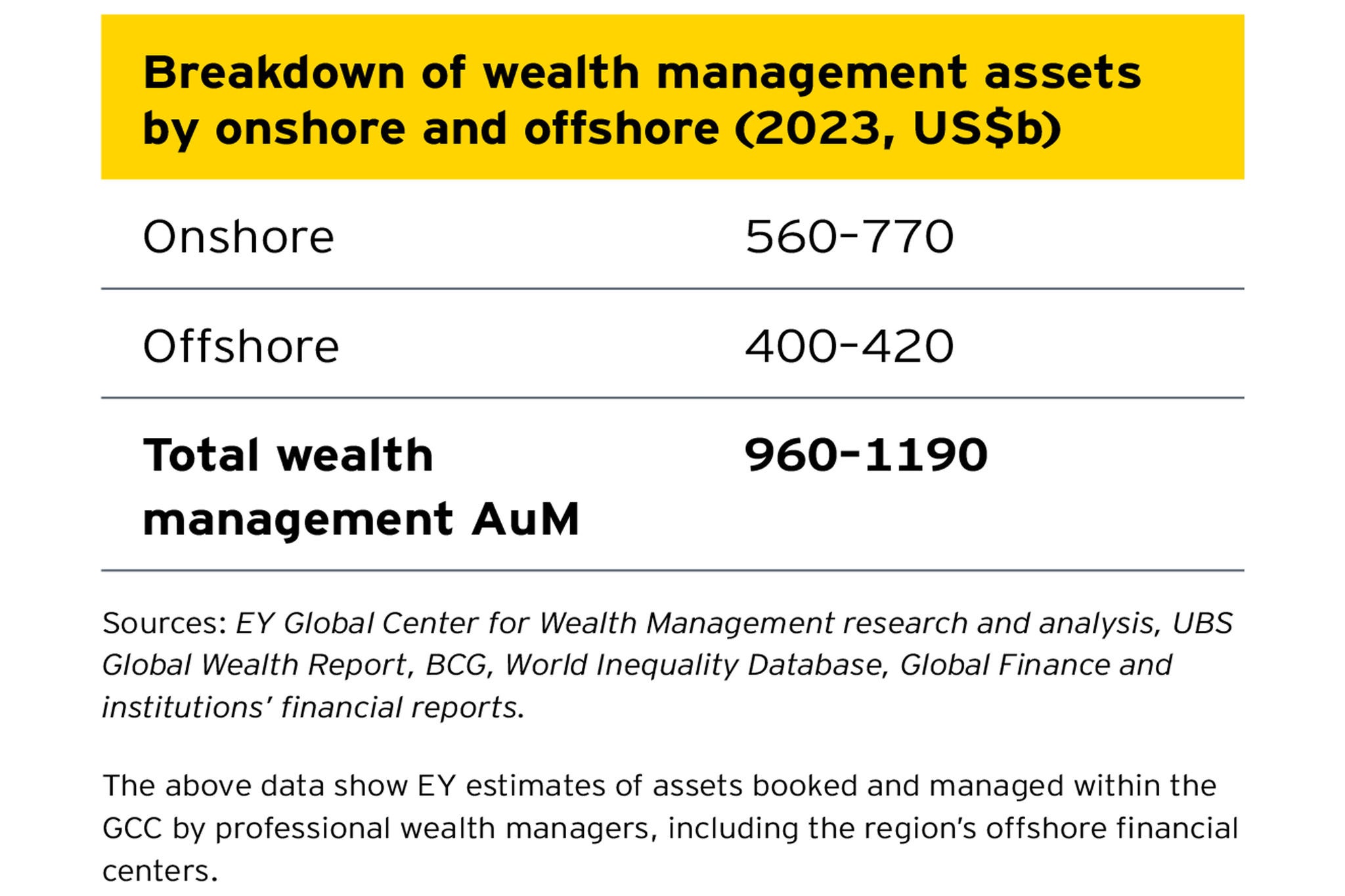
Despite its positive trajectory, the GCC's wealth management industry faces challenges, particularly in the depth and breadth of wealth advisory services and the distribution of financial products. Much of the region's investable private wealth remains offshore. However, this has not hindered the GCC's ascent as a financial hub with the highest growth in wealth management assets globally. Global wealth managers are increasingly establishing offices and booking centers in the region, positioning it to become the sixth-largest wealth management center worldwide.

Wealth Management Industry graphic 01

The United Arab Emirates (UAE) has emerged as the premier wealth management center in the GCC, with over half of the region's professionally managed wealth, approximately US$600b, concentrated within its borders. This wealth is primarily managed through key financial hubs such as the Dubai International Financial Centre (DIFC) and the Abu Dhabi Global Market (ADGM), as well as onshore entities.

About one-third of this wealth originates from within the GCC, while the remaining two-third comes from international sources. The UAE stands out not only for its substantial wealth but also for its robust infrastructure, which includes a high concentration of global wealth managers. International private banks manage between 40% and 50% of the region's wealth management assets, underscoring the UAE's role as a vital hub for both regional and offshore wealth.

In comparison, Saudi Arabia and Qatar represent the second and third largest wealth management markets in the GCC. These markets are characterized by a stronger focus on domestic wealth, with a lower proportion of offshore assets compared to the UAE. Saudi Arabia, in particular, boasts a large retail and affluent consumer segment, solidifying its position as the largest asset management hub in the region.

As the GCC continues to evolve, the UAE's strategic advantages and its ability to attract both regional and international wealth are likely to further enhance its status as the leading wealth management destination.

Understanding the GCC wealth management clientele

The GCC boasts a diverse and dynamic clientele of wealthy individuals, characterized by youth, diversity, and entrepreneurial spirit. This client base defies traditional segmentation, encompassing both ultra-high-net-worth (UHNW) individuals and a significant affluent segment, including a large expatriate community.


Key client segments

The GCC is not only home to some of the world’s wealthiest high-net-worth (HNW) individuals but also boasts a significant affluent segment. This region features a diverse client pool that defies simplistic segmentation, including ruling families, affluent youth, diverse expatriates, and business patriarchs. With a large expatriate community and a growing number of semi-permanent residents, understanding these nuances is crucial for navigating the GCC’s wealth management industry.


The population is notably young, yet it also attracts retirees from around the globe, creating a dynamic demographic landscape. In Saudi Arabia alone, approximately three million young affluent investors are emerging, eager for tailored wealth management solutions. However, many of these individuals face challenges in accessing the personalized services they need.


Local banks are beginning to recognize this gap and are automating their services to better cater to this demographic, presenting a unique opportunity to evolve traditional banking models. As the GCC continues to grow as a wealth management hub, understanding the diverse needs of its clients will be key to success in this rapidly changing market.


Expatriates constitute 40% to 50% of the GCC population, with figures as high as 80% in the UAE. This segment is not monolithic; it includes wealthy professionals and entrepreneurs from various backgrounds, each with distinct needs and priorities. Additionally, the region's baby boomers are the first generation to amass wealth through entrepreneurship and investment. An estimated half a million older individuals are expected to transfer approximately US$438b to their heirs by 2030, presenting a strategic opportunity for wealth managers to offer multi-generational planning advice.


Service expectations

Wealthy clients in the GCC have elevated expectations for innovation, cultural understanding, and digital engagement. They are more likely to switch to wealth management providers compared with clients in other regions, with 36% planning to change their primary provider in the next three years. Key expectations include the need for relationship managers to understand family dynamics and values, with 55% of clients emphasizing this importance. A strong brand reputation is crucial, with 57% of clients considering it a key factor in provider selection. Furthermore, a significant 71% of wealthy individuals expect wealth managers to leverage AI in service delivery, while 60% express concerns about data privacy.

Key service expectations
of wealthy individuals expect wealth managers to leverage AI in service delivery.

Product expectations

While traditional asset classes remain important, GCC clients show a stronger appetite for alternative investments and digital assets. As the industry matures, more local providers are offering discretionary management, which is increasingly valued by clients. A remarkable 69% of wealthy clients in the Middle East hold alternative investments, significantly higher than global averages. Additionally, the adoption of digital assets is on the rise, with 46% of wealthy clients already exposed to them, indicating a growing market for wealth managers to tap into.

Talent development

The GCC wealth management sector has historically relied on expatriate professionals, but there is a growing emphasis on developing local talent. While recruitment remains a challenge, firms are investing in training and development to build a hybrid workforce that meets client expectations.

Regulatory landscape

GCC governments are actively aligning regulations with international standards to attract global players. The UAE, for instance, has established robust regulatory frameworks in its offshore financial centers, while Saudi Arabia's Vision 2030 aims to enhance its financial sector through improved regulations and innovation.

sweet friendly cheerful positive family
2

Chapter 2

Key opportunities for profitable growth in GCC wealth management

Explore strategic avenues for wealth managers in the GCC to drive profitable growth, focusing on alternative investments, affluent banking, multi-generational servicing and AI integration.

As the wealth management landscape in the Gulf Cooperation Council (GCC) continues to evolve, firms are presented with significant opportunities for profitable growth. EY outlines strategic approaches that wealth managers can adopt to enhance their long-term performance in this dynamic region. To thrive in this unique environment, wealth managers must focus on four key concepts that can drive outperformance:

  • Strategic leverage of alternative investments
  • Multigenerational wealth advice approaches and solutions
  • Advice-centered affluent banking
  • Leveraging AI for HNW and UHNW segments


Strategic leverage of alternative investments

The democratization of alternative investments is transforming the wealth management sector. Innovations in technology and financial products are making these previously exclusive assets accessible to a broader range of investors. Over the next five years, alternative assets managed by wealth managers are expected to grow at twice the rate of traditional asset classes, with profits from alternatives projected to nearly triple by 2033. However, many wealth managers face challenges in delivering profitable growth and client satisfaction in this area. To capitalize on this opportunity, firms must develop a cohesive strategy that aligns alternative investment offerings with client needs, streamline operational processes, and enhance advisor education and productivity.


Advice-centered affluent banking

Affluent individuals in the GCC possess significant liquid assets but often find existing wealth advice models lacking. The affluent segment currently holds 35% of all GCC bankable assets and is poised for substantial growth. By redesigning affluent banking around an advice-led proposition, wealth managers can tap into this underserved market. However, challenges such as differentiation, the financial implications of shifting client assets, and the limitations of existing infrastructure must be addressed. A successful affluent banking model will focus on improving clients' financial health through goal-based planning, leveraging technology to enhance client experiences, and fostering trust through personalized interactions.

Multigenerational approaches to wealth management servicing

With wealth transfers accelerating, the need for multigenerational relationships is more critical than ever. Wealth managers must navigate the differing goals and values of donors and inheritors, particularly in the GCC, where recent wealth creation complicates traditional advisory models. Firms that successfully engage with both generations can capture a larger share of legacy wealth and attract new clients. This requires a deep understanding of family dynamics, tailored planning and advisory services, and product offerings that resonate with younger generations. By fostering trust and connection, wealth managers can retain inherited assets and enhance their overall value proposition.


Leveraging AI in the HNW+ segment

Artificial intelligence (AI) presents a transformative opportunity for wealth managers to enhance efficiency and deliver hyper-personalized services. As clients increasingly expect tailored experiences, firms must strategically invest in AI capabilities that drive value. This includes identifying high-priority use cases, improving data quality and architecture, and addressing regulatory challenges. By leveraging AI effectively, wealth managers can boost revenue through data-driven insights, increase productivity by automating routine tasks and enhance client satisfaction through personalized interactions.


These four strategic opportunities—leveraging alternative investments, redesigning affluent banking, adopting multi-generational approaches, and harnessing AI—represent pathways for wealth managers in the GCC to achieve sustainable growth. As the industry continues to innovate, those who embrace these concepts will be well-positioned to thrive in an increasingly competitive landscape. For a deeper dive into these insights and to explore how your firm can capitalize on these opportunities, access the full EY GCC Wealth Management Industry Report 2025.


In conclusion, the GCC wealth management market is ripe with opportunities for firms willing to innovate and adapt. By focusing on these four key areas, wealth managers can position themselves for sustainable growth and success in a rapidly evolving landscape. Embracing these strategies will not only enhance profitability but also foster deeper client relationships and drive long-term value in this dynamic region. Ultimately, sustainable growth in the GCC wealth management sector hinges on a client-led purpose. Despite the region's dynamism, the fundamental need for trusted advice remains constant. Firms that effectively articulate their purpose and tailor their business models will be best positioned to navigate the evolving landscape, achieve profitable growth, and secure long-term success.

Summary 

The GCC wealth management sector is poised for significant growth, driven by evolving client expectations and government reforms. Key trends include a focus on alternative investments, the need for advice-centered affluent banking, and multigenerational wealth management strategies. Additionally, leveraging AI to enhance personalized services is becoming essential. As the region attracts global interest, wealth managers must adapt to these trends to capitalize on opportunities and ensure sustainable growth, addressing challenges such as transparency and service accessibility to meet the diverse needs of a dynamic clientele.

Related articles

How AI is transforming the future of wealth management in Middle East

Artificial intelligence (AI) is revolutionizing wealth management in the Middle East, driven by heightened client engagement and demand for transparency. Read more

How wealth managers can leverage complexity for competitive advantage

Client sentiment is shifting. Learn how wealth managers can respond with targeted improvements in financial and non-financial services.

Top 10 resolutions for wealth and asset management success in 2025 

Our global outlook highlights 10 resolutions that wealth and asset managers should take to drive growth in 2025.

Jun Li + 2

    About this article

    Authors

    Contributors