



windmill and solar energy plant on a sunny day

Learning from Europe: Accelerating the Development of Taiwan’s Renewable Power Trading Market

Although Taiwan’s renewable energy journey began later than Europe’s, industrial development has accelerated the green energy demand. Taiwan can leverage Europe’s experience to refine its green power trading strategies.


In brief

  • Relaxation of renewable energy policies boosts solar power supply and expands the green energy market. Green energy is still insufficient under rising demand in ICT-related industries.
  • Declining Feed-in Tariff (FiT) rates and rising electricity prices promote green energy trading. Time-of-use tariffs and behind-the-meter storage unlock arbitrage opportunities.
  • European green power generation surpasses 50% in 2023 while CPPAs set a record for transaction volume. Renewable energy oversupply results in significant negative electricity price occurrences.

Relaxation of renewable energy policies boosts solar power supply and expands the green energy market

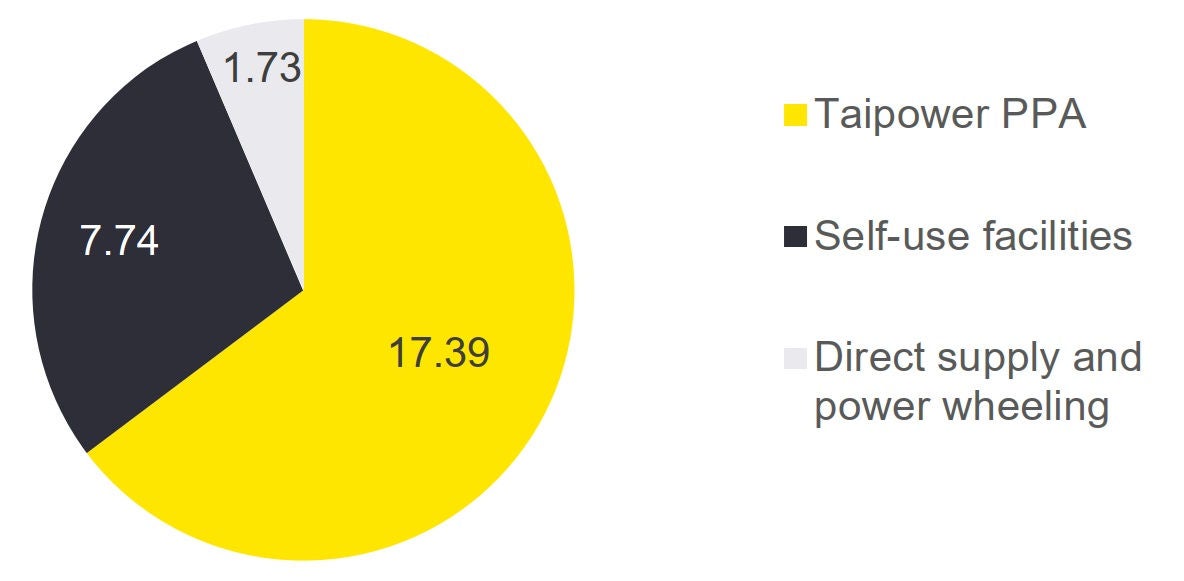
According to statistics from Ernst & Young (EY), Taiwan generated 282.1 TWh of electricity in 2023, with 9.5% from renewable energy (approximately 26.86 TWh). Within this renewable portion, Taiwan Power Company (Taipower) purchased 17.39 TWh of renewable energy under its Feed-in-Tariff (FiT) program, while 1.73 TWh was traded in the renewable energy market, either through direct supply or power wheeling, accounting for only 6% of the total renewable energy generated. The remaining 7.747 TWh, came from self-use facilities and was not released into the renewable energy market.

2023 Taiwan Renewable Energy Distribution (Unit: TWh)

Additionally, given the increasing domestic demand for green energy, Taiwan’s Bureau of Energy under the Ministry of Economic Affairs (MOEA) further relaxed the “Type 3 to Type 1 Conversion” regulations in 2023. This allows renewable energy generated by self-use solar projects (Type 2 and Type 3) to enter the green energy market, to be sold directly to renewable-energy-based electricity retailing enterprises (hereafter “retailing enterprises”). Since Taipower began accepting sales of green energy directly to end-users or via retailing enterprises in May 2020, approximately 5.61 TWh of renewable energy had been traded via Corporate Power Purchase Agreements (CPPAs) by the end of September 2024.

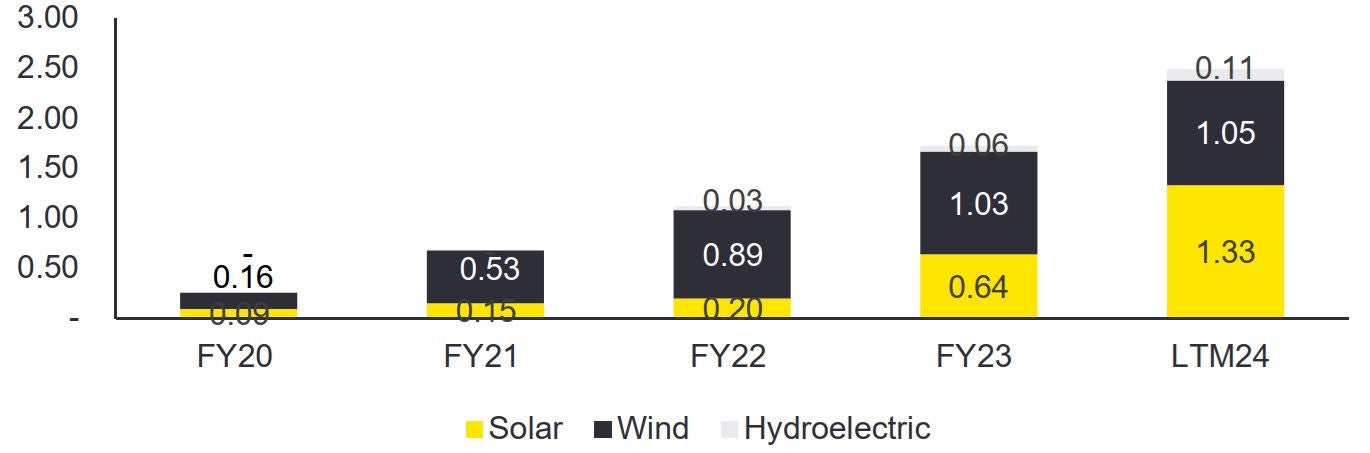
EY statistics show that green electricity traded via CPPA will reach 2.49 TWh in the last 12 months (LTM) of 2024, up by more than 30% compared with 1.73 TWh in 2023. Solar power specifically will increase to 1.33 TWh, over 90% growth compared with 0.64 TWh in 2023. Since the amendment of the Electricity Act on 26 January 2017, enabling green power liberalisation, the renewable energy market in Taiwan has grown at an average annual rate of 50%. The MOEA estimates that approximately 8.6 TWh green electricity from self-use facilities could be traded directly to end-users or sold via retailing enterprises in 2024.

Taiwan Renewable Energy CPPA 2020-2024 (Unit: TWh)


Rising electricity demand in ICT-related industries: green energy still insufficient

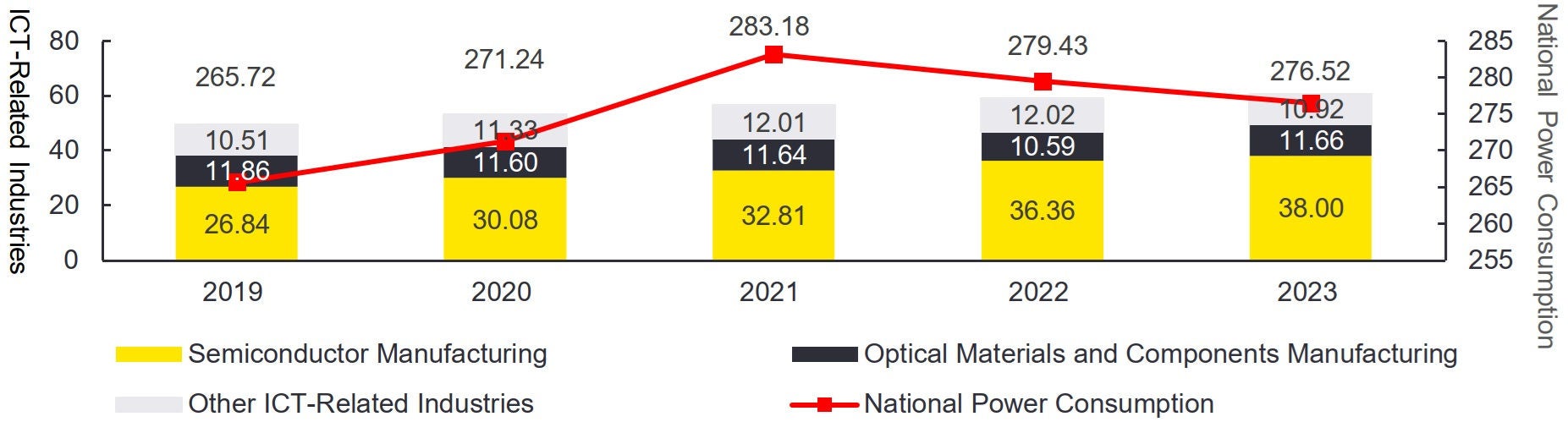
EY highlighted Taiwan’s pivotal role in the global AI computing supply chain. Major technology corporations are actively responding to the “2050 Net Zero Emissions” policy and adopting initiatives such as RE100. Consequently, the demand for green energy among technology companies continues to rise. Despite a nationwide reduction of 2.91 TWh in electricity consumption 2023 compared with 2022, the semiconductor manufacturing’s electricity usage grew by 1.64 TWh (4.5%). Due to the annual increase in advanced semiconductor manufacturing capacity, it is projected that the electricity consumption of Taiwan's semiconductor industry may grow more than threefold in the future. Furthermore, with the establishment of new AI server and data centres by international corporations from 2024 to 2028, these developments could lead to a substantial increase in electricity demand by 2030.

National and ICT-Related Industries Power Consumption 2019-2023 (Unit: TWh)


Declining Feed-in Tariff (FiT) rates and rising electricity prices promote green energy trading

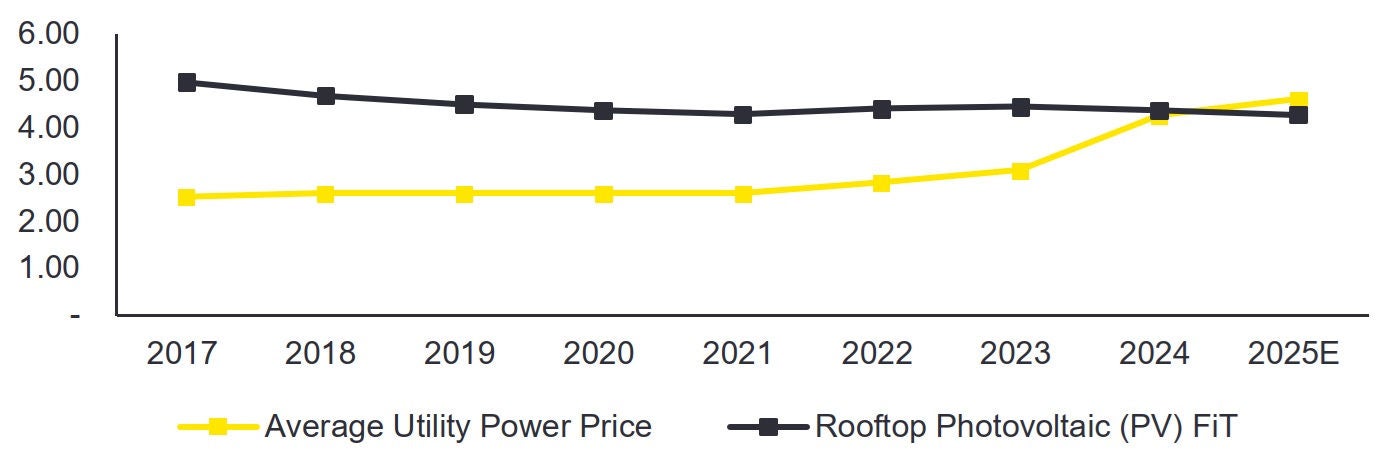
As solar development matures, the FiT rate for second-phase rooftop solar projects in Taiwan in 2024 has been capped at NT$4.37/kWh, a 12.2% reduction over eight years. This narrowing profit margin for long-term power purchase agreements (PPAs) with Taipower has highlighted the benefits of trading on the market over direct grid sales.

Taipower’s recent announcement of a 12.1% average industrial electricity price hike further underscores this trend. With industrial electricity prices averaging NT$4.27/kWh post-adjustment, forecasts suggest that by 2025, grid buyback prices could fall below industrial electricity rates. This transition marks a critical period for green power trading and the development of the free market.

Rooftop PV FiT vs. Average Industrial Electricity Price (Unit: NT$/kWh)


Time-of-use tariffs and behind-the-meter storage unlock arbitrage opportunities

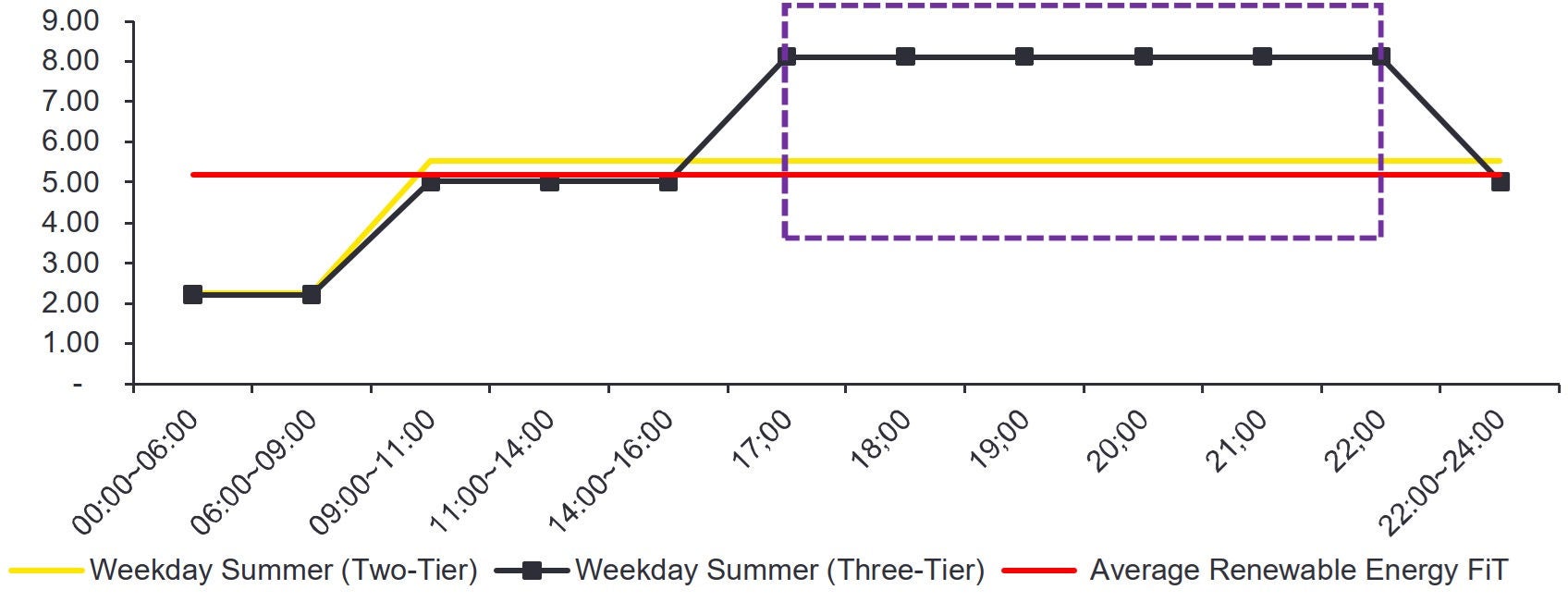
For large corporations, there are many options for signing CPPAs with renewable energy plants or retailing enterprises at fixed rates. However, green energy remains a scarce resource for small and medium enterprises (SMEs) and retail consumers in Taiwan, who are likely to adopt time-of-use tariffs, storing low-cost off-peak electricity for use or sale during peak hours to optimise costs. According to the Bureau of Energy, potential applicants for such systems include 500,000 SMEs, one million small businesses and two million households, yet the current adoption rate is below 3%. EY estimates that if SMEs and retail consumers subsequently adopt time-of-use tariffs, they will need to purchase large amount of green electricity annually to realize arbitrage. This is expected to drive the development of the behind-the-meter energy storage market.

2024 Standard Time-of-Use (TOU) Tariff vs. Average Renewable Energy FiT (Unit: NT$/kWh)


European green power generation surpasses 50% in 2023: growth in CPPA capacity

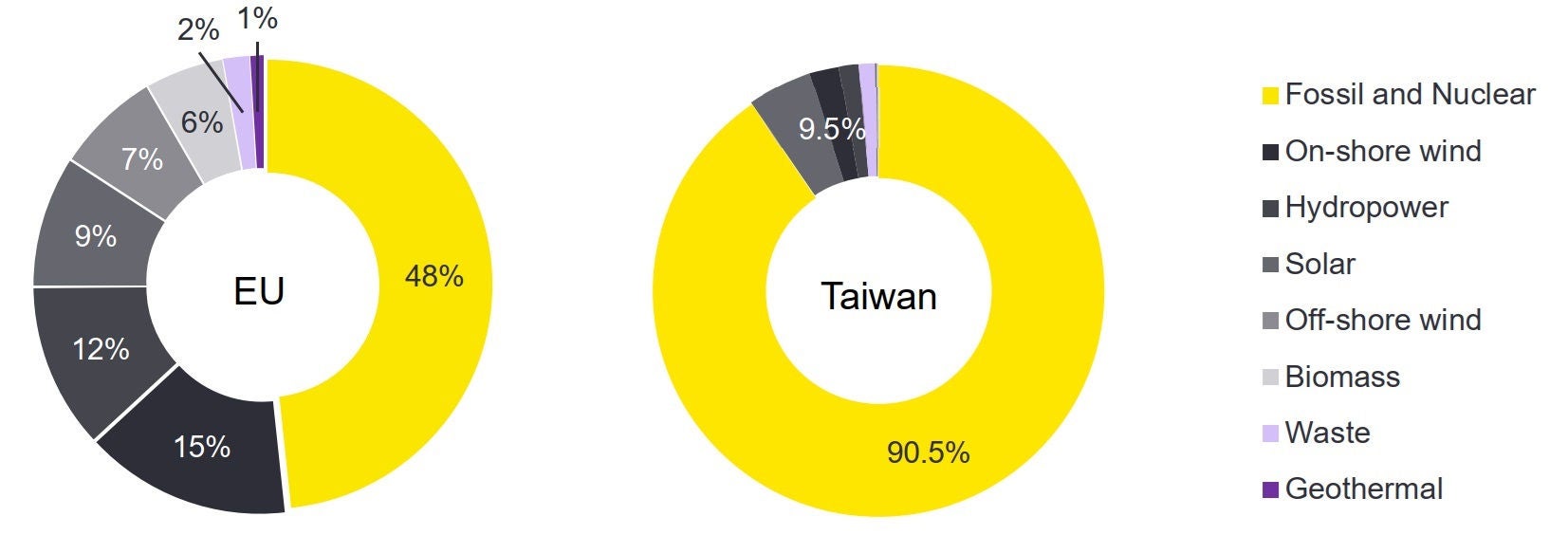
The EU is witnessing unprecedented growth in renewable energy. The International Energy Agency (IEA) reports that renewable energy accounted for 51.7% of total energy production in the EU in 2023. In contrast, Taiwan’s renewable energy penetration remained low at 9.5%, with significant reliance on imports for hydrogen, natural gas, and bringing in advanced carbon capture technologies. The EU presents itself as a key potential partner and supplier for Taiwan.

Renewable energy generation in EU vs. Taiwan as of 2023

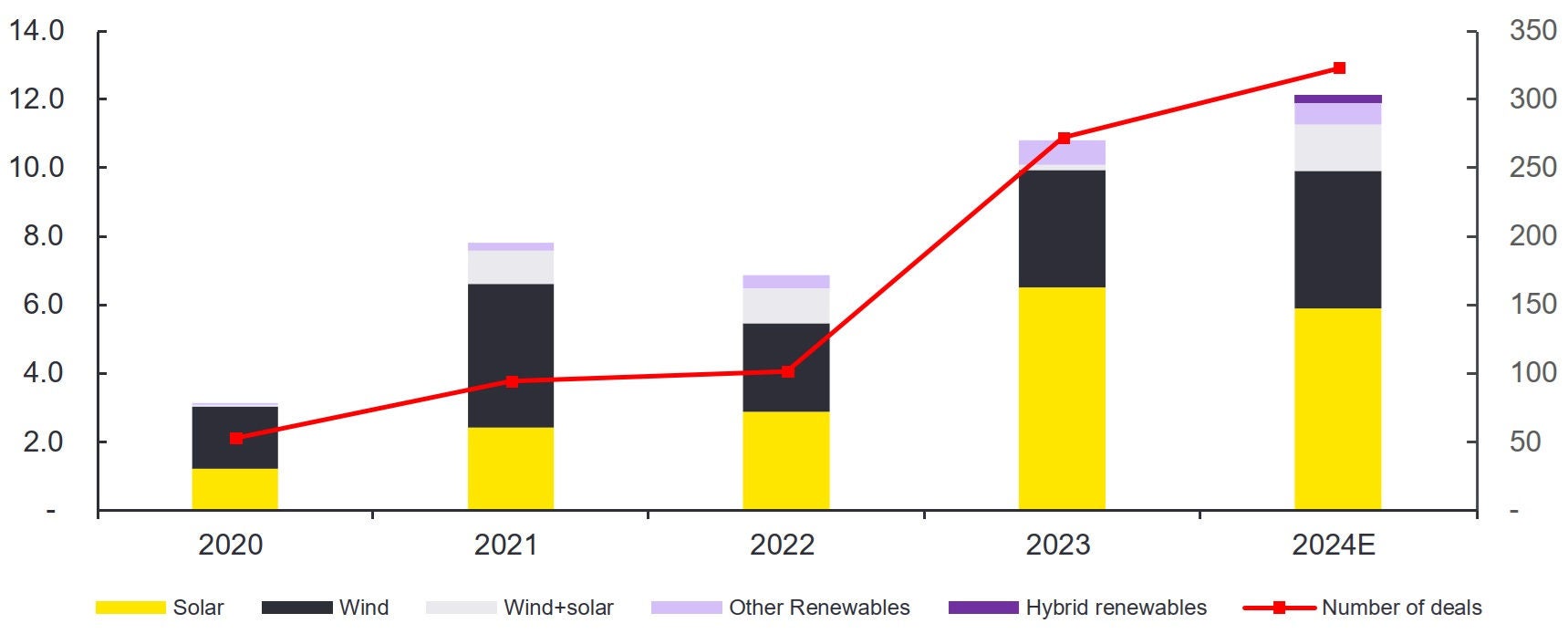
According to statistics from the Brussels-based energy trading platform RE-Source, 145 CPPAs were signed across Europe (including the UK) in the first half of 2024, setting a record for transaction volume. This represents a 54% increase compared with 94 agreements signed during the same period in 2023, equating to 10.6 GW of contracted capacity. Among these, solar energy volumes were double those of both onshore and offshore wind, accounting for approximately 5.9 GW. EY statistics indicate that over the last 12 months in 2024, Europe is expected to reach 323 PPA deals (excluding utility transactions) with a total contracted capacity exceeding 12 GW.

Contracted PPA Capacity Europe (26 countries incl UK) from 2020–2024E (Unit: GW)


Intermittent Renewable Surplus and Negative Electricity Prices in Europe

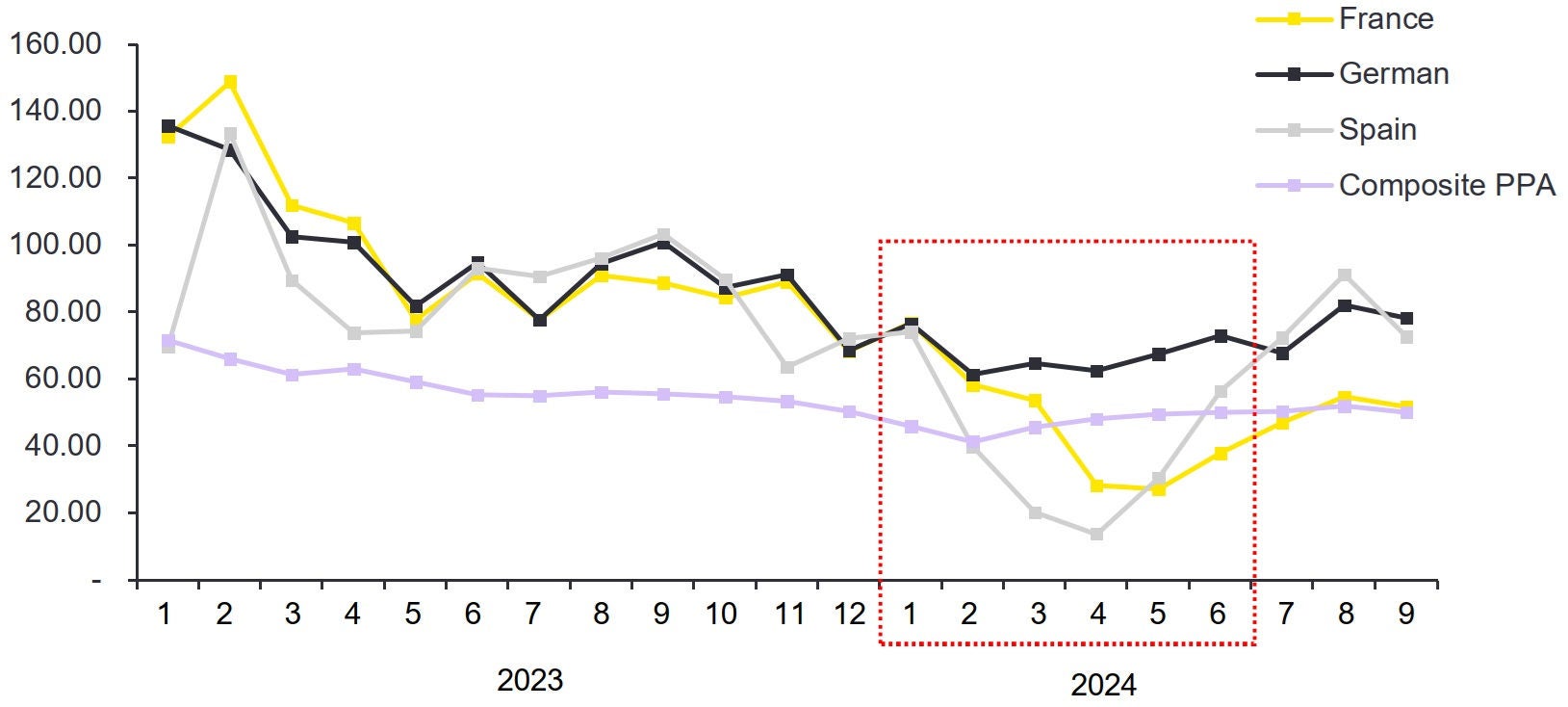
However, rapid expansion of renewable energy sources has led to energy oversupply, resulting in significant negative electricity price occurrences in 2024, with Germany, Spain and France experiencing 142, 160 and 233 hours of negative pricing, respectively. The EU continues to invest in green infrastructure, increasing wind and solar generation by 12.7% in the first half of 2024 compared with the previous year. However, price volatility has raised risks in CPPA agreements.


In contrast, Taiwan’s CPPA market remains nascent, facing supply shortages, heavily capital expenditure on the early stage and above-market financing rates. However, the continued volatility of green electricity prices in Europe serves as a warning to the Taiwanese market, as well as highlighting the importance of energy storage in stabilising green electricity prices.

Average wholesale spot electricity prices vs. Composite PPA 2023–2024 (Unit: EUR/MWh)


"Vision to Reality – A Net Zero Future" Report co-published by Ernst & Young and European Chamber of Commerce Taiwan (ECCT)


Summary

Although Taiwan’s renewable energy journey began later than Europe’s, industrial development has accelerated the green energy demand. Medium-to-short-term CPPAs are expected to dominate in the face of market fluctuations. At the same time, to compensate for losses caused by low electricity prices, the government raised electricity rates in 2024, is gradually reducing the purchase price of green electricity, and is simultaneously relaxing regulations related to solar energy supply. This will inevitably accelerate the development of business models for behind-the-meter green electricity trading and various energy storage arbitrage opportunities.

When renewable energy penetration surpassed 50% in Europe, this necessitated the development of stable pricing mechanisms to manage risks. It is also expected that short-term CPPAs will increase. Additionally, Hybrid PPAs combining hydrogen storage with solar or wind power could offer long-term solutions. Taiwan can leverage Europe’s experience to refine its green power trading strategies.

(Co-written by Aaron Wu, Managing Director, & Vincent Zhu, Senior, EY Transaction Advisory Services Inc.)

Disclaimer: The views reflected in this article are the views of the author and do not necessarily reflect the views of the global EY organization or its member firms.


Our latest thinking

    About this article