



EY refers to the global organization, and may refer to one or more, of the member firms of Ernst & Young Global Limited, each of which is a separate legal entity. Ernst & Young Global Limited, a UK company limited by guarantee, does not provide services to clients.
Recent Searches
Overall ODI maintained steady growth, while overseas M&A values edges up amid divergent regional performance.
In brief
- China’s overall outward direct investment (ODI) reached US$86.5 billion in H1 2026, up 8.1% YoY.1
- Chinese enterprises announced a total of US$21.4 billion in overseas M&As, up 3.6% YoY. The number of announced deals fell 13% YoY to 191, remaining subdued by historical standards.2
- The value of newly signed contracts for Chinese overseas engineering, procurement and construction (EPC) projects reached US$125.6 billion, down 3.3% YoY.3
In H1 2026, China's economy demonstrated strong resilience, with GDP growing 4.7% YoY.4 Meanwhile, overall ODI increased by 8.1% YoY,5 while overseas M&A value rose by 3.6% YoY. Goods exports surged by 17.6% YoY,6 reflecting the continued momentum of Chinese enterprises’ global expansion.
On the policy front, China's first administrative regulation on outbound investment, the Provisions of the State Council on Outbound Investment, came into effect on 1 July. The regulation not only establishes an institutional framework for outbound investment, clarifies measures in areas such as services, management, and protection to effectively safeguard the lawful rights and interests of investors and their outbound investments, but also further extends the regulatory focus from the “starting point” of investment filing and approval to the entire process of overseas operations. In particular, it sets out clear requirements for the regulation of cross-border flows of technology, data, and personnel, as well as security reviews. In terms of the international environment, the spillover effects of the geopolitical conflict in the Middle East continue to persist, shipping in the Red Sea remains disrupted, global economic recovery is sluggish and global supply chains may face a new round of adjustments.
Looking ahead to the second half of the year, Chinese enterprises’ global expansion must closely monitor the risks of abrupt policy shifts and market volatility in key regions, proactively develop alternative plans and contingency mechanisms, and strengthen their operational resilience amid an increasingly complex geopolitical landscape.
Macro environment: global economic recovery remains uneven, while China's diplomacy and institutional guidance support overseas development
In H1 2026, the global economy experienced a moderate recovery, albeit at a slowing pace. The International Monetary Fund (IMF) lowered its full-year global economic growth forecast to 3.0%, a decrease of 0.5 percentage points compared to 2025.7 Geo-economic fragmentation, financial market volatility, constrained fiscal policies, accelerating investment in and adoption of artificial intelligence, and population aging are major forces reshaping businesses. As Chinese enterprises pursue global development, they must balance resilience with efficiency, accelerate supply chain diversification, reshape operations through artificial intelligence and digitalization, and strengthen global compliance and risk management systems. Against the backdrop of a complex external environment, China has continued to deepen high-level institutional opening-up and provide clear policy guidance. Through high-level diplomacy at multiple levels, China has established regular economic and trade dialogue mechanisms with a number of countries and expanded cooperation in areas such as green economy, digital development and mineral resources. These efforts have helped create a stable and predictable environment for Chinese enterprises to diversify their overseas market presence and advance their global operations with greater confidence.
Overall ODI maintains steady growth, while financial ODI surges
In H1 2026, China’s overall ODI reached US$86.5 billion, up 8.1% YoY. Non-financial ODI amounted to US$65.7 billion, down 9.0% YoY. Non-financial ODI in B&R partner countries amounted to US$17.5 billion, down 7.4% YoY, accounting for 27% of overall non-financial ODI during the same period.
Figure 1: China’s overall ODI (US$ billion)
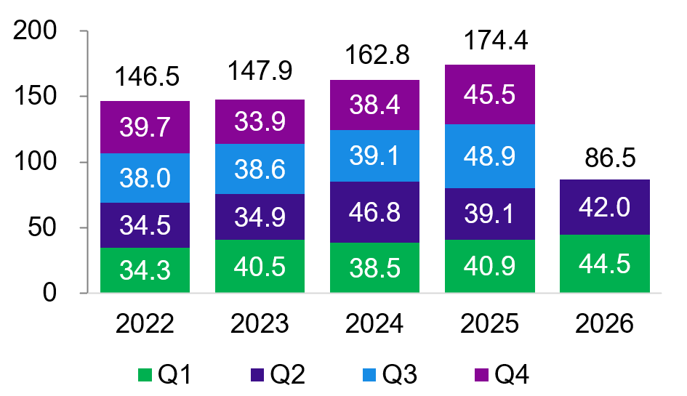
Note: Figures in charts are rounded to the nearest integer; due to rounding, subtotals may not sum to the total.
Source: Monthly Statistics in Brief, China MOFCOM, EY Analysis
Overseas M&A value records a slight increase, while deal volume remains at a historic low
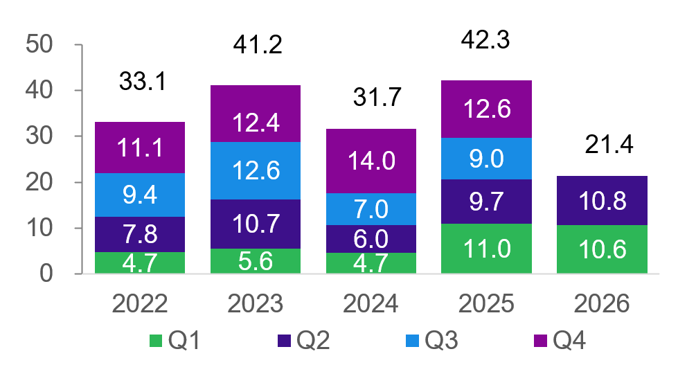
In H1 2026, Chinese enterprises announced a total of US$21.4 billion in overseas M&A, up 3.6% YoY, with deal value exceeding US$10 billion for three consecutive quarters. The number of deals stood at 191, marking a 13% YoY decline, with overall deals remaining subdued by historical standards.
Figure 2: Value of announced China overseas M&As (US$ billion)
Note: Figures in charts are rounded to the nearest integer; due to rounding, subtotals may not sum to the total.
Source: LSEG, Mergermarket, including deals that have been announced but not yet completed, data was downloaded on 6 July 2026; EY analysis
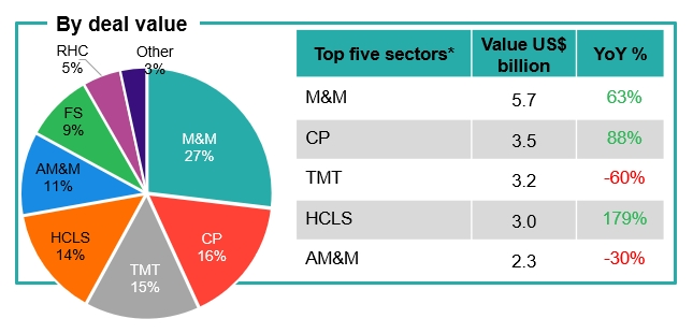
Figure 3: Hot sectors for announced overseas M&A by Chinese enterprises (By deal value)
*TMT refers to Technology, Media, and Telecommunications.
Note: Figures in charts are rounded to the nearest integer; due to rounding, percentages may not sum to 100%.
Source: LSEG, Mergermarket, including deals that have been announced but not yet completed, data was downloaded on 6 July 2026; EY analysis
Figure 4: China overseas M&A distribution by continent (By deal value, YoY growth; By deal number, YoY growth)
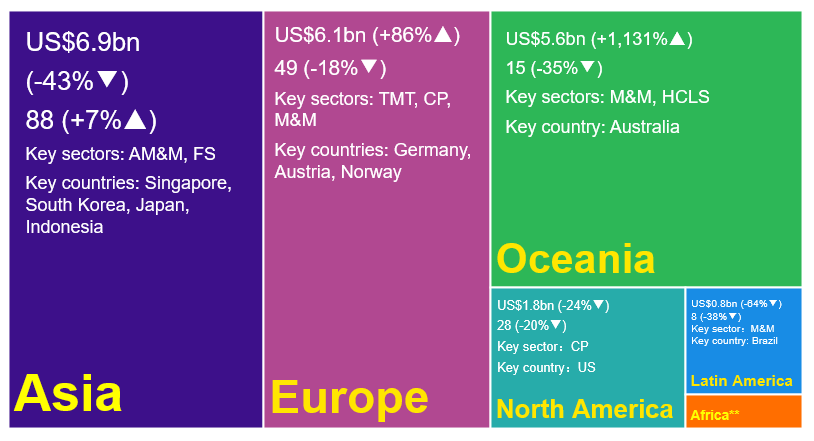
*Note: The above hot sectors and major countries are all calculated by M&A value. Africa recorded M&A value of US$260 million (36%▲) with three deals (-57%▼). The major deal in Africa was a Mining & Metals M&A deal in Sudan in the first quarter.
Source: LSEG, Mergermarket, including deals that have been announced but not yet completed, data was downloaded on 6 July 2026; EY analysis
Overseas EPC new contract value edges down slightly, while completed turnover maintains steady growth
In H1 2026, the value of newly signed overseas EPC contracts by Chinese enterprises reached US$125.6 billion, down 3.3% YoY, while new contracts in B&R partner countries totaled US$114.2 billion, up 0.7% YoY, with their share rising further to 91%. Completed turnover reached US$88.0 billion, up 12.6% YoY. Completed turnover in B&R partner countries amounted to US$75.5 billion, up 16.5% YoY, accounting for 86% of the total.
Summary
China’s overall ODI reached US$86.5 billion, up 8.1% YoY. Overall ODI maintains steady growth, while financial investment surges significantly. Chinese enterprises announced a total of US$21.4 billion in overseas M&A, up 3.6% YoY. Although overseas M&A value recorded a slight increase, deal volumes remained at a historic low. The value of newly signed overseas EPC contracts by Chinese enterprises reached US$125.6 billion. While the value of newly signed overseas EPC contracts edged down slightly, completed turnover continued to grow steadily.
Related articles
Hong Kong’s role in the Belt and Road: from super-connector to value-adding partner
EY unveils a special edition of its Navigator report for the Belt and Road Summit 2025 in Hong Kong — Hong Kong’s role in the Belt and Road: from super-connector to value-adding partner.
Overview of China outbound investment of the first three quarters of 2023
China's ODI sustained growth, while overseas M&A value rebounded amid volume contraction, the market recovery remains uncertain. China's overall ODI amounted to US$114 billion, up 6.7% YOY.
Empowering high-quality development of the Belt and Road
These reports, viewed through the lenses of sustainability and digitalization, summarize the progress, achievements and trends in jointly building the Belt and Road (B&R) since 2013. They also showcase cases and experiences of some Chinese enterprises participating in B&R construction, offering valuable insights to encourage more Chinese and multinational companies to participate in the high-quality development of the BRI.