



illuminated underside of bridge at night

Top 10 business risks and opportunities for mining and metals in 2026

Unpredictable output and tariff tensions mean companies face a new era of operational risk. It’s time to reimagine mining. 


In brief:

  • Operational complexity is miners’ top challenge as deeper, more complex orebodies and declining ore grades create variable output. 
  • Greater scrutiny around license to operate is an opportunity — doing what is right, not just what is regulated can win over communities and governments.
  • AI tops the investment agenda, but ROI depends on alignment with business strategy. 

A shift is underway in mining – from strategic to operational risks, and from prioritizing shareholder returns toward reinvesting for growth. Volatility, along with persistent cost and productivity challenges, continues to rise, just as pressures grow to supply the minerals and materials that underpin the global economy. Companies are moving to capitalize on surging demand while making sure approaches remain resilient amid uncertainty.

The miners surveyed for the latest EY top 10 business risks and opportunities in mining report are responding through transformation, including by adopting artificial intelligence (AI) and tech, working side-by-side with communities and exploring innovative funding options. But for most companies, changes remain slow and fragmented, yielding only incremental gains. Slow, isolated change is not suited for an operating environment that is increasingly nonlinear, accelerated, volatile and interconnected (NAVI). In the NAVI world, risks can materialize overnight and set off cascades of downstream impacts and unexpected outcomes. It’s time for mining and metals companies to think boldly about the scope and potential of transformation – reimagining mining from end-to-end can unlock huge value for companies, and for all of us.

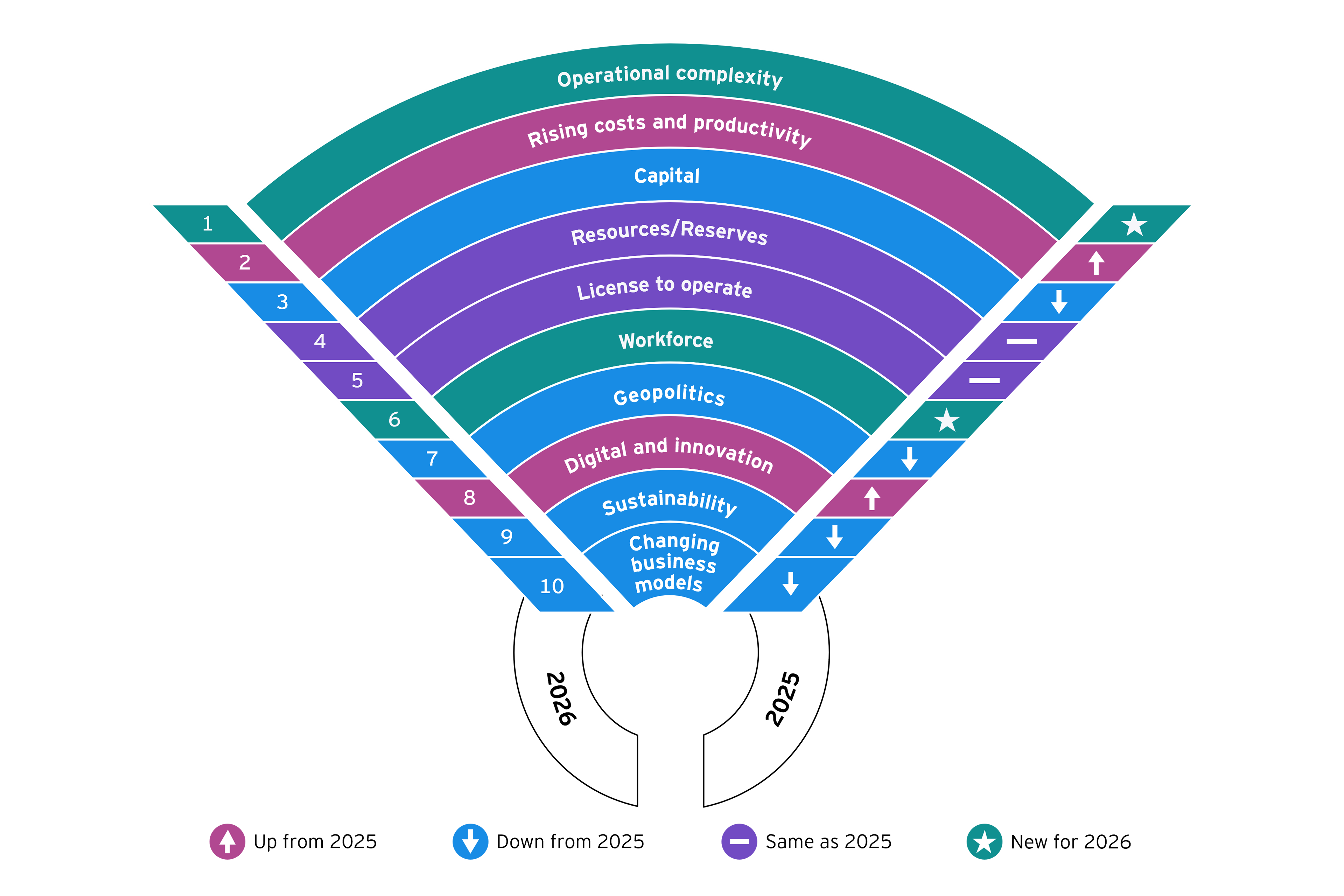
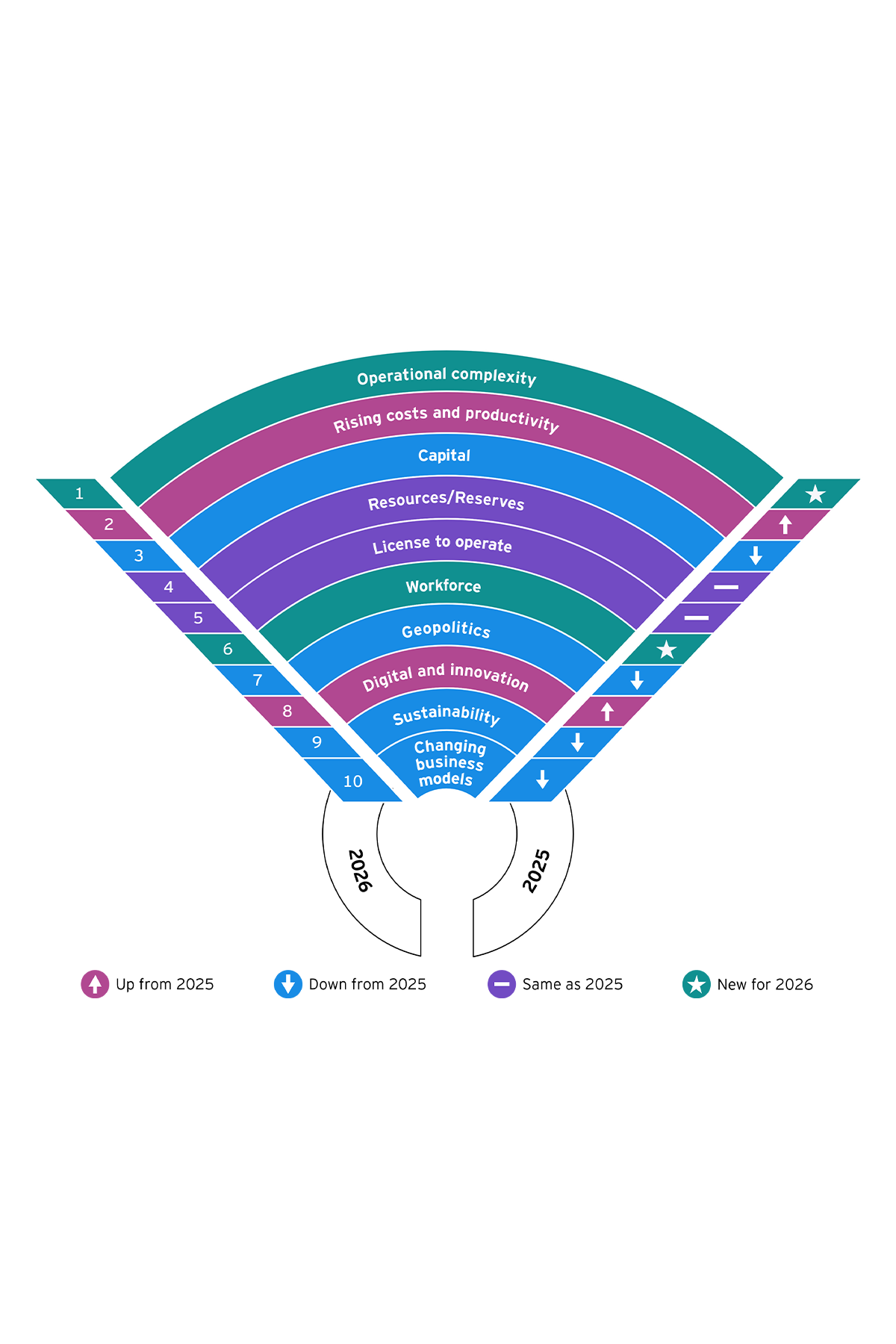
Top 10 risks and opportunities for mining and metals companies in 2026

Top 10 risks and opportunities for mining and metals companies in 2025

1. Operational complexity
 

Predictability underpins investor confidence, capital access and strategic agility. But achieving reliable output is more difficult because of operational complexity – deeper, more complex orebodies, greater variability and declining grades. The average grade of copper mined worldwide has fallen by about 40% since 1991.1 The challenge is heightened by aging assets and capability gaps. Deeper mines require specialist knowledge in geotechnics, logistics and hydrology. 
 

Miners we surveyed gave almost equal weighting to multiple factors impacting throughput, highlighting the need for solutions that consider the entire value chain, focusing on those areas likely to make the biggest impact for each company.
 

Priorities may include tighter planning discipline and capital effectiveness and adopting predictive tools and maintenance to boost uptime and efficiency.
 

2. Costs and productivity
 

Production variability is a significant driver of cost and productivity pressures, which are exacerbated by siloed operating models, little integration between operations and maintenance, and poor inventory optimization. 
 

Meanwhile, digital transformation is yet to deliver real productivity gains, energy and labor costs remain stubbornly high – and new tariffs, royalties and disrupted supply chains are pushing up logistics and procurement costs.
 

In addition to better managing geological variability, miners can unlock gains through analytics and AI that reduce asset downtime and augment human capability. Redesigned operating models – integrated, with humans at the center – encourage and lock in sustainable improvements. Adopting renewable energy can stabilize costs and reduce risk and transparent engagement with investors on costs builds confidence and secures access to favorable financing.

Download our top 10 business risks and opportunities for mining and metals in 2026

3. Capital
 

For three years running, miners have boosted capex while dialing back shareholder payouts – a clear shift toward a growth mindset. Investors back the switch, particularly in copper, where a supply gap offers huge opportunities.


When it comes to growth strategies, miners are considering all options, including both buy and build components, particularly in “future facing” minerals. Most transactions are bolt-on acquisitions and joint ventures, though the announced Anglo American-Teck merger proves that large deals driven by strategic imperatives are still on the table.
 

Higher interest rates and capital intensity mean the sector’s weighted average cost of capital (WACC) is now 8–10%, more than double that of large technology peers.2 Miners are pursuing alternative financing models like royalty, streaming, offtake, partnerships, sustainable finance and government incentives. Others are doubling down on cost controls and aligning risk management with commodity cycles to optimize investment decisions. 
 

4. Resource and reserve depletion
 

Reserve depletion could create supply shortfalls that threaten to undermine the world’s economic growth, create price volatility, geopolitical tensions and even environmental damage in the race to access reserves.
 

The problem is not a lack of geological resources, but declining quality of what’s recovered and a lack of investment in extracting it. Growing demand is anticipated to require US$5.4t of investment in mining and metals by 20353, but exploration budgets fell to US$12.5b in 2024, from US$12.9b in 2023.4
 

The risk of depletion could be a powerful driver for innovation. For example, miners are maximizing brownfield sites, extracting deposits in unconventional areas, such as tailings, and investing in new tech like AI-driven analysis. Others are progressing new partnerships, acquisitions and urban recycling to recover minerals from end-of-life electronics and batteries.


5. License to operate
 

License to operate remains a focus as miners prepare to meet ever-growing expectations and commitments around better performance. Our survey found respondents expect governments to assert greater control over a wide range of mining issues, with sustainability and governance being one of the top areas.


Miners that approach license to operate as an opportunity, not an obligation, can build trust and strengthen reputations, which can help win approvals and funding. Engaging systematically with communities throughout the mining lifecycle, including through closure, is critical, says Mark Bristow, President and CEO of Barrick. “Mining done right is a powerful force for development. When our host communities succeed, we succeed too,"he adds.
 

6. Workforce
 

Mining’s longstanding skills crisis is set to worsen, as retirements increase and new talent looks elsewhere. The sector’s struggle to fill key roles, including in mine planning, process engineering, sustainability, closure and regulatory compliance undermines productivity and safety and threatens future supply. Seventy-five percent of mining executives are not confident in their ability to resolve labor shortages for onsite operations.6

of miners surveyed said vertical integration was the top capital allocation option.
of surveyed mining executives aren't confident resolving labor shortages.

Attracting talent requires countering outdated perceptions of the sector, articulating its role in the energy transition and digital future, and showcasing the exciting roles on offer. Improving diversity, equity and inclusion (DEI) can also help close skills gaps, and it is encouraging to see continued commitment to DEI objectives despite political headwinds. Partnering across the sector with universities and governments can also build new talent pipelines and agile education pathways.

7. Geopolitics

The need for minerals for defense, the energy transition, data centers and semiconductors has created supply gaps that create both security and economic implications. Governments are responding by escalating tariff and export restrictions to strengthen control over mining, processing and refining and safeguard national interests. 

Meanwhile, more countries are adopting carbon pricing, which may become a powerful economic lever as the impacts of climate change intensify.

A proactive approach to geopolitical risks, including through building strategic relationships with governments, helps miners capitalize on shifting dynamics.

8. Digital and innovation

Digital transformation is gaining pace across the sector as companies seek better solutions to enhance cost management, productivity, safety and sustainability in a more complicated environment. AI is top of the agenda – 21% of miners surveyed say they will invest more than 20% additional budget over the next 12 months to build AI capabilities.

Agentic AI also offers huge potential to augment human capabilities and create greater value across the business. But making the most of solutions depends on identifying opportunities to drive tangible business impact and updating risk management processes. So far, ROI in AI and other digital initiatives has been limited, hindered by siloed data and misalignment with business needs. Gains have been realized within core operations, but more value will come from an end-to-end approach that leverages a unified data and AI backbone.


9. Sustainability

Sustainability initiatives are slowing across the sector. More than half of survey respondents have reassessed and/or delayed commitments, likely due to market volatility but also because of few premiums for green materials.

Nature-positive commitments remain strong, but only 56% of respondents are confident of meeting obligations. Many are unsure of what to measure or report and impending International Sustainability Standards Board (ISSB) standards should offer clarity. In the meantime, digital solutions can improve data availability and rigor. Miners are using data analytics, smart sensors and blockchain to track, monitor and report Scope 3 emissions, though reducing these value chain emissions remains difficult. Evidence points to growing transparency in sustainability performance with the latest International Energy Agency (IEA) critical minerals report noting a tenfold increase in companies adopting third-party frameworks over the past five years.7


10. Changing business models

Companies are shifting toward business models that allow them to quickly boost supply through capturing more of the value chain. This is achieved through domestic processing and refining, recycling to extract value from waste, and collaboration that helps miners expand capacity and access strategic resources with lower capital outlay. Vertical integration was the top capital allocation option for 26% of the miners surveyed. Vertical integration into midstream or downstream processing — often through partnerships and local collaboration — allows companies to capture more of the value chain, particularly in battery minerals and rare earth elements.

Miners are also exploring innovative joint venture agreements or “district” strategies to share capital costs and address the technical, environmental and technical challenges of large-scale projects. These partnerships are a way to fast-track projects, pool resources and leverage complementary expertise. 


Summary

As mining and metals companies prepare for 2026, they face external volatility, including tariffs and geopolitical tensions, but also internal pressures around cost, productivity and labor. These risks come at a time of escalating demand and an urgent need to find faster, more efficient ways to supply the materials needed to power a changing energy system, the digital economy and defense commitments. For miners, investors and stakeholders, the next 12 months will bring challenges but also opportunities to capitalize on demand through innovation, collaboration and rethinking traditional ways of operating.


Related articles

Does today’s disruption provide the blueprint for tomorrow’s growth?

EY-Parthenon CEO Survey September 2025 reveals how leaders build confidence, resilience, and growth strategies amid disruption and transformation.

How can reimagining risk prepare you for an unpredictable world?

The 2025 EY Global Risk Transformation Study explores how Risk Strategists see disruption earlier, adapt faster and respond with more precision.

    About this article

    Contributors