


EY refers to the global organization, and may refer to one or more, of the member firms of Ernst & Young Global Limited, each of which is a separate legal entity. Ernst & Young Global Limited, a UK company limited by guarantee, does not provide services to clients.
Recent Searches

A powerful shift is underway in global energy demand, driven by accelerating digitalization, electrification and industrial reinvention.
In brief
- Malaysia’s energy demand is rising as businesses expect smarter, greener and more reliable solutions to support growth and sustainability goals.
- EY research shows companies face growing complexity and want tailored, fast and flexible energy options, supported by digital and AI‑enabled tools.
- Organizations must deepen customer insight and collaborate across ecosystems to drive Malaysia’s low‑carbon transition and deliver higher‑value energy solutions.
As electricity consumption hits new peaks, energy is becoming a strategic enabler of growth, not just an operating expense. The EY Navigating the Energy Transition research was recently conducted to survey more than 2,400 energy leaders in mid-sized to large businesses in eight countries. It found that organizations and solution providers across sectors in Malaysia have a crucial opportunity to redefine their role, from utility supplier to trusted partner in sustainable business transformation.
Commercial and industrial users in Malaysia are now responsible for more than 75% of electricity demand. These business customers are raising their expectations, demanding energy that is reliable, cost-efficient and increasingly green. But many still face fragmented systems and generic solutions that do not reflect the complexity of their operations or ambitions.
In Malaysia, this dynamic is taking center stage. Seventy-five per cent of surveyed businesses say they expect their energy needs to become more complex over the next three years as they navigate rising and unstable energy costs (68%), availability and reliability of energy concerns (80%), increased consumption (91%), and decarbonization (82%) alongside other ESG pressures. These shifts are unfolding in parallel with the country’s National Energy Transition Roadmap (NETR), which sets ambitious targets for decarbonization, clean energy adoption and digital infrastructure development.
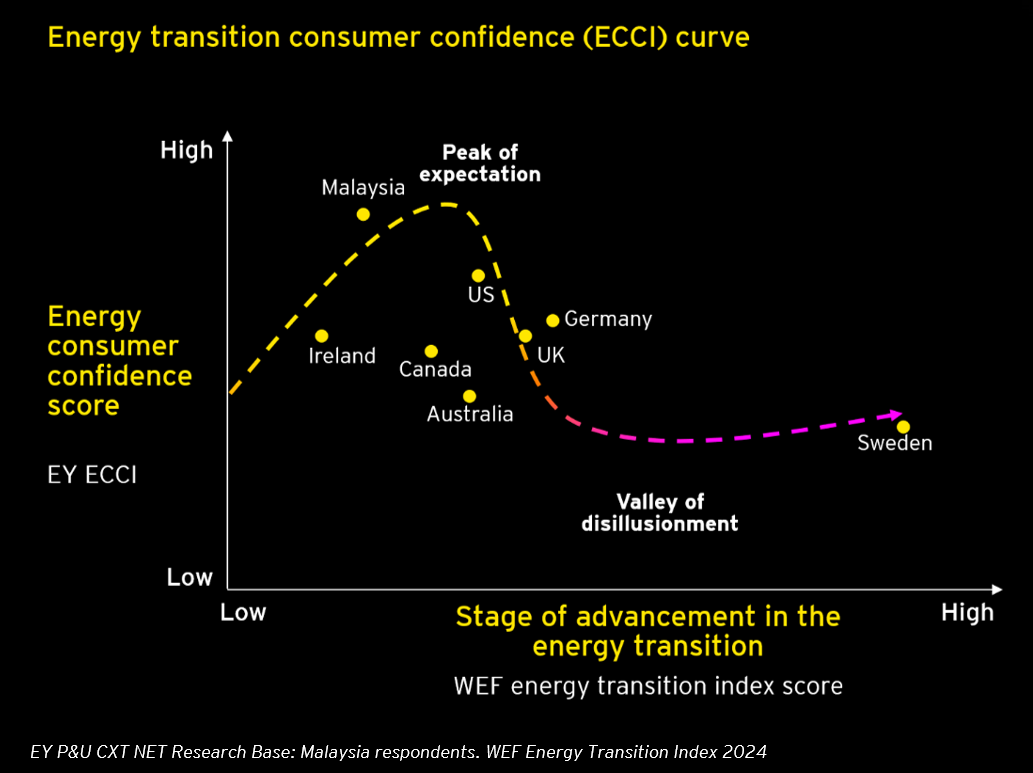
From our research, we know that business confidence in energy transition is key to unlocking the investment in the new sustainable technology’s businesses say they want to make. Energy transition is a multi-decade journey, and what we see globally is that business confidence tends to go through a predictable cycle. When a country starts its energy transition journey, business confidence tends to be high, due to the promise of abundant cheap, clean, green energy.
But as the transition progresses, the tradeoffs start to materialize and often it is business customers who are expected to “pick-up” a significant proportion of the cost of energy transition through the tariffs and other charges. Business confidence naturally falls as energy costs increase, and price stability and energy security often decrease. Over time, business confidence in energy transition returns, as the benefits start to be realized but never (yet) to the levels experienced at the start of the transition.
Malaysia is at the start of its energy transition journey, and confidence is high, especially among larger businesses and in sectors which are arguably easier to decarbonize (services and IT vs natural resources and construction).
Given this context, organizations and solution providers face a dual challenge: driving business growth while supporting the country’s low-carbon transition. This is not a task for them alone. Embedding sustainability into business and operating models will require deeper collaboration across sectors, especially as pressure mounts from regulators, investors and customers to accelerate progress. The imperative is clear: deliver smarter, more tailored energy experiences that help businesses thrive while advancing national sustainability goals.
1. Businesses are powering our energy future
Electricity demand is expected to grow by 60% to 100% by 2050, with businesses as key energy users account for nearly three-quarters of that growth. This is not just about AI and data centers. Local demand is also driven by rising electric vehicle (EV) uptake, increased automation of operations, new manufacturing activity and internal tech infrastructure. A significant finding from the EY research indicates that over 90% of businesses in Malaysia, particularly those in manufacturing, information technology, and natural resources sectors, expect increased electricity consumption in the next three years.
Also in Malaysia, where new EV sales are projected to reach 9.6%1 by end-2025, progress is being made, but infrastructure gaps and consumer readiness remain challenges. This underscores the urgent need for future-ready energy systems that can scale with business ambitions, along with a stronger role for strategic partners and the broader energy ecosystem in supporting business growth.
2. Energy is now a competitive advantage
More than 70% of businesses globally already have a formal energy strategy. Energy is no longer just a cost to manage – it has become central to operational resilience, supply chain efficiency and brand value. In Malaysia, momentum is accelerating behind the NETR, which targets 70% renewables by 2050 and supports digital energy infrastructure like community solar and EV charging. Local businesses are reacting: the majority (83%) say they will increase investment on electrifying operations, lowering emissions and reducing energy costs in the next three years. Many are looking for solution providers who can offer and bundle data insights around consumption, sustainable on-site generation and financing with digitally-enabled solutions.
3. Energy solutions must be both fast and flexible
Businesses are prepared to pay more for green energy, but they want it to work for them, quickly and on their terms. Two-thirds of businesses plan to invest in or expand their use of on-site generation and battery storage within the next three years, seeking greater control over energy sourcing and reliability. The EY research also highlights that 72% of businesses in Malaysia are exploring on-site renewable installations, and 54% are considering selling surplus energy back to the grid.
This shift is a major opportunity for co-creation. Organizations and solution providers that move beyond standardized offerings and work closely with customers to deliver customized solutions, from solar to storage to energy-as-a-service, will be key players in Malaysia’s low-carbon transition aligned with NETR ambitions.
4. Enabling the neglected middle
Mid-sized firms, often the engine of Malaysia’s economy, have similarly ambitious energy goals, but limited support to act on them. Despite having sustainability commitments similar to larger companies, mid-sized businesses are more likely to feel less confident and face slightly more barriers in executing effective energy strategies due to affordability and complex regulations.
The challenges mid-size businesses face can in part be addressed through provisioning of better digital and AI-enabled energy products and services. Digital engagement is becoming essential. Globally, more than 70% of businesses want AI-powered advice and tools to help them make smarter energy decisions. Organizations and solution providers that prioritize personalization, intuitive platforms and local responsiveness can capture a fast-growing segment of the market.
5. Redefining energy partnerships
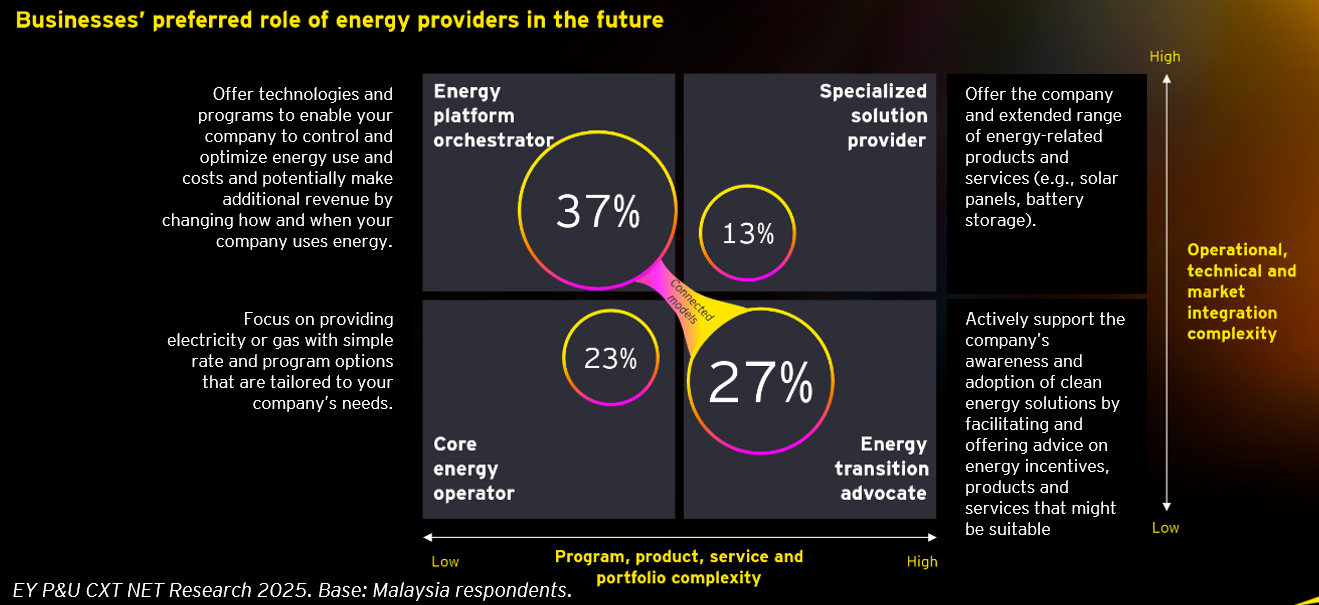
To better serve business customers, organizations and solution providers must decide what role they want to play. Four emerging models are taking shape:
- Core energy operator offering simple, transparent rates and tailored packages.
- Energy transition advocate guiding customers toward clean energy adoption.
- Energy platform orchestrator enabling energy optimization and control.
- Specialized solution provider delivering modular technologies like EV charging or microgrids.
In EY’s global survey, 42% of businesses indicated they want their provider to act as a clean energy advocate. In Malaysia, where businesses face dual pressures of rising costs and sustainability goals, this highlights a timely opportunity for organizations to step into that role. The research also notes a strong desire for personalized service, with more than 90% of businesses in Malaysia seeking customized guidance on reducing energy costs and emissions. Organizations and solution providers that lean into this role can deliver high-impact value and build enduring customer relationships.
Five steps to drive business energy transformation in Malaysia
To stay ahead, organizations and solution providers must move beyond legacy models and take bold, customer-centric action. These five steps offer a roadmap for transformation:
- Deepen customer insights: Go beyond basic segmentation to understand the unique motivations and expectations of all business customers in achieving their energy goals.
- Evolve account management roles: Shift business managers into strategic energy advisors who deliver personalized energy solutions and help bridge internal silos.
- Enhance digital engagement: Use smart tools and AI-driven platforms to provide insights, self-service options, and educational support.
- Clarify strategic position: Develop a clear, future-focused roadmap to meet business needs and close internal capability gaps.
- Foster collaborative ecosystems: Build alliances to co-create innovative energy solutions that better serve varied customer needs.
Charting a new energy path for Malaysia
Malaysian organizations and solution providers across various sectors stand at a turning point. The demand from business customers is clear: smarter, faster and greener energy that supports sustainable growth. Those that listen, adapt and lead with innovation, leveraging digital technologies and ecosystem partnerships, will not only support their clients but also help shape a resilient, prosperous energy future for the country.
Malaysia’s energy landscape is rapidly evolving as digitalization, electrification and rising business demand reshape expectations. With commercial and industrial users driving over 75% of electricity consumption, businesses seek reliable, cost‑efficient and greener energy solutions. EY research shows rising complexity in energy needs alongside the country’s National Energy Transition Roadmap. Organizations face pressure to deliver tailored, fast and flexible solutions, from on‑site renewables to digital, AI‑enabled tools. Mid-sized firms need greater support, while partnerships are shifting toward advisory and platform-based models. To lead, providers must deepen customer insights, enhance digital engagement and collaborate to accelerate Malaysia’s low‑carbon transition.
Sources:
- How can soaring energy demand drive lasting prosperity?, EYGM Limited, 2025.
- Six actions to turn soaring energy demand into lasting prosperity, EYGM Limited, 2025.
- Malaysian Automotive Association (MAA), 22 July 2025