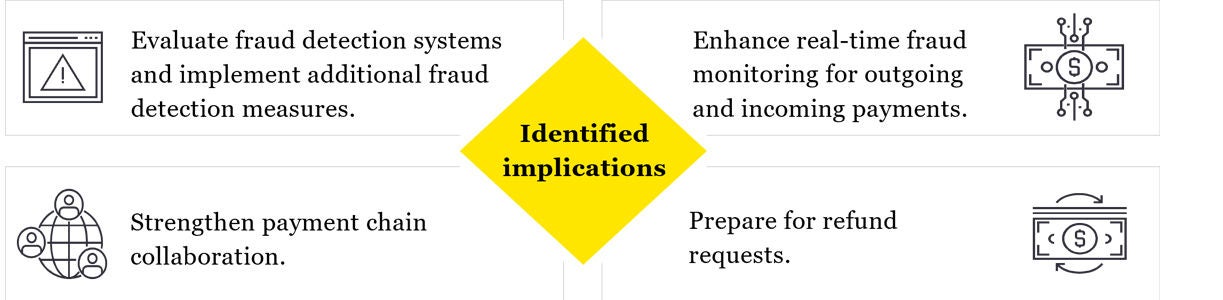
The PSR also sets out several specific technical measures that PSPs are required to implement. Examples are the obligation to block suspicious transactions, both incoming and outgoing; IBAN–name matching or verification of the payee; and cooling-off periods for changes to spending limits.
Some of the Dutch banks already apply such cooling-off periods, and experience shows that these have a positive impact on fraud prevention. In addition, the PSR introduces mandatory verification of PSP licenses by social media platforms and enables the sharing of fraud-related data among PSPs.
Transaction Monitoring and fraud data sharing
What does change?
PSPs must implement transaction monitoring to enable strong customer authentication and reduce fraud, covering all PSPs in the chain. The PSR will require more advanced monitoring than PSD2, including data monitoring such as payment account details, transaction specifics, and session information that PSPs must verify for fraud prevention. Part of the data that must be monitored also includes shared fraud data. What a PSP can monitor is limited to the data that is listed in the regulation. On one hand, this provides protection for consumers, but it also makes the legislation less future proof since fraud evolves and new methods may emerge that require monitoring of different types of data.
In addition to the data that must be included in transaction monitoring, risk-based factors must also be considered. Unlike the limited data, the PSR specifies a minimum set of risk factors that PSPs must consider. Examples of risk-based factors include known fraud scenarios in the provision of payment services and signs of malware infection in any sessions of the authentication procedure.
The data as noted above may be shared with other PSPs when the PSP has objective and justified reasons to suspect fraudulent behavior by a payment service user. The purpose of this data sharing is solely for the detection and prevention of fraud. The data that may be shared is strictly limited to the listed data in the PSR, such as the previously mentioned transaction specifics and session information. Transaction monitoring systems process substantial numbers of data and data must be processed with well-defined objectives and privacy safeguards. Exchanging information about fraudulent transactions requires collaboration and data-sharing agreements between PSPs to ensure compliance with GDPR regulations.
What does this mean for PSPs?
As a result of the additional requirements regarding monitoring and sharing, the following requirements can be identified.
- Requirement for the implementation of additional toolings or the redesign of current tooling for transaction monitoring.
- Requirement to be up to date on risk-based fraud factors.
- Requirement for close collaboration internally and within the payment chain.
Meeting the requirements for monitoring is not merely a matter of implementing more advanced tooling. The key challenge lies in developing a deeper understanding of the behavior underlying a transaction and being able to substantiate, in a transparent and consistent manner, why a transaction was or was not flagged as potentially fraudulent. PSPs must therefore ensure that monitoring outcomes are explainable and defensible, both towards customers and supervisory authorities.
In addition, the PSR explicitly requires PSPs to monitor data while taking at least a minimum set of risk‑based factors into account. This includes reviewing behavioral signals, unusual transaction patterns and customer‑specific risk characteristics. A stronger focus on these risk‑based factors supports earlier detection of fraud and enables PSPs to concentrate their efforts on transactions and customers that pose the highest risk.
The regulation also makes clear that PSPs can no longer assess suspicious behavior in isolation. Where there are objective and justified reasons to suspect fraudulent activity by a payment service user, PSPs are required to share specific types of data with other PSPs. This marks a shift towards a more collective fraud‑defense model across the payment services industry, in which collaboration and timely information exchange play a central role in preventing and mitigating fraud.
Payment fraud risks and trends
What does change?
As per the PSR, PSPs need to create adequate customer fraud awareness and internal staff training for PSPs representatives. Customer fraud awareness includes proactively alerting customers, through all appropriate channels and media, when new forms of payment fraud emerge. PSPs should provide customers with clear and practical guidance on how to identify fraudulent attempts and clearly warn them about the actions and precautions necessary to avoid becoming victims of fraud. In addition, customers must be clearly informed about where and how they can report fraudulent activities and quickly obtain relevant fraud-related information.
With these measures PSPs must consider the needs of their most vulnerable customers. This may be challenging as it requires a clear understanding of who the most vulnerable customers are, as well as how they can be most effectively reached. PSPs are not alone when it comes to customer awareness. The PSR also stipulates that providers of electronic communications services, as well as providers of very large online platforms and very large online search engines, share this responsibility.
In addition to raising fraud awareness among customers, the PSR emphasizes the importance of internal fraud training for personnel. To ensure effective mitigation of payment fraud risks, PSPs are required to provide personnel with at least annual training programs focused on payment fraud risks and emerging trends. These training sessions equip personnel with the necessary skills and knowledge to fulfil their responsibilities in identifying and responding to fraudulent activities.
What does this mean for PSPs?
Based on the requirements outlined above, we identify the following responsibilities.
- Warn customers regarding new fraud types across multiple channels.
- Provide clear guidance on recognizing fraud, steps to take, and where to report it.
- Address needs of vulnerable customers with tailored communication.
- Offer mandatory annual fraud‑risk training for relevant personnel.
- Collaborate with online platforms, online search engines and electronic communications service providers.
When designing training programs for personnel, it is important to cover several key areas to ensure employees are well-equipped to recognize and respond to payment fraud risks. We consider it as a leading practice to work with criminal journeys that incorporate modus operandi. This approach enables personnel to learn about the various stages in a criminal’s method for committing fraud, as well as the measures that can be implemented to disrupt their activities. It helps personnel identify vulnerable points in the payment process where intervention can be most effective. In addition, collaborating with online platforms to tackle fraud in an integrated manner definitely has added value.