


EY refers to the global organization, and may refer to one or more, of the member firms of Ernst & Young Global Limited, each of which is a separate legal entity. Ernst & Young Global Limited, a UK company limited by guarantee, does not provide services to clients.
Unified Digital Management Model
The Unified Digital Management Model (UDMM) provides a strategic framework to simplify compliance with digital regulations, enabling organizations to enhance governance and foster innovation.
Organizations today face an overwhelming and rapidly expanding landscape of European digital regulations. With an extensive and growing set of laws touching on several digital topics such as security, privacy, resilience, and data use, compliance has become increasingly fragmented, costly, and complex.
Many organizations struggle because each regulation introduces its own requirements, roles, reporting timelines, and control expectations – resulting in duplication of work, inconsistent governance, and pressure on innovation. This regulatory overload not only raises compliance risks but also diverts resources away from digital transformation, making it harder for organizations to stay competitive and maintain trust.
What Is the Unified Digital Management Model?
The UDMM is a strategic framework designed to unify and simplify compliance with digital regulations. It translates the requirements of key European regulations, such as GDPR, AI Act, NIS2, and DORA, into a single set of design principles that organizations can apply across their operations.
The UDMM helps organizations shift from a regulation-by-regulation approach to a domain-based perspective. This shift enables organizations to build a strong compliance foundation that supports innovation, reduces the administrative burden, and enhances regulatory effectiveness.
Importantly, the UDMM is designed to be adaptable for organizations at different maturity levels. While highly mature organizations can utilize the model to refine their existing compliance frameworks, less mature organizations can adopt the UDMM as a foundational strategy to build their compliance capabilities and improve their digital governance.
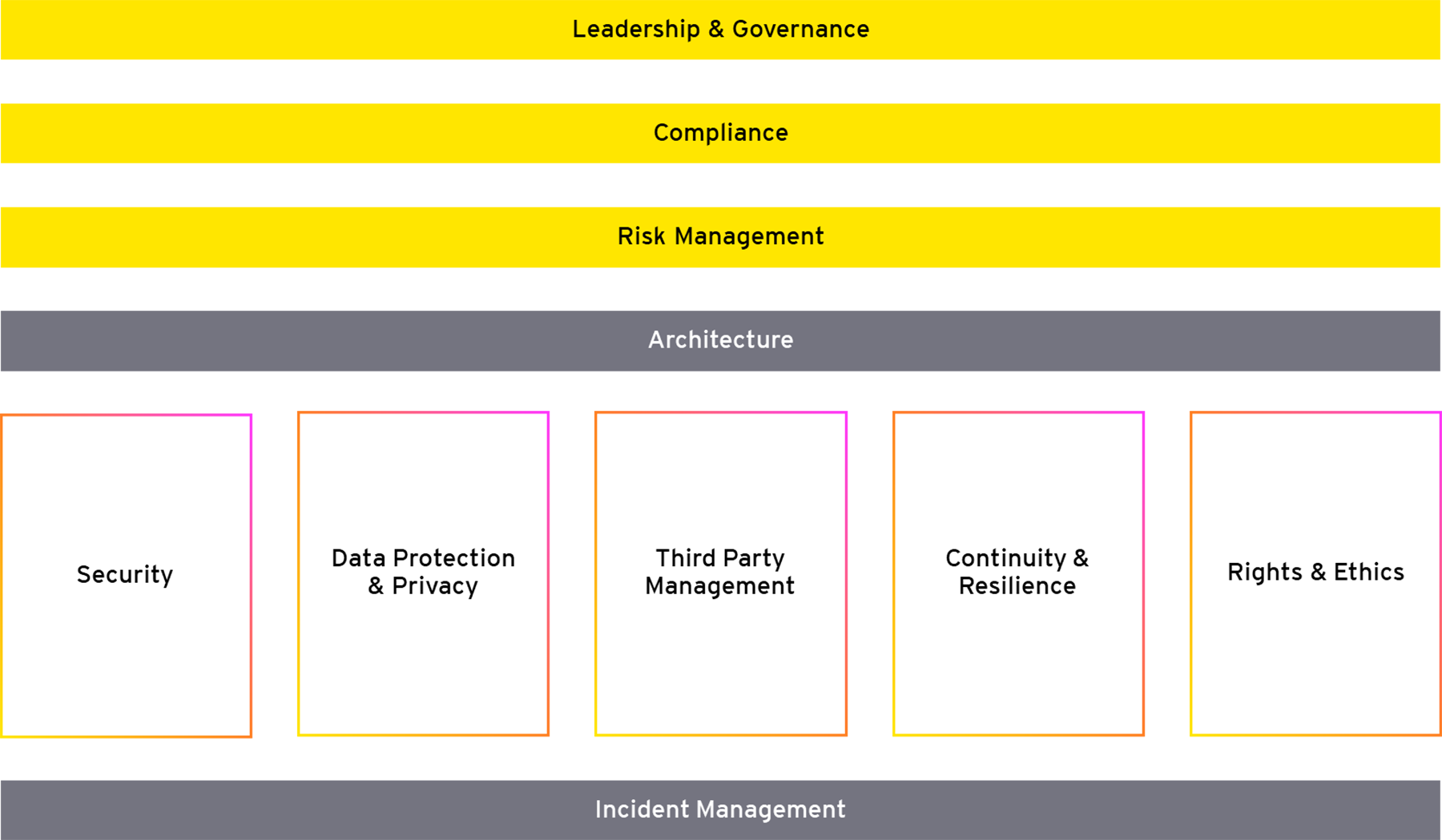
The UDMM is structured around ten key themes, each broken down into 36 sub-themes. These themes cover foundational governance, transversal processes, and topic-specific pillars:
- Foundational governance:
Serve as the foundational pillars of the organization, guiding its overall direction and ensuring alignment with regulatory requirements. They encompass critical areas which collectively shape the organization's compliance culture and strategic objectives.
- Transversal processes:
Focus on processes that span across the organization and support various capabilities. Transversal Processes refer to the organizational processes that are not confined to a single department or function but instead span across multiple areas of the organization. These processes are essential for ensuring that various capabilities work together effectively to support the overall objectives of the organization.
- Topic-based pillars:
Outline the minimum expectations for specific topics or capabilities.
Each sub-theme includes:
- A definition
- Design principles (the “what”)
- Implementation guidance (the “how”)
- Mapping to relevant regulatory articles
How EY can help
EY supports organizations in adopting and operationalizing the Unified Digital Management Model through a comprehensive suite of services tailored to your digital maturity and strategic goals.
Our approach
- Strategic alignment
We help redefine your digital objectives and align them with the imperatives of the European Digital Decade—whether your goal is baseline compliance or becoming best-in-class.
- Gap analysis & streamlining
We assess your current governance structures, policy frameworks, and risk controls to identify overlaps, inefficiencies, and opportunities for simplification.
- Integrated implementation
EY guides the integration of existing frameworks (e.g., cybersecurity, privacy, ESG, AI) into a unified UDMM-based model that manages digital risks cohesively.
- Multidisciplinary enablement
We help you establish cross-functional working groups—spanning cyber, privacy, data ethics, legal, compliance, and more—to ensure holistic adoption.
- Continuous monitoring & adaptation
EY supports the setup of monitoring mechanisms and reporting lines to ensure ongoing compliance and readiness for future regulatory changes.
- Technology enablement
We advise on tooling strategies that avoid fragmentation across domains and stakeholder groups, enabling efficient incident tracking, risk registration, and control management.
By partnering with EY, your organization gains access to deep regulatory expertise, proven methodologies, and a collaborative approach that turns complexity into clarity.