EY se nanaša na globalno organizacijo in lahko pomeni eno ali več podjetji v okviru Ernst&Young Global Limited, vsako od katerih je samostojna pravna oseba. Ernst & Young Global Limited, družba z omejenim jamstvom s sedežem v Združenem kraljestvu, ne opravlja storitev za stranke.
Nedavna iskanja
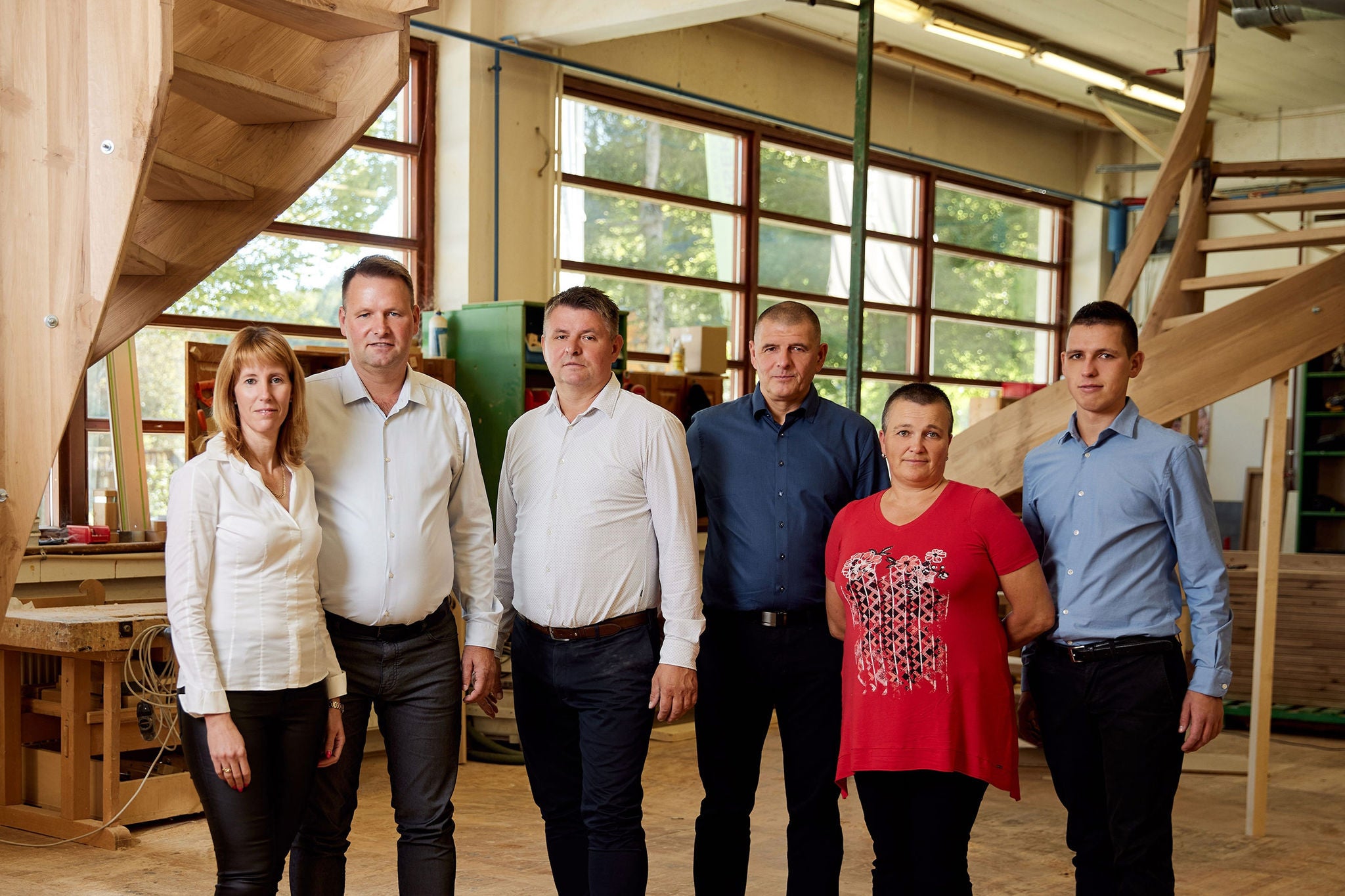
Each brother has an equal say in the future of Mizarstvo Jezeršek
Jernej, Boštjan and Janez are three brothers who took over the successful family business of Mizarstvo Jezeršek from their late father Karel. The company based in Hotavlje specializes in producing stairs and can proudly claim that they have left a mark in more than 40 countries around the world with their products. Despite their success reaching far beyond their home, they are still aware of the significance of their local environment and the continued importance of manual work. From the very beginning, the story of this family business has been shaped by other influential figures, from their mother Ana and wives Silvana and Marjeta to the now already partially active third generation.
The first stairs, for an artist, made in the garage
According to Boštjan, the company’s story began with the after-work side business of his father Karel, who started making stairs in his garage. His father’s first challenge was to create stairs for academic painter France Slana. “It took him a long time to design them and great perseverance to make them. Stairs have always been considered very challenging in terms of carpentry.” After a while, the side business outgrew its boundaries. When Karel realized that his sons would join him, they moved the business into a real workshop. “Our father never needed to push us to get involved in the company, as we had liked helping in the workshop since we were little boys,” Boštjan remembers. So, three of the brothers focused on carpentry, while the fourth took over the family farm.
They attribute their success to distribution of duties and mutual trust
After all, it is extraordinary for three brothers to be involved in a company. This is how Jernej, the Director, describes their organization: “We all ‘grew up’ in the workshop, so we all know how to do everything. However, we have divided areas of responsibility between ourselves, depending on what each of us does best. As the volume of work increases, we redistribute certain tasks from time to time.” The oldest brother, Boštjan, is the most experienced in drawing, technical preparation of work for production and is involved in larger and more demanding assemblies. He has been with the company the longest, from the time when no technology was used at work. The middle brother, Janez, who now organizes the work and is responsible for the Austrian market, also accompanied his father on business outside their workshop: “Even when I was young, I liked to go to trade fairs with my father,” he remembers. The youngest brother, Jernej, joined the company when they already used machinery and technology in their work. In his words, he “somehow automatically” focused on that. He became Director a month before his father’s unexpected death. At that time, the sons and their father had agreed on ownership and positions in the company together. “We have stuck to this agreement ever since and we have never had any problems,” Jernej explains. He also points out the special rule which he follows at work: “I have one third of the vote for investments and major decisions. If Boštjan and Janez have a different opinion, they can outvote me.”
During the period of their joint takeover of the company, they were still young and needed to adapt quickly: “We knew that we couldn’t show that we didn’t know or weren’t capable of something, not even for a moment. We were so well organized that neither customers, suppliers nor the workers themselves noticed any kind of change,” Jernej recalls. At the same time, they attribute their success in this respect to the distribution of duties and the mutual trust between them: “For us, each set of stairs is unique, regardless of the size of the project. That is, the values of our projects range from one thousand to a few hundred thousand euros. Therefore, we discuss each project, set the priorities, and then I know that the project will be implemented. I also know that we have good assembly teams and that everyone will strive to do a quality job. On the other hand, my brothers don’t need to worry about finances, sales and other things that are my responsibility. We trust each other and we know that everyone will take care of their area,” Jernej explains.
Business is also discussed at home
Jezeršek Carpentry is a close-knit family business and from the very beginning, Karel had the support of his wife Ana. “She was involved in all the decisions. She also prepared meals for the employees and played a big role in making everything work,” Jernej recalls. His wife Marjeta describes her as a person who “kept together not only the company, but also her family and the families of her sons.” The sons’ wives are very much embedded in the internal mechanism of the company. Marjeta, who has become more closely involved in the last five years, describes her work as taking care of foreign markets, communications and marketing. Becoming a part of the family business was a change for her as there is quite a difference between working in a family company and having a job elsewhere. The gap between work and privacy is more blurred now: “We discuss business more often at home. Work doesn’t end when we get out of here, we are involved in it all the time.”
Silvana, Boštjan’s wife, also says that they sometimes talk about work at home, but “there have never been any major conflicts or complications,” she adds. “They do arise, of course, but we solve them in the right way.” She has been involved in the company since 1996, when she was offered a position by Karel after her maternity leave: “I did everything that needed to be done, took whatever was needed to the assembly sites or went to pick things up. I take care of administrative work now, but I still drive things around and go to pick them up occasionally. So, I still do everything that needs to be done!”
Involvement in the company is now extending to the third generation. While Jernej’s children are too small for that, Janez’s school-aged children help during the holidays. Silvana and Boštjan’s son, Jernej, got involved very early through holiday work: “I kind of knew from a young age that I would choose this area. I went to the secondary school for wood engineering in Škofja Loka and then to a higher vocational college. Wood engineering was the only school that I was interested in,” he explains. Now that he is employed in the company, he is involved in the workshop and has taken over as the account manager for one of their German clients. “We will see what happens next. But if everything goes well, I see myself here in the future as well,” says Jernej, the youngest in the family who is already involved in the company on a permanent basis.
A local team and buyers from 40 countries
Apart from Jernej, a lot of other employers learnt their trade at the Secondary School of Wood Engineering in Škofja Loka. They have established a good relationship with the school and there are currently 11 pupils, or apprentices, from different years of secondary school training with them. The company prefers to employ local people and it currently has 26. The company’s focus on the local environment is also quite evident in its acquisition of wood, which they buy from Slovenian traders, while some of it comes from Croatia and Bosnia and Herzegovina. “We buy everything the surrounding farms have at their disposal. In general, many of our suppliers are local, which has always proved to be a good strategy.”
Despite them being locally orientated, they sell their products beyond the national borders. Additionally, although the company specializes in producing stairs, they do not limit themselves to that and “are capable of doing everything”, Jernej says. They are already present in more than 40 countries, engaged in standalone projects as well as more extended work for permanent customers: “We have ongoing projects in France, Germany, England and Austria, where we have our own company through which we manage the Austrian market, as well as in Croatia and former Yugoslav countries. We have individual, private customers, and the rest are prefabricated house manufacturers or stair dealers and hotels,” Jernej explains.
The more challenging the project, the more interesting it is
“We certainly have a vision of where we want to position ourselves in domestic and foreign markets, yet we do not make very detailed long-term plans, as we know how the times are changing, so we give priority to our flexibility and ability to react quickly and effectively to changes,” says Jernej in response to a question on plans for the future. At the same time, he adds, they never run out of work and the business is constantly growing. “When we started planning to build our current workshop, we also began working on increasing our sales. We decided to participate in the Munich BAU fair, one of the world’s largest fairs for architecture, construction and building materials, and certainly the most important construction fair in this part of Europe.” This proved to be the right decision. “We gained several large customers, with whom we cooperate very well today,” he remembers. As Janez claims: “We have never had to say that we were not capable of completing a project, which is the reason we get very demanding projects from around the world. This is our specialty – the more difficult the project, the more interesting we find it.”
Summary
Mizarstvo Jezeršek in a nutshell: mutual trust, cooperation, local, connectedness, spontaneity.