





EY refers to the global organization, and may refer to one or more, of the member firms of Ernst & Young Global Limited, each of which is a separate legal entity. Ernst & Young Global Limited, a UK company limited by guarantee, does not provide services to clients.
Recent Searches

As the Guangdong-Hong Kong-Macao Greater Bay Area (GBA) continues to develop, this report explores how GBA enterprises are advancing toward a new model of sustainable, high-quality global expansion with industrial resilience, technological innovation and supportive policies.
In brief
- Global expansion is shifting from product exports to long-term localized operations. Competitive advantage now depends on sustaining a strong overseas presence, not just entering new markets.
- The GBA is rapidly emerging as a bridgehead for Chinese enterprises going global, supported by strong growth foundations despite ongoing development challenges.
- The GBA’s competitive edge lies in ecosystem empowerment, while the next phase of global expansion requires sustainable execution over speed.
Amid profound global value chain restructuring and accelerating global expansion of Chinese enterprises, the GBA, with its institutional diversity, concentrated endowments of production factors and industrial completeness, is becoming a vital hub for going global. To systematically articulate this advantage, EY introduces the GBA Globalized Ecosystem framework. Anchored in the overarching vision of “building global competitiveness × participating in global value chain restructuring”, the framework is centered on “Four Pillars and Eight Dimensions” and grounded in the coordinated development of Guangdong, Hong Kong and Macao. Together, these elements form a comprehensive ecosystem that supports enterprises’ global expansion. The GBA Globalized Ecosystem not only serves as a panoramic roadmap but also reveals the key to success: integrating the eight dimensions to transform the GBA’s locational and institutional advantages into global competitiveness, shifting global expansion from isolated breakthroughs to systematic, ecosystem driven expansion.
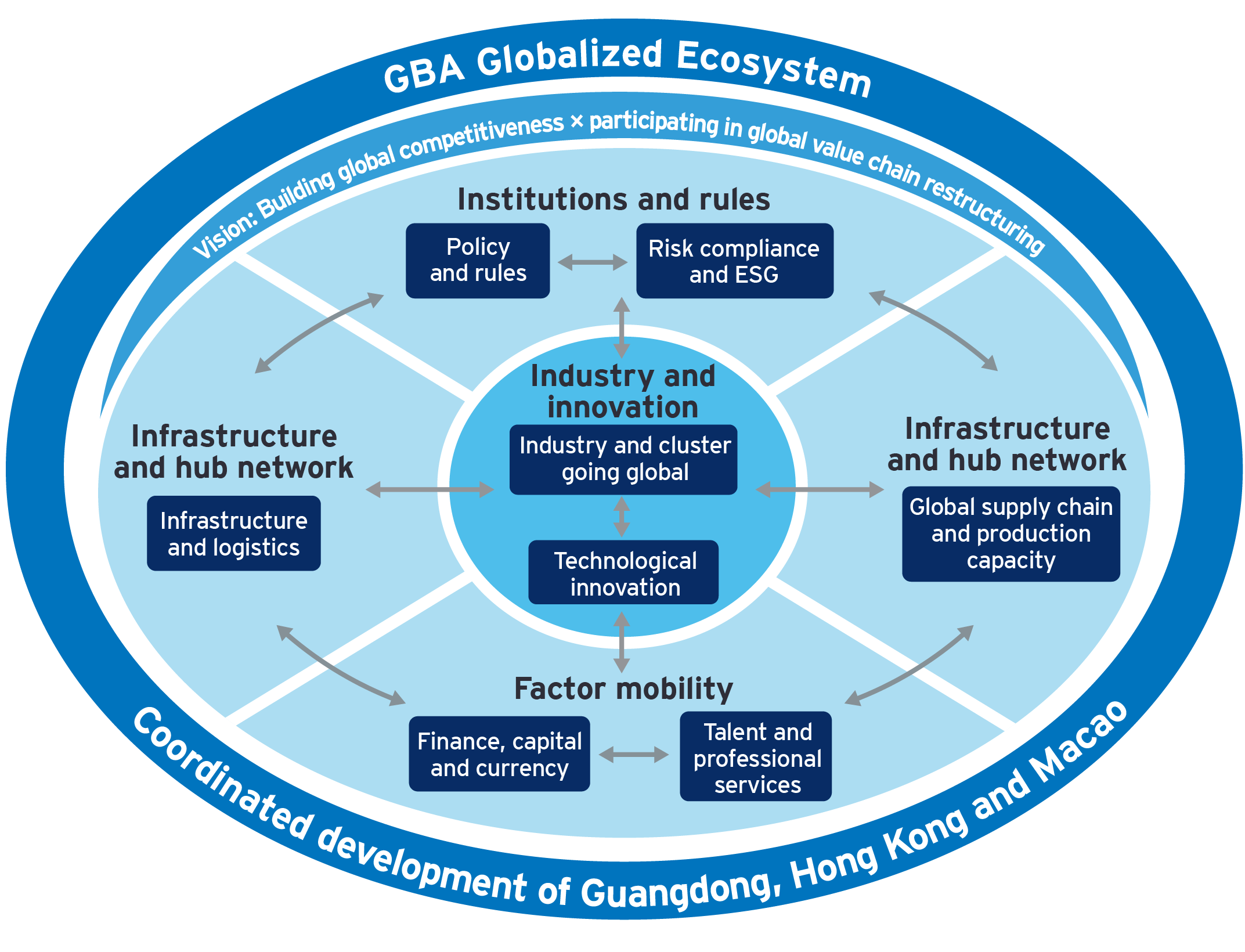
| Four pillars | Eight dimensions | Ecosystem value |
|---|---|---|
| Institutions and rules | 1. Policy and rules | Align with high-standard international trade and economic rules to reduce cross-border institutional transaction costs |
| 2. Risk compliance and ESG | Strengthen geopolitical and data security safeguards, integrate international ESG standards and enhance business credibility | |
| Factor mobility | 3. Finance, capital and currency | Leverage Hong Kong's financial hub status to facilitate cross-border financing, fund allocation, RMB settlement and other services |
| 4. Talent and professional services | Consolidate professional services such as legal, tax, financial and intellectual property to provide intellectual support | |
| Industry and innovation | 5. Industry and cluster globalization | Enhance international competitiveness, drive upstream-downstream collaboration in competitive industries and improve overseas operations and risk resilience |
| 6. Technological innovation | Promote international export of technology standards and patents, enabling global R&D collaboration | |
| Infrastructure and hub network | 7. Infrastructure and logistics | Leverage world-class ports and airport clusters to build high-efficiency, low-cost logistics networks |
| 8. Global supply chain and production capacity | Optimize global production capacity layout to enhance cross-border supply chain resilience and security |
Challenges and responses for GBA enterprises going global
GBA enterprises benefit from geographic advantages and a strong industrial ecosystem during overseas expansion, yet face multiple challenges, including high compliance costs, global talent shortage, localization difficulties and spillover of intense domestic competition. For enterprises, these challenges are no longer merely market entry issues, but systemic challenges affecting stability, organizational efficiency and long-term profitability of cross-border operations. To address these challenges, enterprises should continuously strengthen their own capabilities while working in synergy with the institutional support and public services provided by governments and industry associations, driving Chinese enterprises' global expansion toward high-quality development.
1. High compliance risks and costs weigh on operational stability
Overseas regulatory environments vary significantly and are increasingly complex, with stricter requirements across taxation, data privacy, labor rights, export controls and ESG. Enterprises need to navigate these evolving standards or face extended project execution and rising operational costs. Meanwhile, most enterprises lack sound compliance mechanisms and professional capabilities to embed risk management throughout investment decisions and long-term operations. Geopolitical tensions and policy volatility in some countries further heighten the uncertainty of operational continuity and overseas assets.
2. Global talent shortage hinders cross-border organizational management
With the acceleration of global expansion, companies face urgent demand for versatile management professionals with both technical expertise and an international mindset, coupled with deep understanding of overseas regulatory environments, yet market supply remains relatively limited. Meanwhile, local talent reserves are insufficient. Attracting and retaining quality local talent overseas remains challenging due to limited brand recognition and cultural differences. Furthermore, as the number of overseas branches continues to grow, defining the appropriate division of responsibilities between headquarters and local entities, while ensuring effectiveness and empowering local teams becomes increasingly complex. Cross-time-zone and cross-cultural communication efficiency and execution consistency also face significant tests. Without clear control boundaries and digital collaboration mechanisms, enterprises can easily fall into the dilemma of either headquarters micromanagement with slow local response, or insufficient oversight that triggers compliance risks.
3. High localization barriers impede brand development
Significant market variations in consumer habits, channels and cultures mean that companies cannot simply replicate a uniform business model for overseas operations. In popular markets such as Southeast Asia, countries differ markedly in national conditions, culture, religion, market demand and regulatory requirements. Enterprises generally need to adopt a refined “one country, one strategy” approach, which places considerable demands on market intelligence, talent deployment and resource allocation. Currently, many Chinese enterprises remain in a “strong product, weak brand” phase, prone to relying on price competition for early market entry but struggling to build long-term brand recognition and customer loyalty. Moreover, some enterprises view ESG and social responsibility as compliance costs or one-off investments, lacking a long-term commitment mindset, which undermines deep trust within local mainstream society.
4. Intense homogeneous competition erodes profitability
Domestic market saturation is driving intense “involution” abroad, as Chinese firms replicate business models and strategies in key overseas markets, intensifying the competition. Over-reliance on price competition undermines sustainable operations and brand value. Also, enterprises are competing for local channels, talent and supply chain resources, further driving up operational costs in a zero-sum game. In the long term, this harms both enterprises’ profitability and the overall image of Chinese enterprises overseas.
Download the Chinese full report to learn more
Summary
For the GBA, the imperative for the next stage is to systematically enhance its support framework, enabling enterprises to deeply integrate into overseas markets and ensure long-term, compliant operations.
Related articles
Overview of China outbound investment of H1 2026
Overall ODI maintained steady growth, while overseas M&A values edges up amid divergent regional performance.
Hong Kong’s role in the Belt and Road: from super-connector to value-adding partner
EY unveils a special edition of its Navigator report for the Belt and Road Summit 2025 in Hong Kong — Hong Kong’s role in the Belt and Road: from super-connector to value-adding partner.
Empowering high-quality development of the Belt and Road
These reports, viewed through the lenses of sustainability and digitalization, summarize the progress, achievements and trends in jointly building the Belt and Road (B&R) since 2013. They also showcase cases and experiences of some Chinese enterprises participating in B&R construction, offering valuable insights to encourage more Chinese and multinational companies to participate in the high-quality development of the BRI.