




Asian businesswoman using tablet device with the night scene of central business district, Central, Hong Kong Island.

Danish Supreme Court issues ruling on taxation of interest payments

Related topics

Ruling clarifies taxation of interest under Danish tax law in accordance with the Interest and Royalty Directive and DTT.


In brief
  • Danish Supreme Court clarifies criteria for beneficial ownership in interest payments.
  • Ruling impacts withholding tax exemptions for foreign companies.

On 16 September 2024, the Danish Supreme Court delivered a judgment addressing the taxation of interests under Danish tax law in accordance with the European Union (EU) Interest and Royalty Directive and Double Taxation Treaties (“DTT”). This ruling is part of the "beneficial owner" cases complex and published in UfR 2024.5235 H.

The case is of great importance as it brings further clarification on the exemption, or reduction of, withholding tax imposed on interest paid by companies located in Denmark to affiliated companies within the EU, or located in countries which have signed a DTT with Denmark. More precisely, the judgment highlights the criteria for determining whether a company is an intermediary or the beneficial owner of interest payments.

The legal framework

Danish domestic tax law imposes withholding taxes on inter-group interest payments paid from a Danish company (debtor) to a foreign affiliated company (creditor). The withholding tax rate on the interest payments is 22%, and the Danish company is liable for paying and withholding the tax. As a main rule, the domestic law operates with three exemptions that forfeits Denmark’s right to apply withholding tax on interest payments:

  1. EU Interest and Royalty Directive: If Denmark, based on the directive, is obligated to forfeit the withholding tax, domestic tax law forfeits the withholding tax completely for the covered interest payments. Under the directive, interest is not subject to tax if all of the following conditions are satisfied: i) the debtor company and the creditor company fall within the definition of a company under Article 3 in the EU Interest and Royalty Directive, ii) the companies have been associated (as stated in the directive) for at least a 12-month period, and iii) the recipient is beneficial owner of the interest received.

  2. DTT: If Denmark, based on a DTT in force with the country in which the creditor is resident for tax purposes, is obligated to decrease or forfeit the withholding tax, domestic tax law forfeits the withholding tax completely for the covered interest payments.

  3. The “3/4 exemption”: If the interest is taxed in the jurisdiction of the creditor at a rate of at least three quarters of the Danish tax rate, domestic tax law also forfeits the withholding tax completely for the covered interest payments.

It is important to note that the exemptions generally only apply if the recipient of the interest payments is in fact considered the beneficial owner of the interests. The beneficial owner is the company that actually enjoys the benefit of the payment received. Over recent years, the Danish Supreme Court has issued several rulings on the interpretation of the “beneficial owner” requirement.

Based on the answers provided by the Danish Minister of Taxation, the overall accepted approach was to align the concepts of “rightful income recipient” (rette indkomstmodtager) under Danish law and “beneficial ownership” as defined by the Organisation for Economic Co-operation and Development (OECD) Model Convention. In Appendix 26 to L 213 of 18 April 2007, it was stated that “if the immediate recipient of the interest payment redistributes the amount via a dividend, repayment of a loan, or similar, it must be assessed whether the immediate recipient is the rightful income recipient (beneficial owner). If the ultimate recipient of the amount is considered to be the beneficial owner, the conditions in § 2(1), litra d, immediately apply to the ultimate recipient of the amount.”

Therefore, the changed form of the cash flow - interest payment and dividend distribution - would not be decisive in relation to the question of relief from withholding tax for the interest payment. Instead, emphasis would be placed on whether the ultimate recipient of the amount is located in an E -country or in a country which has a DTT in force with Denmark.

Details of the 2024 Supreme Court ruling

In the recent judgement made in September the payment of interest occurred as part of a restructuring of a Group between 2004 and 2005. Before the restructuring,  Denmark I was owned by C Cayman Islands, domiciled in the Cayman Islands. C Cayman Islands, in turn, was owned by C United States, located in the US.

It is worth noting that in 2004, during the restructuring, Danish law introduced withholding taxation on interest payments to companies resident in non-EU or non-treaty country. As the Cayman Islands is a non-EU country and Denmark does not have a DTT with the Cayman Islands, the interest paid directly by C Denmark I to C Cayman Islands could not benefit from exemptions or reductions.

The restructuring involved the addition of intermediary holding companies between C Denmark I and C Cayman Islands. C Denmark I was subsequently owned by C Denmark II, which, in turn, was owned by C Sweden I. The latter was owned by C Sweden II, owned by C Cayman Islands.

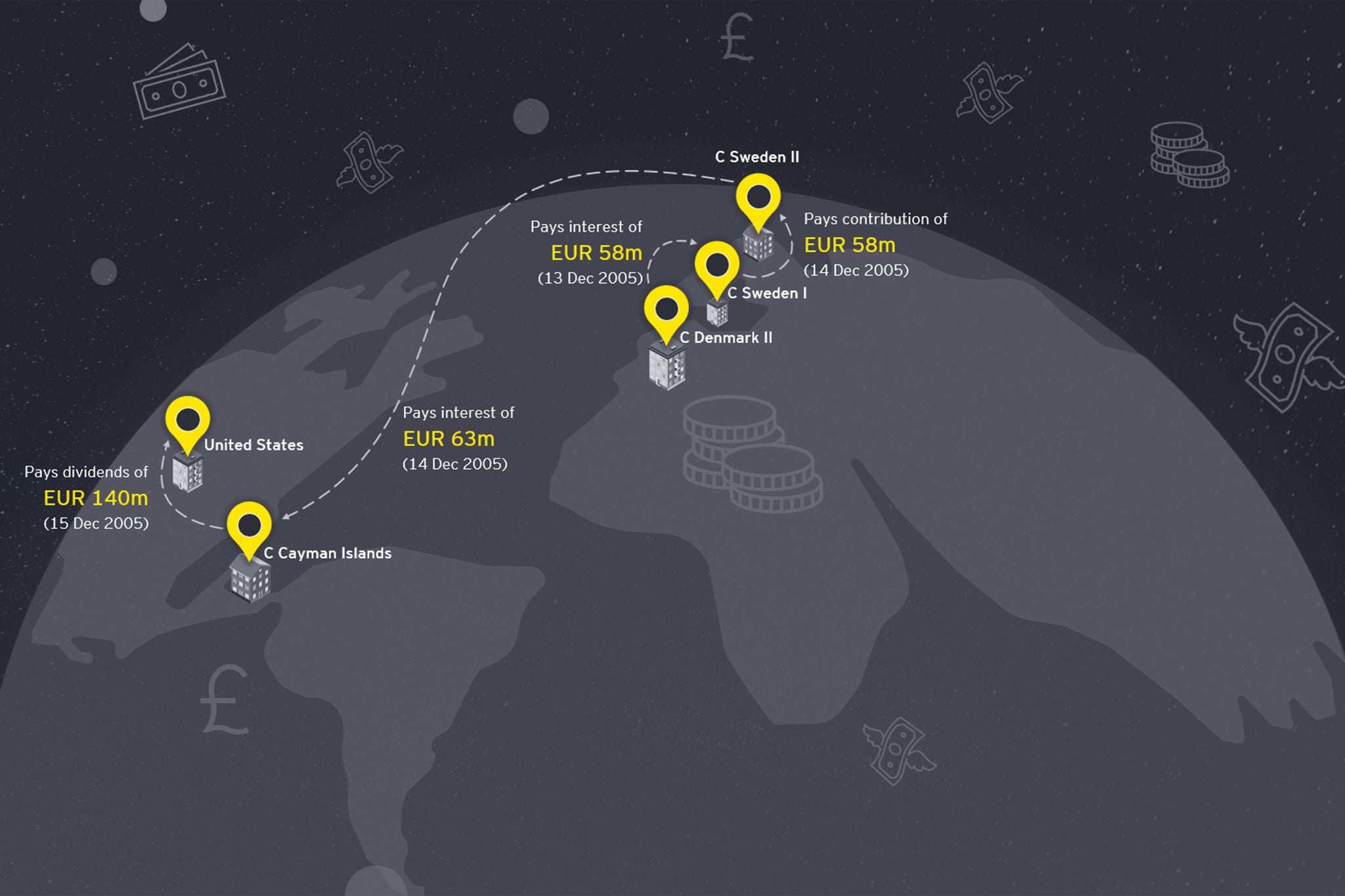
Two loan agreements of €900m were concluded on completely identical terms by C Cayman Islands to C Sweden II and by C Sweden I to C Danmark II. From this configuration, over a three-day interval, the following transactions were carried out in the group:

  1. 13 December 2005: C Denmark II pays interest of €58m to C Sweden I.
  2. 14 December 2005: C Sweden I pays a contribution of €58m to C Sweden II, which effectively neutralized the interest income by deducting the group contribution under the Swedish tax law.
  3. 14 December 2005: C Sweden II pays interest of €63m (and a contribution of €77m) to C Cayman Islands.
  4. 15 December 2005: C Cayman Islands decides to distribute dividends of €140m to C United States.
Illustration of the transactions

The Supreme Court first determined that C Sweden I or C Sweden II were not the beneficial owners, due to their lack of actual business substance. It was emphasized that the Swedish companies did not have any employees,  turnover, and business activities, except for the operations related to the loans. Consequently, the withholding tax on the interests could not be waived under Article 1(1) and (4) of the Interest and Royalty Directive, or under Article 11 of the Nordic Convention.

Next, the Court found that the value of €140 million received by C United States did not constitute a payment of interest, but rather a distribution of dividends. Since the payment from C Cayman Island to C United States was considered a dividend payment and not interest payment, Article 11 of the Danish – United States DTT on relief of withholding taxes on interest payments did not apply.

In conclusion, the Supreme Court agreed that Danish withholding tax was due, since C Sweden I, C Sweden II and C United States were not the beneficial owners of the interest paid by the Danish company. Therefore, the withholding tax on the payment of interest was due by C Denmark II.


As stated by the Supreme Court, for a company to be recognized as the beneficial owner of interest payments, there must be a direct link between the funds received and the loan provided. If the ultimate company in the financial chain is not directly involved in the loan or does not hold related obligations, the payments are not deemed interest for withholding tax exemption purposes.


Reflections on the ruling

The ruling highlights strongly the need for taxpayers to provide clear documentation of beneficial ownership, and the economic substance of the companies involved to qualify for withholding tax exemptions or reductions. Among the documentation is the evidence that the recipients of funds repatriated from Denmark have the power to freely determine how such funds will be used.

The most recent case made a particular clarification on the need to demonstrate that the interest receiver has business substance, and it is not simply inserted as an intermediary entity in restructuring processes, for purposes of tax avoidance or reduction. Such proof must be carried out taking into account, above all, whether the company has considerable turnover and activities beyond the reception and transfer of interest.


It is particularly noteworthy that the nature of the payment, as interest or dividends, had a decisive influence in the ruling. This position seems to diverge from the previous understanding established by the Danish Minister of Taxation, which suggested that when the recipient of the interest repays the amount through dividend distribution, the ultimate recipient, i.e., the company receiving the dividends, is the beneficial owner. Accordingly, the withholding tax exemption would apply if the ultimate recipient, in this case the US company, is based in an EU-country or a country that has a DTT with Denmark.


As stated by the Supreme Court, for a company to be recognized as the beneficial owner of interest payments, there must be a direct link between the funds received and the loan provided. If the ultimate company in the financial chain is not directly involved in the loan or does not hold related obligations, the payments are not deemed interest for withholding tax exemption purposes. Instead, they may be treated as dividends distributed to its shareholder company, and the beneficial ownership must be assessed with this in mind. It is essential to consider that this classification could vary under different circumstances.


In summary , to benefit from the exemptions for interest payments provided by  Danish law, the amount must be paid as interest and received by the beneficial owner as interest. Conversely, if the nature of the payment changes as it moves through the group - from interest to dividend or another form - the ultimate parent company that receives the amount cannot be considered the beneficial owner of the interest for purposes of withholding tax exemptions. It becomes paramount for entities within intra-group interest payment structures to not only accurately determine the beneficial owner of the interest, but also the most appropriate DTT article - be it Article 10 for dividends or Article 11 for interest - to base the withholding tax exemption.


Contacts:

  • Kasper Friis, Senior Tax Consultant, International Tax and Transaction Services, +45 2529 6134
  • Larissa Guimaraes, Tax Consultant, International Tax and Transaction Services, +45 2529 3795
  • Malte Søgaard, Executive Director, International Tax and Transaction Services, +45 2529 3174

Summary 

The recent ruling by the Danish Supreme Court clarifies the taxation of interest under Danish law, emphasizing the importance of beneficial ownership for withholding tax exemptions. The court determined that the Swedish companies were not beneficial owners due to a lack of economic substance, classifying the interest payments as dividend distributions. This decision highlights the need for clear and substantial documentation to prove beneficial ownership and the nature of payments, reinforcing that withholding tax exemptions depend on the correct classification of payments within intra-group structures.

About this article