Recent Searches



IPO readiness assessment


What EY can do for you
All our work on IPOs and secondary listings shows us that the most critical success factors are:
- Approaching the IPO as a transformational process rather than just the transaction
- Behaving and operating as a public company at least one year before the IPO
- Outperforming competitors on key performance measures before, during and after the IPO
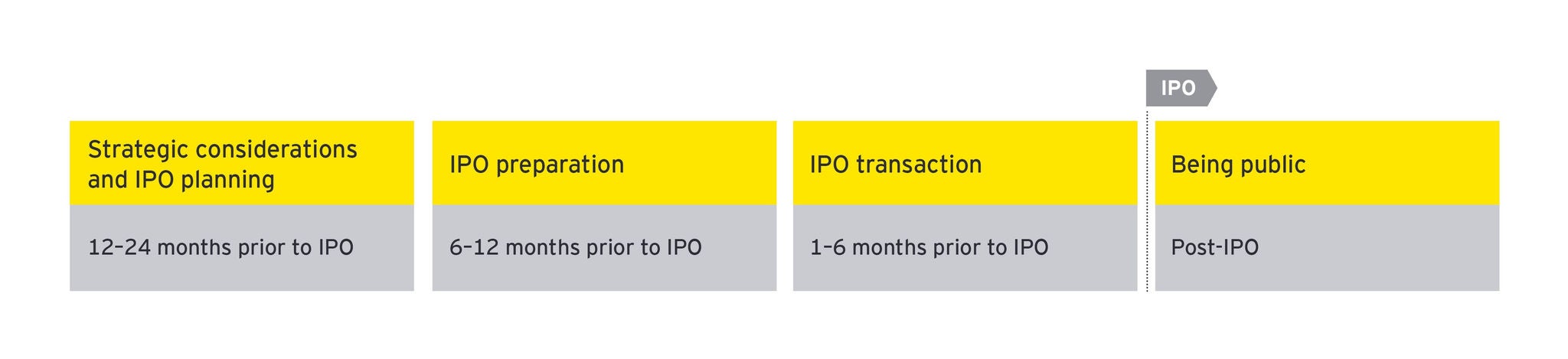
You can save time and costs, and reduce uncertainties, by adopting a structured approach to your preparation and life after listing. This starts 12 to 24 months prior to going public with strategic considerations and IPO planning:
Readiness for IPO inevitably will mean you have to make changes, such as:
- Organization change
- Leadership and management responsibilities
- Transparency
- Ownership structure and control
- Leading financial organization
- Delivering on promises to investors
We carry out IPO readiness assessments to help you identify the most critical changes you will have to make.
First, we look at the capital agenda and IPO as a strategic option. We compare the relative merits of a multitrack approach, the pros and cons of an IPO, and help you evaluate what life will be like as a public company.
An understanding of the IPO markets is important; so we introduce you to the data that will help you act at the best possible time, and we provide detailed analysis of the markets that helps you make that decision.
We evaluate the relative merits of the home market or of a cross-border listing.
Finally, we help you determine what you are going to prioritize to prepare for life as a public company.
Explore our IPO services and insights

The team
Our latest thinking

How the global IPO market proved its resilience in Q3
The EY Global IPO Trends Q3 2026 highlights the market’s resilience as sector participation broadens amid ongoing geopolitical and economic challenges.

Why successful investors focus on sustainability pre- and post-IPO
An EU directive will soon obligate companies to adopt an ESG strategy. In anticipation, pre-IPO candidates should articulate their position. Learn more.

How ESG disclosures impact IPO valuation
IPO valuation is positively impacted by robust ESG disclosure practices.

How an IPO can strengthen family businesses for generations to come
EY Private Perspectives: family businesses should consider opening doors to new sources of capital in order to build a long-lasting legacy.