


How EY-Parthenon can help
While an affordable, quality education that leads to a sustaining career is the core component of the mission of higher education institutions, it is increasingly clear that students and their families are also interested in the non-academic elements that contribute to the student experience (e.g., housing, dining, athletic facilities). In 2015, 45% of incoming freshman rated their college or university’s social activities as “very important” to their decision, up 21% from 1983.1 And often, these social activities are driven by investments made in the university facilities, as opposed to independent actions of students or the local community.
For cash-strapped institutions, this presents a conundrum: allow their facilities to deteriorate and forgo investment, thus becoming less attractive to prospective students and compounding financial challenges associated with reduced enrollment, or seek to attract more students by taking on more debt and/or raising tuition to finance new construction and renovations.
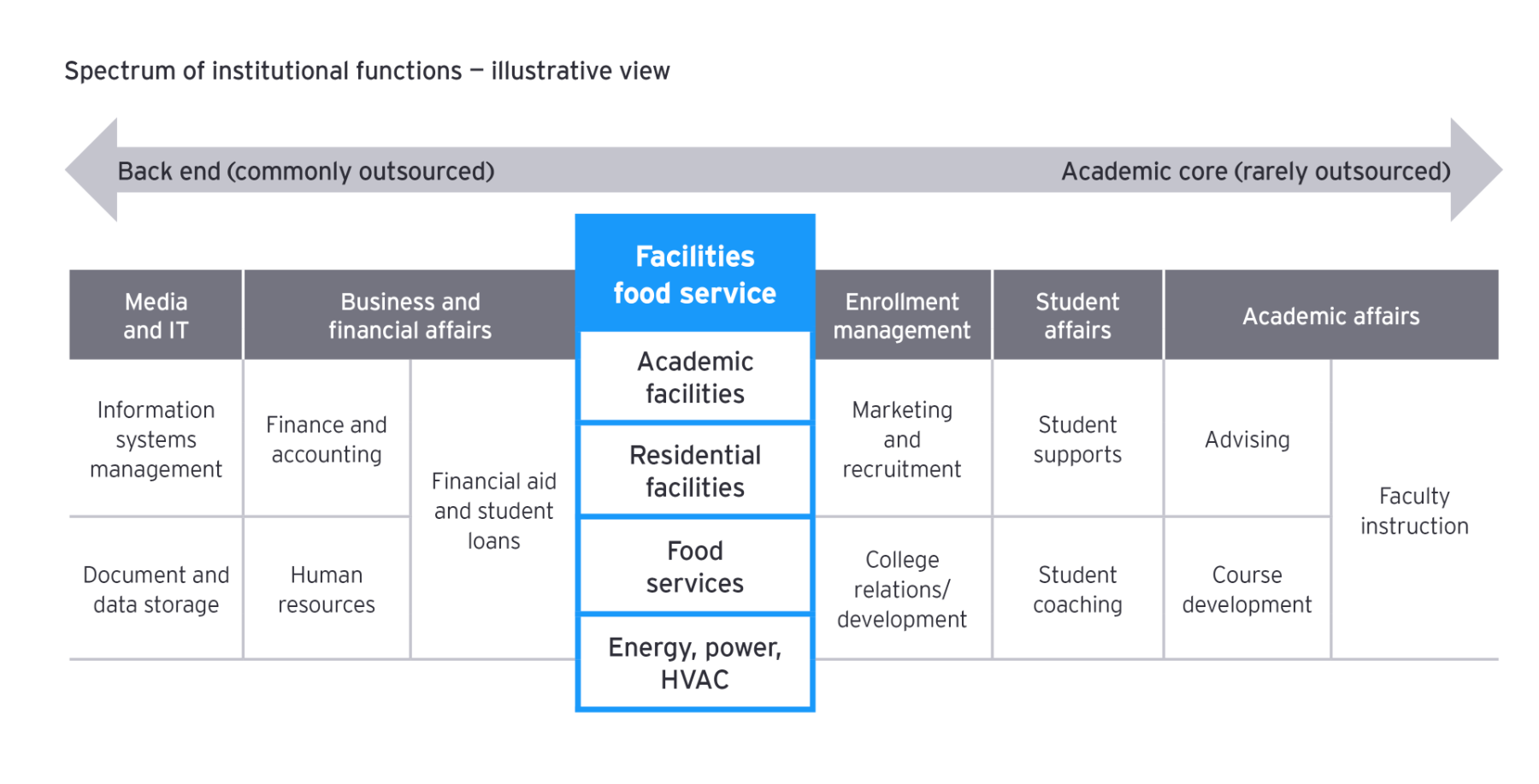
In addition, as complex mechanical, energy and HVAC systems reach the ends of their useful lives, institutions can face further dilemmas between using scarce capital to fund necessary replacements or projects that are more visible to staff and students. These types of projects are often atypical for facilities personnel to oversee, and the risks of overruns during construction and/or adverse surprises during future operations can be significant.
Public institutions are particularly affected, having been hamstrung by freezes or cuts in state funding. State appropriations across the US grew by just 0.5% annually between 2005 and 2015. State funding has still not recovered to 2008 levels, the last year in which state funding decisions would not have been affected by the Great Recession.2
Private colleges and universities are not exempt from financial pressure, particularly those with limited endowments. At the end of 2014, the roughly 800 private institutions with fewer than 1,000 enrolled students had just $17.5b in endowment assets combined, while the 50 richest schools ended FY14 with an average of $5.2b apiece.3