









EY refers to the global organization, and may refer to one or more, of the member firms of Ernst & Young Global Limited, each of which is a separate legal entity. Ernst & Young Global Limited, a UK company limited by guarantee, does not provide services to clients.
How EY can Help
-
EY sustainable finance teams helps financial services companies define sustainability goals that create value and make a measurable difference. Learn more.
Read more
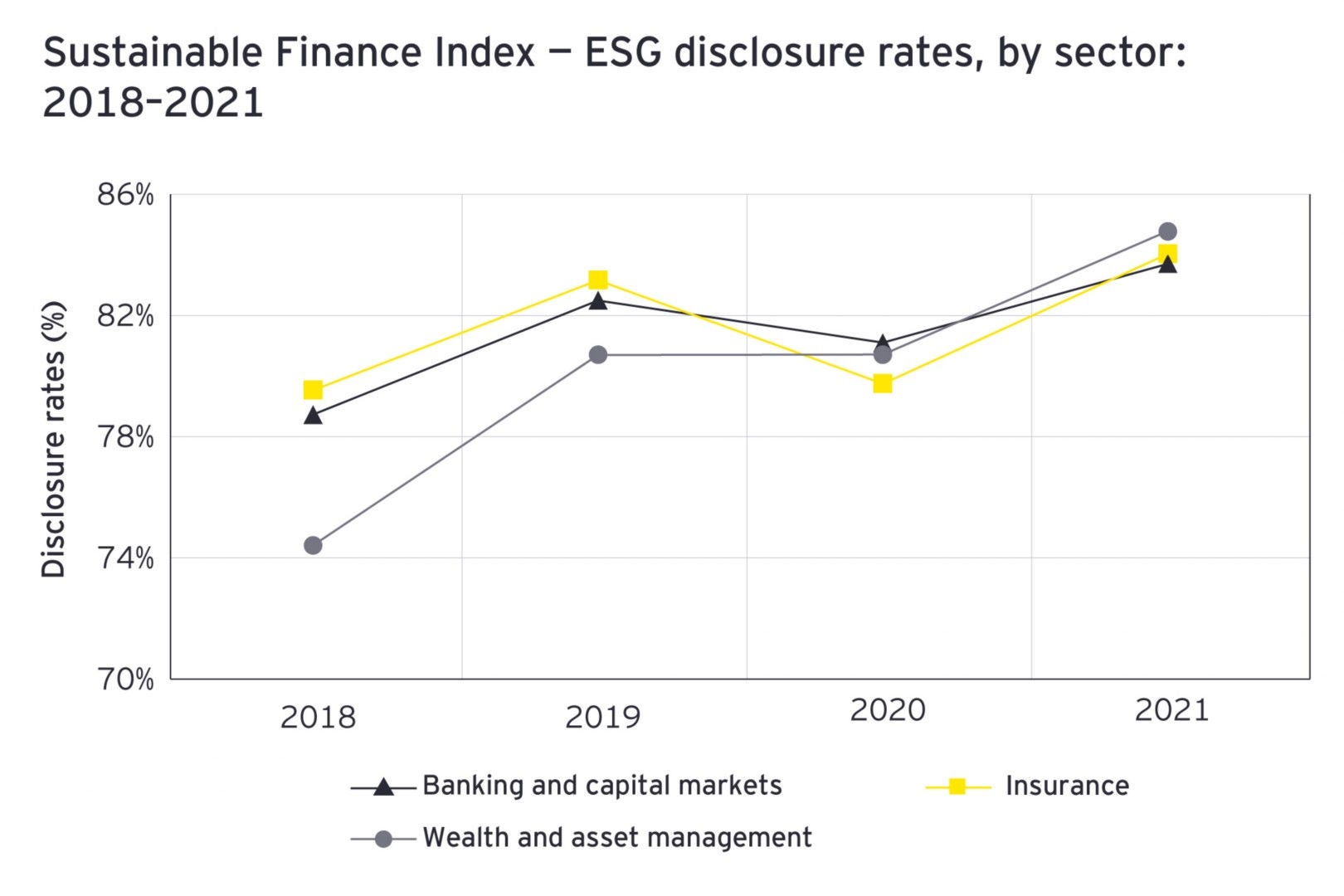
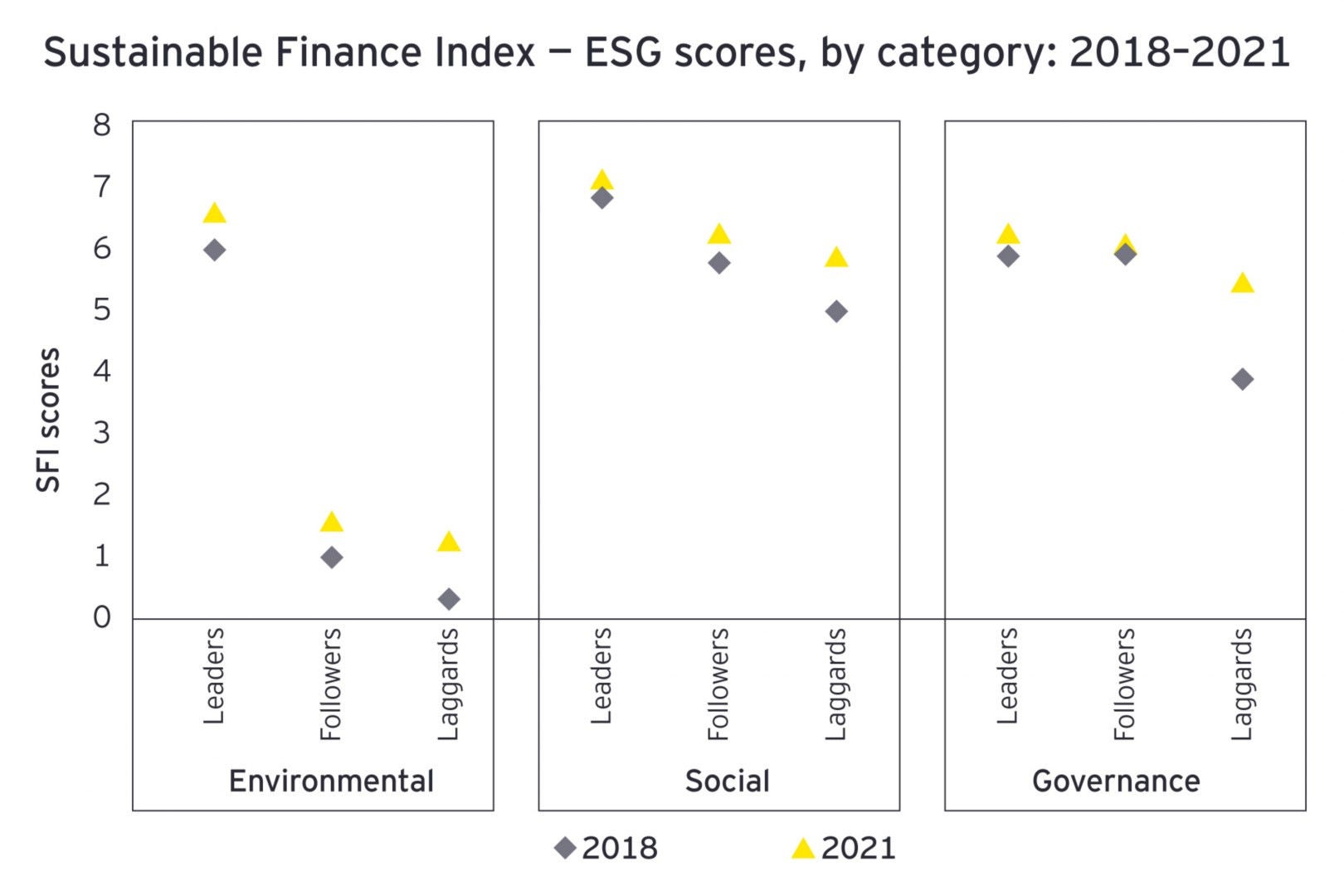
The disclosure rates of social parameters – including data protection, workplace safety, equality policies, and whistle-blower protection – has increased from 83% in 2018 to 87% in 2021. However, there are notable regional and sectoral variations within that strong overall performance. For example, the average disclosure rates of social parameters for wealth and asset managers improved the most. At a regional level, the rise in the disclosure rates of the Asian-Pacific financial institutions was higher than their peers in Europe and North America (See table below).
Whistle-blower protections: Globally, insurers take a lead
More companies understand the importance of enabling their employees to feel safe in reporting concerns in the workplace. The SFI reveals that 77% of institutions had whistle- blower protections in place in 2021, up from 63% in 2018.
Insurers are setting the standard: 81% have established policies, compared to 76% of banks and 72% of wealth and asset managers. Only 60% of European institutions disclosed that they have such protections in place, compared to 70% of firms in the Asia-Pacific region and 90% of North American firms.
As of Q1 2022, only 10 out of 27 EU countries had adopted the 2019 EU Directive on Whistleblowing; 16 nations had delayed the adoption and one had not started. As more EU nations adopt the Directive, the level of disclosure by European institutions will likely rise.
Customer data protection and privacy: Asian institutions make significant gains
Longstanding regulations in Europe and North America mean almost 100% of institutions in those regions have had customer data and privacy protection policies in place for many years. But far fewer Asia-Pacific institutions reported having a customer data protection policy in 2018. Today, the gap has closed as Japan, China, Australia, India and other nations have strengthened their regulatory oversight and reporting requirements.
Talent retention and diversity: fierce competition puts a premium on training
Financial services firms around the world have made significant strides in disclosing their diversity and equal opportunity initiatives. In 2021, 90% of the institutions publicly reported their targets, initiatives and policies, compared to just 70% in 2018. This improvement should enable financial services companies to strengthen their reputation and attract talent.
Still, there are opportunities to improve. Only six out of 10 institutions report on gender balance across the workforce. Women represent 49% of total employees across the industry, but there continues to be much lower representation at the top levels of the organization; just 38% of managerial positions across all subsectors are held by women.
Given that financial services compete with the tech industry for top talent, it’s no surprise that more firms have made training their workforce a top priority. This year’s SFI found that 80% of institutions have a policy on up-skilling and re-skilling employees, up from 62% in 2018. Nine in 10 banks reported having such a policy versus 70% of wealth and asset managers. In Europe and the Asia-Pacific region, 85% of financial services firms report having such a policy, versus only 67% in North America.