



EY refers to the global organization, and may refer to one or more, of the member firms of Ernst & Young Global Limited, each of which is a separate legal entity. Ernst & Young Global Limited, a UK company limited by guarantee, does not provide services to clients.
Recent Searches

Navigating the changing business landscape
Since the 1990s, Viet Nam has achieved notable success in drawing foreign direct investment (FDI) through a variety of compelling policy mechanisms, particularly tax incentives. According to the Foreign Investment Agency (FIA) - Ministry of Planning and Investment, by the end of 2023, the country had over 39,000 active FDI projects with a total registered capital nearing 469 billion USD. The cumulative actualized investment of FDI projects was approximately 297 billion USD, representing 63.4% of the total registered investment capital still in effect. This milestone has positioned Viet Nam among the ASEAN leaders in FDI attraction, consistently ranking third since 2015, following Singapore and Indonesia.
Even in the current challenging climate, Viet Nam's stature in the eyes of foreign investors remains robust, with total FDI pledges in Q1 of 2024 reaching nearly 6.2 billion USD, a surge of over 13% compared to Q1 of 2023. The disbursed capital in Q1 also exceeded 4.6 billion USD, marking an increase of over 7% from the previous year, as reported by the FIA.
Owing to its high and stable economic growth over several years, coupled with a youthful, skilled labor force and a vast consumer market exceeding 100 million individuals, Viet Nam is projected to remain an attractive investment haven amidst global trade tensions.
Nevertheless, in this new phase of development, it is my conviction that Viet Nam requires fresh investment incentive policies to maintain and elevate its investment appeal.
Firstly, these adjustments are intended to align with global economic shifts, with the aim of attracting investment in high-tech and sustainable sectors. The second objective is to preserve competitiveness relative to regional counterparts such as Thailand, Indonesia, and Malaysia.
The third objective is to steer investment towards sectors that Viet Nam seeks to prioritize, including high-tech, eco-friendly industries, and nascent industries.
Fourthly, enhancing the business environment through institutional and administrative reforms is crucial.
In addition to traditional policies like tax incentives, provision of preferential loans, credit guarantees, or interest rate support for businesses investing in pivotal sectors, and investment in infrastructure and human resource development, cash grants emerge as an effective instrument to attract and guide investment.
A call for prompt and decisive actions
As the implementation of Global Minimum Tax (GMT) regulations diminishes the efficacy of tax incentive policies, nations worldwide are racing to introduce compensatory measures for impacted enterprises, with many opting for cash incentives.
For instance, the United States has implemented cash subsidies for semiconductor projects, recognizing their vital importance to national security, economic competitiveness, and technological innovation.
In Europe, several countries offer cash grants or financial inducements to attract investments in industries deemed strategic for economic growth and development. These incentives are often integral to broader economic development strategies. For example, Germany provides cash grants to bolster investment in certain industries, particularly in economically disadvantaged regions. The French government extends various incentives, including cash grants, especially for new investments in research and development, innovation, and job creation. Poland, Spain, Italy, the UK, the Netherlands, Ireland, Portugal, and Hungary have adopted comparable policies.
In Asia, Japan has initiated measures to support and fortify its domestic semiconductor industry, including the establishment of a semiconductor production support fund endowed with substantial financial resources by the government. The fund's objectives include financial backing for production facility construction, research and development (R&D) encouragement, cooperative endeavors, supply chain security, and foreign investment attraction. Japan also provides direct cash subsidies and other financial assistance programs to foreign investors, including land purchase support.
China, too, has introduced policies that offer cash grants or financial incentives to attract foreign investment into high-tech industries, green energy, environmental technology, R&D, or projects in special economic zones (SEZs), free trade zones (FTZs), and select development-focused provinces or cities. Eligible businesses in China can deduct 175% of qualified R&D expenses for tax purposes, and high-tech and new technology enterprises may carry forward losses for up to ten years for tax calculations.
In Thailand, businesses are permitted to claim an additional 100% deduction (double deduction) for R&D expenses paid to authorized government bodies or private R&D service providers. Additionally, Thailand offers other benefits, including unrestricted visa and work permit issuance for eligible foreign workers and preferential credits for enterprises with R&D projects.
To avoid lagging behind and to fulfill its strategic objectives in attracting foreign investment into preferred sectors, Viet Nam should consider similar initiatives. Cash support can compensate for increased tax liabilities, stimulate R&D investment, facilitate continued expansion in Viet Nam, and assist in the effective restructuring of international financial operations to comply with new tax regulations.
It is important to recognize that no single measure is a cure-all, but cash grants can be strategically applied to support enterprises in special or strategic sectors vital to Viet Nam's economy, such as renewable energy, green and sustainable production, high-tech fields, and other investment-encouraged areas.
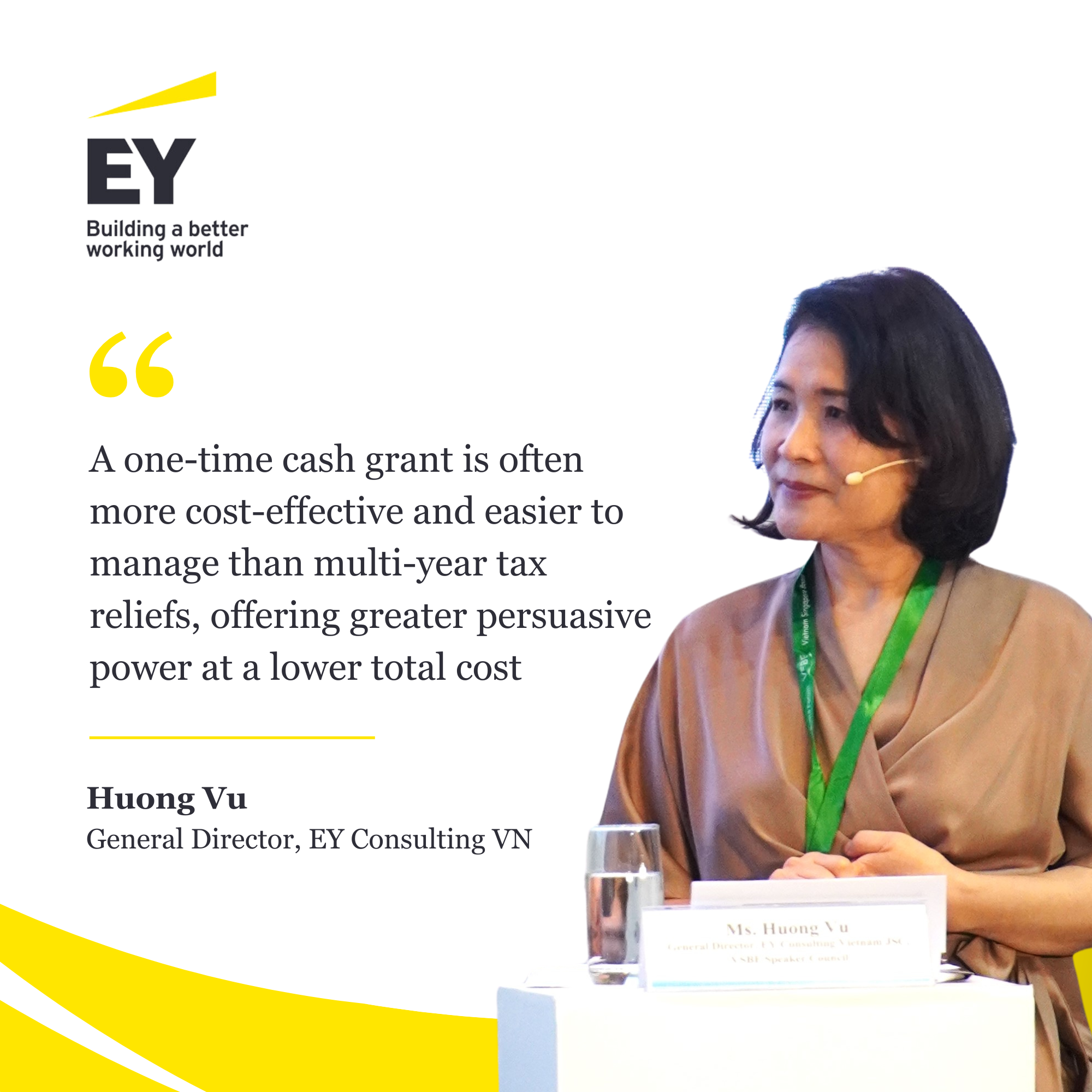
One point to consider is that a one-time cash grant holds considerable persuasive power while incurring significantly lower aggregate costs compared to multi-year income tax reliefs. In other words, in a variety of specific situations, cash grants surpass tax reductions in terms of overall cost-effectiveness and the capacity to effectively oversee the fulfillment of commitments.
In the strategic competition among major nations, the current significant adjustments in FDI flows present a significant opportunity for Viet Nam to capitalize on attracting quality investment by implementing policies that precisely address the practical needs of investors.
*Note to readers: The opinions expressed in this article are those of the author and do not necessarily represent the views of the global EY organization and its members.
This article was first published on The Investor Magazine on 4 July 2024
Summary
In the strategic competition among major nations, the current significant adjustments in FDI flows present a significant opportunity for Viet Nam to capitalize on attracting quality investment by implementing policies that precisely address the practical needs of investors.