



Professional Financial Data Analysts Working

How transaction monitoring is evolving in exchange houses

Transaction monitoring in exchange houses is becoming central, with risk-based approaches supporting stronger compliance systems.


In brief

  • Transaction monitoring is becoming the primary lens for assessing AML, CTF and CPF effectiveness in exchange houses.
  • Many frameworks are built on banking-style rules, resulting in alert volumes and false positives that are not always aligned with remittance-led operating models.
  • Future-ready transaction monitoring uses risk-based segmentation, tailored typologies and data governance with analytics to improve detection and faster, compliant decisions.

Exchange houses play an integral role in the domestic and cross-border payment ecosystem, particularly for cash-intensive transactions, worker remittances, Wages Protection System (WPS) flows and foreign exchange services. With this importance comes increased scrutiny, and transaction monitoring is becoming central to how this role is assessed.

Transaction monitoring is no longer just a compliance requirement. It has become one of the primary ways regulators assess the effectiveness of anti-money laundering (AML), counter-terrorist financing (CTF) and counter-proliferation financing (CPF) controls within an institution.

At the same time, many exchange houses continue to operate with legacy monitoring frameworks that do not fully reflect their unique risk profile or operating model. In practice, this has led to approaches that reflect banking-style rules resulting in alert volumes and outcomes that are not always aligned with remittance-led business models.

Regulators are now sending a clear message: transaction monitoring needs to be risk-based, tailored and demonstrably effective. This shift is reshaping expectations around transaction monitoring systems, pushing them to move beyond checkbox approaches toward more proactive, data-driven, and outcome-focused frameworks.

This article explores what makes transaction monitoring in exchange houses different, where the current gaps lie, and how leading institutions are evolving toward a more effective, future-ready approach.

Why transaction monitoring is different for exchange houses

Exchange houses differ from other financial institutions in several important ways.

  • They have a high transaction velocity and volume, low individual value, but high aggregate exposure.
  • Exchange houses predominantly deal in cash transactions and cross-border flows.
  • They serve a large expatriate customer base, often transacting on behalf of family networks.
  • Exchange houses use agents, correspondents and external payment rails.
  • They have a potential exposure to unregulated value transfer mechanisms and informal transfer risks.

Supervisory authorities require exchange houses to demonstrate alignment of transaction monitoring arrangements with the nature, scale and complexity of business.


These dynamics introduce unique money laundering and financial crime risks. Supervisory authorities recognize these sector-specific risks. They require exchange houses to demonstrate that transaction monitoring arrangements are aligned with the nature, scale and complexity of their business.


Regulatory expectations for transaction monitoring


Regulatory expectations are becoming sharper and more stringent. At the baseline, exchange houses are expected to1:


  • Continuously monitor all transactions
  • Detect patterns inconsistent in customer profiles or expected activity
  • Investigate alerts promptly and submit Suspicious Transaction Reports (STRs) or Suspicious Activity Reports (SARs) where appropriate
  • Maintain comprehensive audit trails across alert generation, investigation and decision-making


Recent supervisory communications and enforcement actions2 point to persistent areas of focus in transaction monitoring. These include data lineage and completeness, the lack of exchange house-specific typologies, inadequate alert quality management and excessive false positives, and limited governance, validation as well as independent testing. Regulators are increasingly focusing not just on the presence of transaction monitoring, but on how effectively it works in practice.


Where exchange houses can strengthen transaction monitoring effectiveness

Exchange houses can strengthen transaction monitoring effectiveness by adopting more tailored, risk-sensitive approaches aligned to their business model. Based on recent current-state assessments and remediation reviews across the UAE, the most commonly observed transaction monitoring challenges include:

Reducing over-reliance on banking-style rules

Many exchange houses still depend on:

  • Threshold-based rules designed for account-based banking
  • Transaction monitoring rules such as one-to-many, many-to-one, foreign currency exchange above predefined limits and high-risk country exposure, often implemented without sufficient risk calibration
  • Limited contextual linkage to remittance corridors, beneficiary behavior or agent patterns

The challenge is that these rules often generate large volumes of alerts without delivering meaningful insight, largely because they are not tailored to remittance-driven business models.

Strengthening customer and transaction segmentation

Customers and transactions are often not segmented effectively. For example:

  • Applying the same monitoring approach to retail remittance users and SMEs despite fundamentally different transaction profiles
  • Failing to distinguish salary and WPS flows from ad hoc transfers
  • Failure to consider geographic corridor risk differences in transaction behavior and monitoring requirements

Without proper segmentation, thresholds lose effectiveness, leading to inconsistent and often unreliable monitoring outcomes.3

Overcoming data challenges

Data remains a foundational challenge. Key issues include:

  • Inconsistent or incomplete transaction data
  • Insufficient reconciliation between source systems and TM tools
  • Limited governance over data pipelines and exceptions management

Collectively, these factors directly affect the accuracy and credibility of transaction monitoring systems.

How transaction monitoring is evolving among leading exchange houses


Institutions that are adapting to emerging challenges are fundamentally re-shaping transaction monitoring, shifting it from a traditional rules-based engine to a strategic risk intelligence capability.


  • Typology-led scenario design: Leading exchange houses are moving beyond generic red flags to sector-specific typologies such as structured remittance patterns, alternate beneficiary usage, rapid pass-through remittances and corridor-specific risk behaviors aligned with Middle East and North Africa Financial Action Task Force (MENAFATF), Financial Intelligence Unit (FIU) advisory and National Risk Assessment (NRA) guidance. It also includes risk patterns targeting wash transactions, smurfing activities and networks that may misuse third-party accounts. This approach aligns transaction monitoring coverage more closely with supervisory expectations and Financial Action Task Force (FATF) guidance.

  • Behavioral and network analytics: Monitoring is increasingly focused on customer activity over time, links between senders, beneficiaries, agents and corridors, and patterns across low-value transactions that may indicate aggregation risk.

  • Dynamic thresholds: Modern transaction monitoring models apply differentiated thresholds based on customer risk rating, transaction type (WPS, cash remittance, FX), and corridor and beneficiary risk.

  • Enhanced post-alert analytics: Leading exchange houses are embedding automated alert enrichment and case management capabilities, pre investigation risk scoring as well as advanced performance monitoring and investigator decision-support dashboards.

Governance, validation and independent assurance

Regulators increasingly require transaction monitoring frameworks to be supported by clear ownership across compliance, IT and operations, as well as structured scenario approval and tuning processes. Independent reviews, including back-testing and validation, also form a key part of these frameworks. Transaction monitoring is increasingly recognized as a continuously evolving control, requiring ongoing enhancement and oversight.

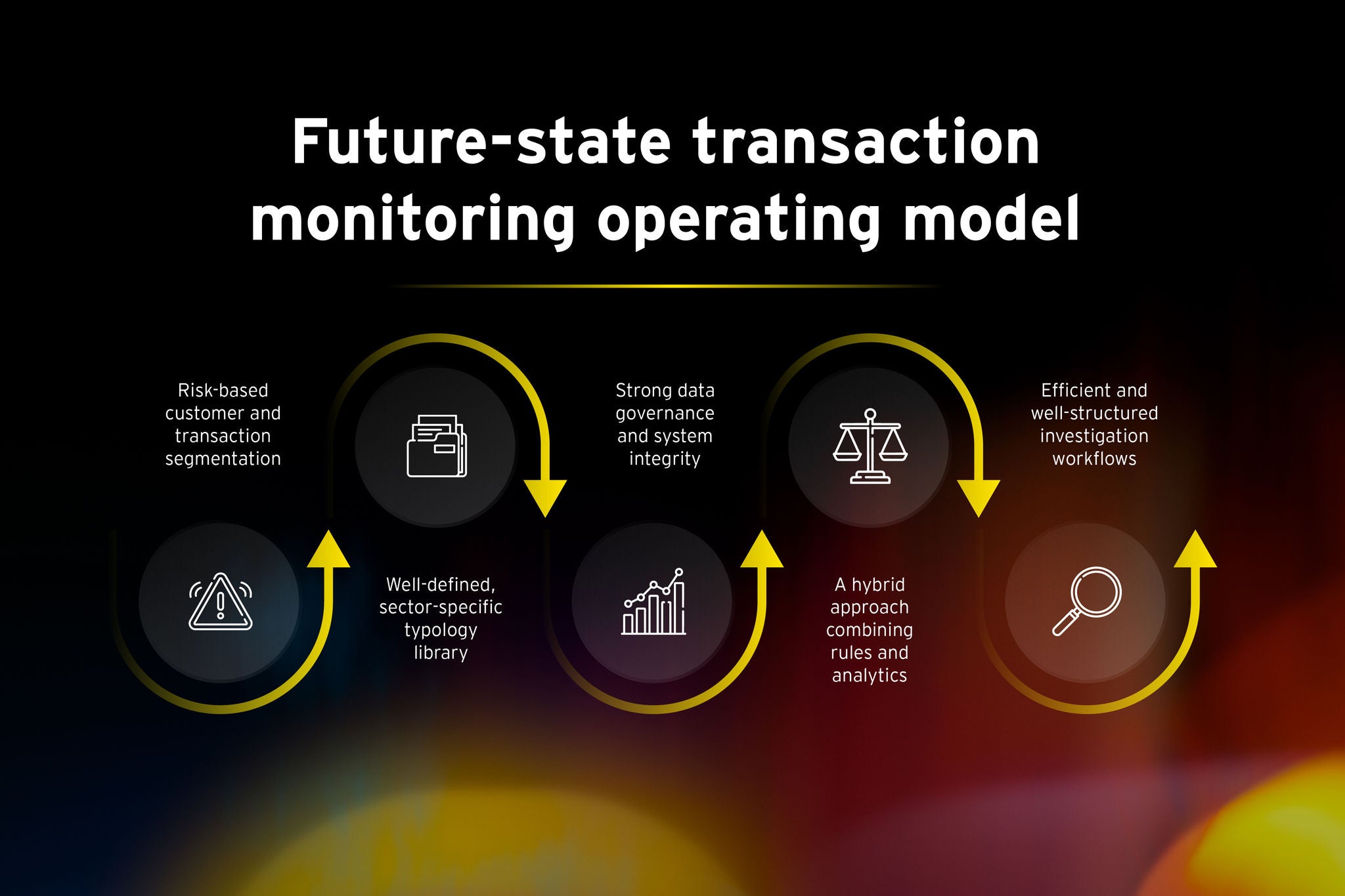
What good looks like: the future-state transaction monitoring model

A robust future-state transaction monitoring model for exchange houses includes:

  • Risk-based customer and transaction segmentation
  • Well-defined, sector-specific typology library
  • Strong data governance and system integrity
  • A hybrid approach combining rules and analytics
  • Efficient and well-structured investigation workflows
Transaction monitoring graphic

Together, these capabilities align closely with supervisory expectations and support more confident responses to inspections and thematic reviews.

Conclusion

Transaction monitoring has become the primary lens through which regulators assess AML, CTF and CPF effectiveness in exchange houses. Institutions that continue to rely on generic or legacy frameworks face increasing regulatory, reputational and operational risk. Those investing in risk-aligned, data-driven and sector-specific transaction monitoring framework are better positioned to meet regulatory expectations, enhance operational efficiency and strengthen long-term supervisory credibility.


Summary

Transaction monitoring in exchange houses is becoming a central area of focus for regulatory bodies assessing whether AML, CTF and CPF controls work in practice. Many still rely on banking-style rules and legacy monitoring frameworks that drive alert volumes, weak insights and unreliable outcomes. A future-ready approach links risk-based segmentation, sector-specific typologies, strong data governance, a hybrid rules-and-analytics model and structured investigation workflows. Together, these capabilities strengthen transaction monitoring systems stand up to supervisory inspections and thematic reviews.

About this article

Contributors