





EY refers to the global organization, and may refer to one or more, of the member firms of Ernst & Young Global Limited, each of which is a separate legal entity. Ernst & Young Global Limited, a UK company limited by guarantee, does not provide services to clients.
Recent Searches

Overall outward direct investment (ODI) maintained growth, while rising market uncertainties led Chinese enterprises to adopt a more prudent approach to global expansion.
In brief
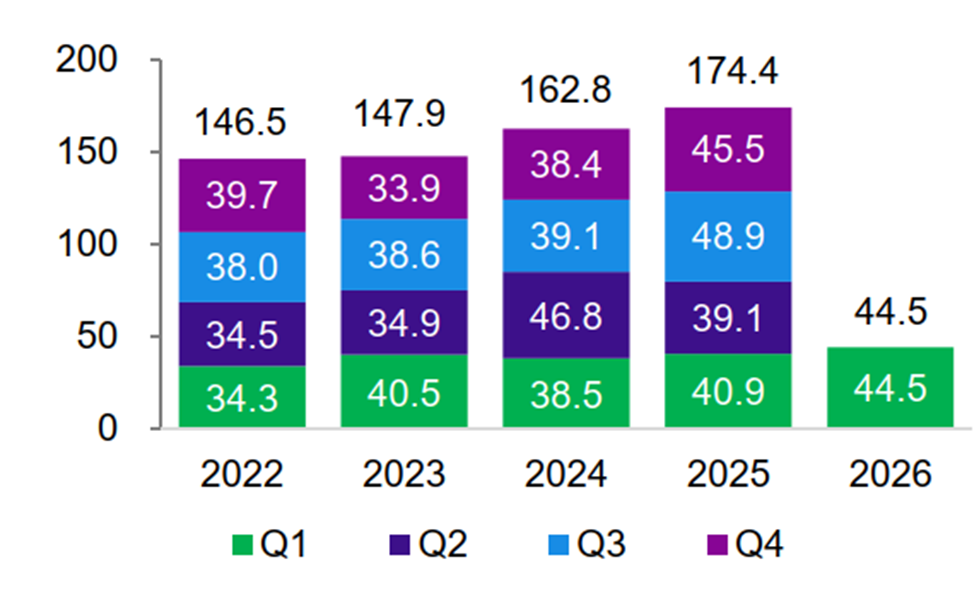
- China’s overall ODI reached US$44.5 billion, up 8.9% year-on-year (YoY). Non-financial ODI totaled US$33.5 billion, down 6.1% YoY, continuing the adjustment trend seen in the fourth quarter of 2025.
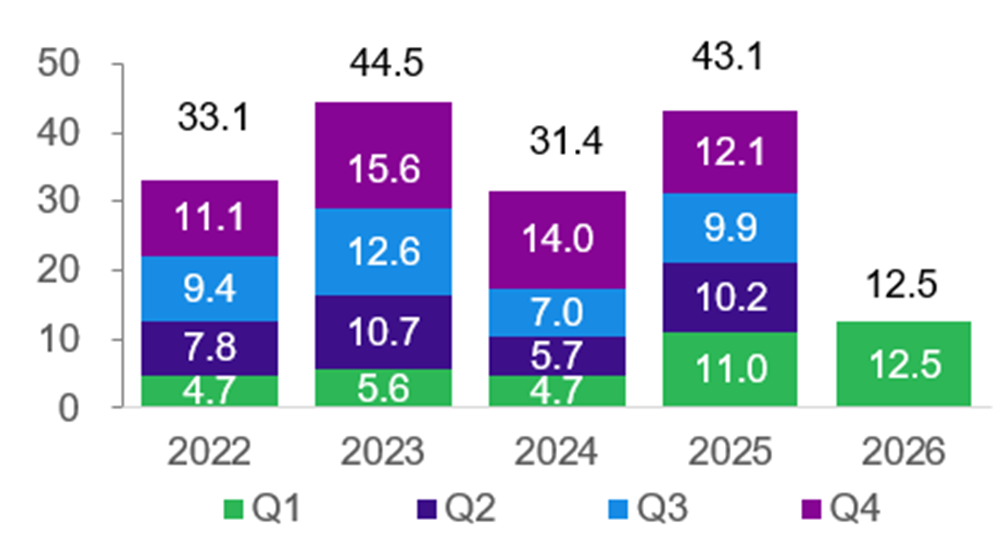
- Chinese enterprises announced overseas M&A transactions totalling US$12.5 billion, up 14% YoY. The number of deals stood at 84, a decline of 28% YoY, marking a new quarterly low in nearly a decade, while average deal value increased.
- The value of newly signed overseas engineering, procurement and construction (EPC) contracts by Chinese enterprises reached US$55.4 billion, down 5.5% YoY. New contracts in B&R (Belt and Road) partner countries totaled US$50.2 billion, up 5.8% YoY.
In Q1 2026, despite an increasingly turbulent international landscape, China's economy started the year on a solid footing, with GDP growing 5% YoY1. Overall ODI increased by 8.9% YoY2, while overseas M&A value rose by 14% YoY3. Goods exports increased by 14.7% YoY4, reflecting continued momentum in Chinese enterprises' global expansion. However, amid rising market uncertainties, non-financial ODI, the number of overseas M&A deals and the value of newly signed overseas EPC contracts all declined.
In the face of a complex external environment, China has maintained strategic resolve, continued to pursue high-quality development and high-standard opening up, and remained a stabilizing force for global development. In March, China’s annual Two Sessions were successfully convened, and the Chinese government officially released China’s 15th Five-Year Plan5, setting out a blueprint for future development.
From a going-global perspective, relevant policy deployment is characterized by systematic empowerment, the dual drivers of digitalization and green development, and an equal emphasis on rules-based governance and risk compliance. This marks a shift in overseas strategy from scale-driven expansion to institutional opening up and value-chain-wide coordination.
A series of supporting policies has since been rolled out, including the establishment of the Bureau of Overseas State-Owned Assets Supervision by State-owned Assets Supervision and Administration Commission's (SASAC), underscoring the heightened national focus on optimizing outbound strategies and strengthening risk management for Chinese enterprises. In addition, since the beginning of this year, numerous leaders of state and senior government officials from various countries have paid high-level visits to China, resulting in the signing of more than 100 bilateral cooperation documents and further deepening mutual trust and collaboration between China and major economies.
Looking at the global landscape, conflict in the Middle East is profoundly disrupting the global economic order. The more protracted the conflict, the greater its impact on global energy security and supply-chain stability. Against this backdrop, Chinese enterprises going global need to adopt a more prudent approach. In particular, they should closely monitor economic dynamics and spillover risks of countries highly dependent on energy imports, and conduct advance multi-scenario analyses. Robust risk-management and contingency plans should be developed, and operational and strategic actions identified and implemented immediately to enhance corporate resilience.
Macro environment: Rising external uncertainties and new domestic policies supporting high-quality global expansion of Chinese enterprises
In Q1 2026, the global geopolitical and economic landscape continued to undergo profound adjustments, with external uncertainties once again on the rise. Taking the impact of regional conflicts into account, the International Monetary Fund (IMF) projects global economic growth of 3.1% in 2026, down 0.2 percentage points from its January 2026 forecast and 0.3 percentage points lower than the growth rate recorded in 20256.
Advanced economies are expected to maintain growth, with the United States posting slightly higher growth than in 2025, while growth in most other major advanced economies remains flat or declines. Emerging economies continue to lead global growth, although some Middle Eastern countries have experienced a marked slowdown.
The conflict in the Middle East is disrupting the global supplies of energy and bulk commodities, with the most directly affected industries including Oil & Gas, Chemicals, Power & Utilities, Insurance, Aerospace & Defense, Mobility, Technology, Consumer Products and Infrastructure. Currently, the conflict is affecting the global economy primarily through three transmission channels: oil and gas supply disruptions, global supply-chain disruptions and financial-market volatility.
Enterprises are advised to conduct multi-scenario analyses and identify operational and strategic actions that can be implemented immediately to strengthen resilience7, such as diversifying supplier networks, hedging against price-increase risks and increasing inventory reserves.
In response to external challenges, China is expanding the scope of multi-sector cooperation through proactive policy deployments and pragmatic bilateral diplomacy. In Q1, high-level interactions and dialogues between China and major global economies intensified, creating a more favourable macro environment for Chinese enterprises to expand internationally.
Meanwhile, China's stable economic fundamentals and continuously improving opening-up policies have strengthened confidence and provided sustained support for enterprises seeking steady integration into the global value chain.
As reflected in the Report on the Work of the Government adopted at this year's Two Sessions and in the China’s 15th Five-Year Plan, the strategic direction for supporting Chinese enterprises global expansion has become more targeted and proactive. The focus has shifted from simply “encouraging enterprises to expand overseas” to providing systematic support that is “well-coordinated, risk-mitigating and service-oriented”, together outlining a new blueprint for the high-quality global expansion of Chinese enterprises.
Overall ODI maintains growth, non-financial investment continues its adjustment trend
In Q1 2026, China's overall ODI reached US$44.5 billion, up 8.9% YoY. Non-financial ODI totaled US$33.5 billion, down 6.1% YoY. Non-financial ODI in B&R partner countries amounted to US$8.8 billion, down 0.9% YoY, accounting for 26% of the total during the same period.
Figure 1: China’s overall ODI (US$ billion)
Note: Figures in charts are rounded to the nearest integer; due to rounding, subtotals may not sum to the total.
Sources: Monthly Statistics in Brief, China MOFCOM, EY Analysis
Overseas M&A value maintains growth, while deal volume declines sharply
In Q1 2026, overseas M&A value continued to grow, with Chinese enterprises announcing US$12.5 billion in overseas M&A transactions, up 14% YoY, although the pace of growth moderated. Against a backdrop of heightened geopolitical risks, Chinese enterprises' investment decisions are expected to become increasingly rational and prudent, and cross-border M&A activity in 2026 may face challenged in sustaining the strong momentum seen last year.
The number of deals stood at 84, a decline of 28% YoY, marking a new quarterly low in nearly a decade, while average deal value increased during the period.
Figure 2: Value of announced China overseas M&As (US$ billion)
Note: Figures in charts are rounded to the nearest integer; due to rounding, subtotals may not sum to the total.
Sources: LSEG, Mergermarket, including deals that have been announced but not yet completed, data was downloaded on 8 April 2026; EY analysis
Figure 3: Hot sectors for announced overseas M&A by Chinese enterprises (By deal value)
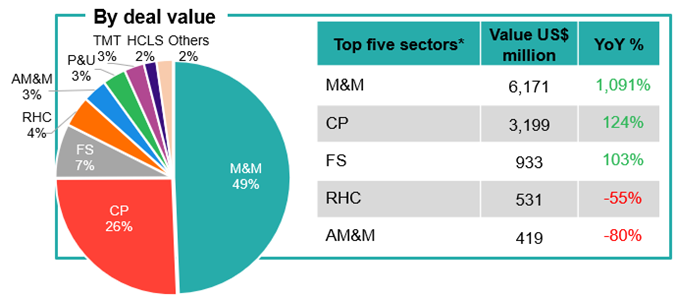
*AM&M refers to advanced manufacturing & mobility; HCLS refers to health care & life sciences; RHC refers to real estate, hospitality & construction; M&M refers to mining & metals; P&U refers to power & utilities; CP refers to consumer products; FS refers to financial services; O&G refers to oil and gas.
Note: Figures in charts are rounded to the nearest integer; due to rounding, percentages may not sum to 100%.
Sources: LSEG, Mergermarket, including deals that have been announced but not yet completed, data was downloaded on 8 April 2026; EY analysis
Figure 4: Distribution of China overseas M&A by continent (By deal value, YoY growth; By deal number, YoY growth)
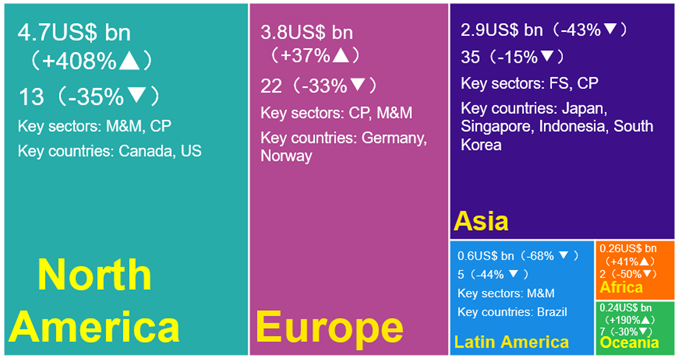
Note: The above hot sectors and major countries are all calculated by M&A value. The major deal in Africa was a Mining & Metals M&A deal in Sudan; the major deals in Oceania were a Healthcare & Life Sciences M&A deal in Australia and a TMT M&A deal in New Zealand.
Sources: LSEG, Mergermarket, including deals that have been announced but not yet completed, data was downloaded on 8 April 2026; EY analysis
B&R EPC new contract value defies the trend as its share rises further
In Q1 2026, the value of newly signed overseas EPC contracts by Chinese enterprises reached US$55.4 billion, down 5.5% YoY. New contracts in B&R partner countries reached US$50.2 billion, up 5.8% YoY, with their share rising to 90%.
Completed turnover reached US$37.3 billion, up 9.2% YoY, with completed turnover in B&R partner countries amounted to US$31.5 billion, up 13.6% YoY8, accounting for 84% of the total.
Summary
China's outbound investment demonstrated resilience amid an increasingly complex and volatile global trade environment in Q1 2026, while rising market uncertainties led Chinese enterprises to adopt a more prudent approach to global expansion. China’s overall ODI reached US$44.5 billion, up 8.9% YoY. Non-financial ODI totaled US$33.5 billion, down 6.1% YoY, continuing the adjustment trend observed in the fourth quarter of 2025. Chinese enterprises announced overseas M&A transactions totaling US$12.5 billion, up 14% YoY. However, the number of deals stood at 84, representing a sharp decline of 28% YoY and marking a new quarterly low in nearly a decade.
Related articles
Overview of 2025 China outbound investment
China ODI maintained growth in 2025, while overseas M&A rebounded with surge in large-scale deals.
Overview of China outbound investment of the first three quarters of 2025
China’s outbound investment rebounded in Q1–Q3 2025, with outbound direct investment (ODI) growth and overseas mergers and acquisitions (M&A) recovery driven by large deals.
Hong Kong’s role in the Belt and Road: from super-connector to value-adding partner
EY unveils a special edition of its Navigator report for the Belt and Road Summit 2025 in Hong Kong — Hong Kong’s role in the Belt and Road: from super-connector to value-adding partner.