







Business people having a meeting on the hallway

Five priorities for banks to improve stability in 2025


Improved stability will allow bank leadership teams to focus on addressing wider structural opportunities and risks.


In brief

  • Sustaining profitability will be critical to unlocking the capacity that will support future growth.
  • As ever, banking leadership teams will be busy in 2025, managing a host of business-as-usual risks and adapting to a new geopolitical environment.

If one theme represented 2024, it was uncertainty. The uncertainties included geopolitical uncertainty, regulatory uncertainty driven by fragmentation, economic uncertainty and technological uncertainty. Despite this, banks have proven their resilience with strong results supported by a keen focus on profitability and consistently low loan losses.

We expect uncertainty to be the watchword of 2025 too, but we expect industry leaders to have the capacity to be able to navigate it successfully, with sector profitability (returns on equity) likely to remain in the double digits.

Download the Global banking outlook 2025

Profitability stability

Average global banking returns on equity (ROE) in 2024 are expected to be slightly shy of 12%. This is about one percentage point below the 2023 outturn (the post-financial crisis peak). Nevertheless, it is a better outcome than many might have expected at the start of this year, given both anticipated interest rate pathways and expectations around asset quality.

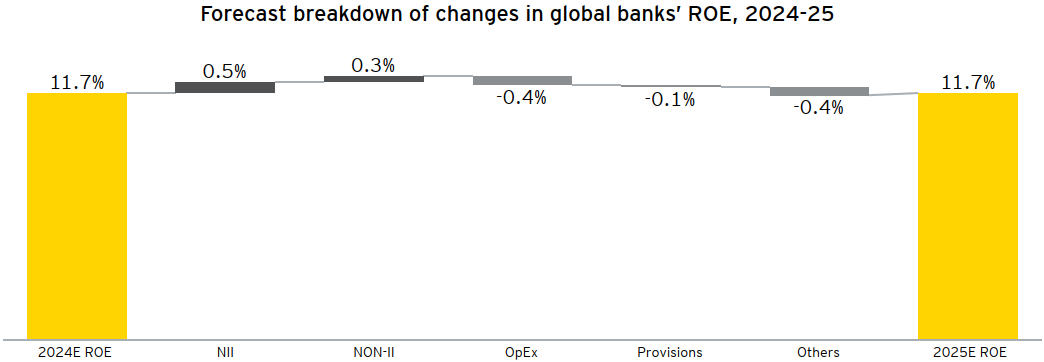
Looking to 2025, we expect profitability to remain flat, but the drivers of banking profitability will be different and further gains will increasingly depend on banks’ ability to transform their business models.

Forecast breakdown in changes in global banks’ ROE, 2024-25e
Source: EY Insights analysis, LSEG workspace

Five priorities for banks

1. Managing geopolitical risk

Banks now confront complex and costly challenges in ensuring compliance that extends beyond traditional risk management to emerging domains like artificial intelligence (AI) and data privacy. They also face challenging business and operational decisions around location strategies. Increased focus on operational resiliency means banks need to factor in not just the political operating environment, but also international talent pools, infrastructure, and the use data across their organization. Banks are proactively developing scenario planning capabilities to assess potential risks and opportunities, including through divestments or acquisitions.

2. Unlocking value from technology investment

One explicit area of focus for banks to achieve this will be getting their data AI-ready, in anticipation of accelerated AI deployment in 2026 and beyond. Without understanding what data is needed, ensuring it is clean and standardized, appropriately structured and secure, it will be near impossible for banks to unlock the full value of AI in their organization.


Unlocking the value from these investments offers compelling rewards. Cloud adoption highlights this. Using cloud for storage and computing may save costs, but leveraging cloud with AI for advanced data analytics can allow banks to offer personalization at scale, amplifying the overall return on investment.


To succeed, banks must fundamentally transform their approach to technology investment and implementation. This means cultivating a culture of continuous learning, prioritizing the value of new technologies over their costs, actively capturing client and colleague feedback, and reimagining work processes during technological implementation.

3. Adapting to changed customer and colleague expectations

Customer behaviours have fundamentally changed with the digital revolution. Both retail and corporate banking customers now expect seamless, round-the-clock service across multiple channels and devices. Many banks continue to invest significant resources in resolving data quality issues rather than generating actionable, monetizable customer insights.

Colleague expectations have evolved equally. Banks need to maximize culture for onsite workers and space for knowledge-worker collaboration while addressing compliance risks of working from anywhere.

4. Redefining purpose

There have been suggestions of slowing environmental, social and governance (ESG) momentum, and there is an increasing probability that many banks will reassess their interim net-zero targets due to inconsistent global climate policy. Data — what ESG data you should capture and report, how you capture it and the transparency of it — continues to be a challenge.


The EY Sustainable Finance Index reveals a steady rise in environmental scores across 800 banks globally, reflecting cumulative efforts to address climate change.


The Sustainable Finance Index ‘Social and Governance’ parameters also show the industry is making steady progress on diversity. The latest data shows broad gender balance between staff. There is more to do at senior management and board level, where women make up 37% and 25% of those cohorts respectively, but there has been steady improvement over recent years that we expect to continue in the year ahead. We also expect banks to continue to build diversity in skills both at board and senior management level.

5. Finding a path to sustainable profitability

Sluggish growth is pushing banks toward cost transformation, but the challenge is daunting. EY estimates suggest a single percentage point increase in ROE requires a 6% reduction in the sector's cost base. If banks were to achieve a percentage point improvement in ROE through growth alone, they would need to grow just 3%.

The critical insight is that neither cost reduction nor growth alone will guarantee sustainable returns. Banks must find a balanced approach that simultaneously controls costs and drives expansion, requiring a fundamental reimagining of their business models and growth strategies.

The views reflected in this article are the views of the author and do not necessarily reflect the views of the global EY organization or its member firms.

Summary

As we look ahead, we see an exciting opportunity for banks to unlock the investment capacity that enables them to manage their existing priorities while seizing the to transform their businesses for future growth and be a force for good.

Related articles

Four regulatory priorities to drive financial institutions' focus in 2025

Our Global Financial Services Regulatory Outlook has four regulatory priorities to drive financial institutions' focus in 2025. Download the report.

How banks can develop a winning strategy in cross-border payments

Our global payment leaders reveal strategies for banks to thrive in the dynamic, global cross-border payments market. Download the report.

EY Global + 1

Five priorities for harnessing the power of GenAI in banking

For banks with the right strategy, talent and technology, GenAI can transform operations and help reimagine future business models. Learn more.


    About this article

    Contributors