


EY refers to the global organization, and may refer to one or more, of the member firms of Ernst & Young Global Limited, each of which is a separate legal entity. Ernst & Young Global Limited, a UK company limited by guarantee, does not provide services to clients.
Recent Searches

Sustainability is increasingly treated as a business decision, with leaders focusing on ROI, operating model and long-term value rather than compliance alone.
In brief:
- Sustainability is increasingly treated as a business imperative, with leaders focusing on ROI, execution and long-term value rather than compliance alone.
- Leadership commitment outweighs strategic plans, with executive sponsorship emerging as the strongest enabler of sustainability integration.
- As roles evolve, closer collaboration between sustainability, finance and strategy is shaping more value‑driven business models.
The world is undergoing significant shifts driven by geopolitical, technological and market forces. At the same time, resource constraints and climate impacts are becoming tangible and immediate. Sustainability sits at the center of these shifts — both as a key driver and as an area of growing impact.
On one hand, external turbulence has resulted in pockets of sustainability headwinds, for example, through changes in global climate cooperation and mitigation efforts, as well as some companies revising their commitments.
On the other hand, countervailing trends are simultaneously reshaping sustainability across sectors, with a much clearer business and resilience logic. Triggered by the transition to a green economy, new value pools are forming across value chains, and strategic collaborations to overcome barriers and capture value are becoming increasingly prominent. Industrial, technological and AI‑driven transformations are reshaping companies. Meanwhile, the combined effects of climate change, resource constraints and geopolitical tensions are prompting greater government action focused on resilience and security and driving companies to invest in material and energy resilience. Together, these factors are pushing sustainability to the forefront of strategic decision‑making, and among leaders, sustainability is increasingly perceived as a critical business imperative.
As a result, leading organizations are positioning sustainability as a driver of energy security, resilience, competitive advantage and long‑term value creation. It is also emerging as a platform for technological innovation and is becoming more deeply integrated into corporate strategy and business planning.
Across client conversations in the Nordics, common questions are emerging around how to move sustainability forward and maintain a leading position in this fast-paced landscape of our time:
- What are the main drivers behind companies’ sustainability ambition?
- How do companies build operating models that truly support execution and integration?
- How can organizations make confident investment decisions when value creation is distributed across long and complex value chains?
To ground these discussions in evidence and executive insight, EY teams launched the EY Sustainability Survey in 2025, gathering perspectives from Nordic companies across multiple sectors. This was followed by a series of roundtables during the end of 2025–26, designed to provide an arena for peer-to-peer learning and an opportunity to share leading practices between sustainability professionals in the Nordics.
EY 2025 Nordic Sustainability Survey
To co‑create answers to key questions around the integration of sustainability into strategy and operations, an exploratory interview-based study was conducted. The interviews centered around a mix of qualitative and quantitative questions, with responses collected from chief sustainability officers or similar roles at around 40 of the largest Nordic companies, spanning multiple sectors.
The objective of the survey was twofold. First, the EY team collected insights into how companies approach sustainability strategy integration and the operating models they employ. Second, the survey explored how sustainability ambitions and execution are being influenced by a changing geopolitical and regulatory landscape.
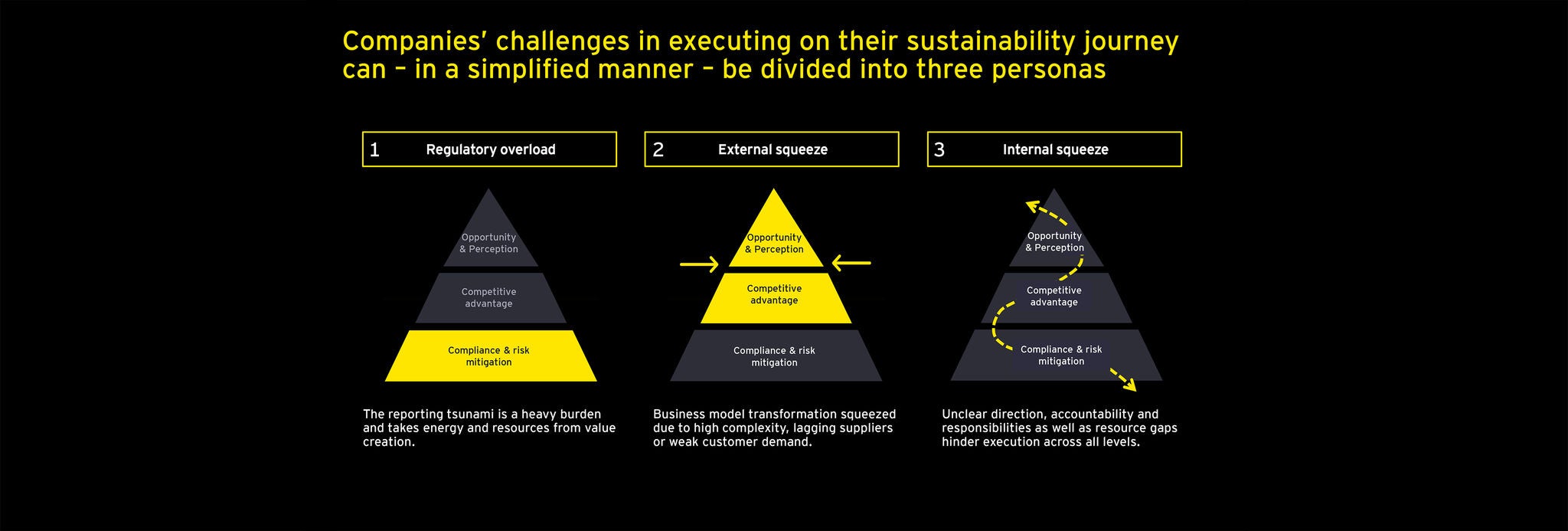
Companies are dealing with challenges and squeezes from different directions, when it comes to executing on their sustainability journey.
Sustainability and ROI: a key driver — and a key challenge
One message from the survey came through clearly: sustainability is not viewed as a compliance exercise. All respondents agreed that sustainability can create significant business value, with topline growth, access to markets, investor expectations and brand strength cited as key drivers.
At the same time, 50% of respondents identified unclear or difficult‑to‑measure ROI as one of their biggest challenges. The issue is not a lack of ambition, but rather the complexity of building a robust business case when value creation is distributed across customers, suppliers and partners.
Unclear ROI remains one of the biggest barriers. The challenge is not ambition but turning sustainability investments into measurable business value across complex value chains.
Helena Ernbo
EY Sweden Consulting Sustainability Leader; Partner, Ernst & Young AB
This challenge often becomes most visible at the value chain level. Survey responses and roundtable discussions highlighted that sustainability-driven ROI is often constrained by value chain dependencies. On one hand, customer demand may not be strong enough, while on the other, suppliers may not transition at the required pace, making it difficult for companies to sustain long‑term investment commitments. Collaboration across the value chain is crucial to break free from this stagnation and eventually reap the ROI from those investments.
With challenges in assessing ROI, the survey findings reinforce the need for closer alignment between sustainability, strategy, finance and supply chain to enable sustainability to become more embedded in business decision‑making and to agree on the value the company wants to create and capture.
Clear alignment between sustainability initiatives and financial outcomes is critical for organizations to make confident investment decisions and strengthen long-term value creation.
Sara Vikman Areskär
Associate Partner, Climate Change and Sustainability Services, EY Sweden
C-suite sponsorship: setting the tone from the top
When asked what enables successful sustainability integration, survey respondents pointed decisively to leadership. A prominent aspect of integrating sustainability into business is the sponsorship from the top-tier leadership. C‑suite commitment or support from other leaders (such as business unit heads and middle management) was cited among the top three most important enablers by 94% of respondents, while 53% identified it as the single most important factor. A fully integrated strategy was ranked as the second most important enabler, followed by client demand. Executive sponsorship is the key as leaders need to adopt a long-term perspective, resist pressures from immediate returns, and allow sustainability capabilities to mature.
Capturing business value from strategic sustainability requires C-suite commitment, curiosity and cooperation.
Lauri Larvus
Partner, Head of Strategy & Sustainability Services, EY Finland
Interestingly, more concrete tools such as climate transition plans, internal carbon pricing, methods to manage goal conflicts, and KPIs combining financial and sustainability aspects found their place at the bottom of the list. None of the respondents identified these as the most important enabler to integrate their sustainability strategy.
This reflects a practical reality. Sustainability transformations are long‑term, cross‑functional and often involve tradeoffs. These conditions require leaders who set direction, create clarity and allow capabilities to mature — even when short-term returns are difficult to quantify. Only with clear and committed top‑level sponsorship can these concrete tools be effectively introduced and implemented. In other words, leadership provides the essential foundation and mandate without which the tools would not find traction or be prioritized.
In any transformation, leadership commitment is decisive. Without visible top-level sponsorship, sustainability stays aspirational, failing to translate into daily decisions or meaningful business impact.
Sustainability ambitions stable amid geopolitical and regulatory shifts
Another area explored by the survey was the perceived impact of geopolitical developments and changes in the sustainability regulatory environment on Nordic companies’ sustainability initiatives and ambitions.
While almost 60% of respondents indicated that regulatory uncertainty can be hampering, most do not view it as a primary barrier to executing their sustainability strategy, and none cited regulation as a key driver of ambition. This may indicate that after several years of significant regulatory change and implementation, companies have become more practiced in navigating sustainability-related requirements while maintaining focus on execution.
In addition, findings from the Nordic companies interviewed show that sustainability ambitions remain largely intact, despite global instability and flux in the legal environment:
- 70% state that they are maintaining both their sustainability ambitions and execution pace.
- Around 10% indicated an increase in ambition and execution pace, despite ongoing uncertainties.
- Around 20% chose a market‑based adaptation in ambition and execution pace, which reflects agility and an acknowledgement of regulatory changes and fluctuations in market demand (regardless of direction).
To conclude, regulatory requirements remain important, but sustainability is increasingly linked to resilience, competitiveness and long-term business relevance. This long-term mindset was echoed in the roundtables, where participants emphasized the importance of continuously acting early rather than waiting for full certainty.
From strategy to execution: where operating models need to evolve
While sustainability is widely integrated at a strategic level, execution remains uneven. Nearly 70% of companies reported high (49%) or full integration (20%) of sustainability into overall strategy. Yet, day‑to‑day implementation tells a more mixed story with survey answers indicating that all respondents see room for improvement in their sustainability operating models.
When asked about which elements of their operating model need the most improvement, more than half of the respondents (56%) concluded that the single most important improvement area is related to financial steering, sustainability performance management, and sustainability data and technology in general. This signals a shift where most companies do not only set out to collect, analyze and report sustainability data in a more efficient way, but also to embed sustainability into everyday decision-making and connect it to financial impacts. Linking back to the perceived challenge with showcasing ROI on sustainability, these are essential internal tools to assess the financial implications on different strategic sustainability initiatives.
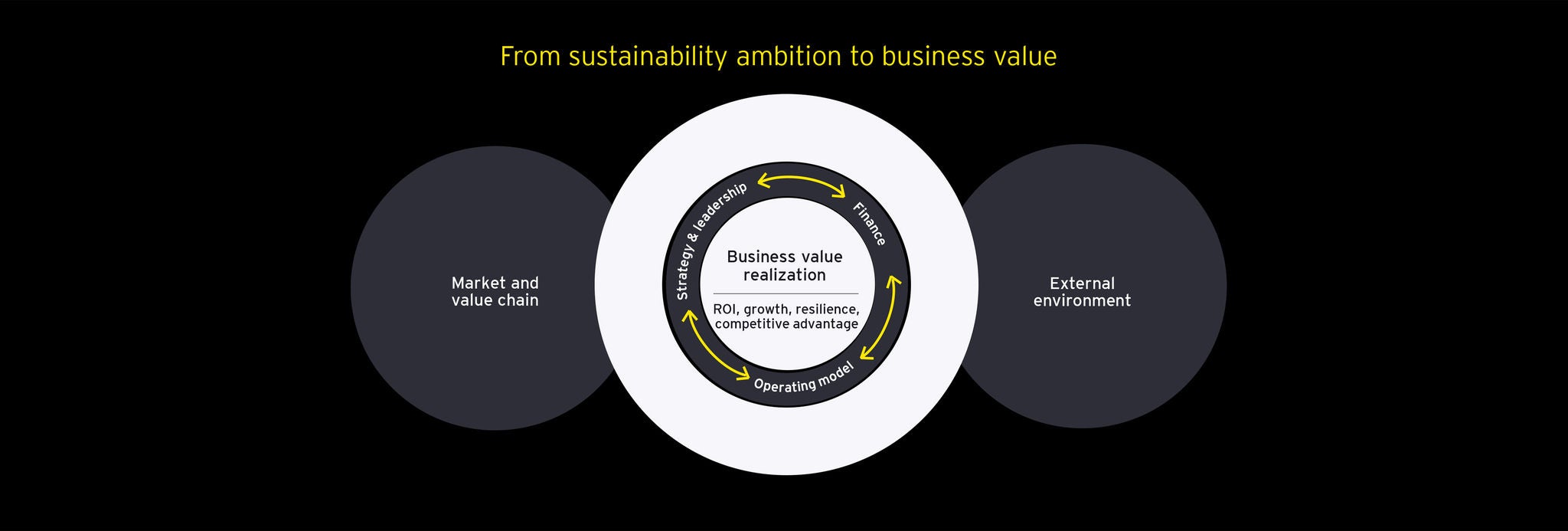
Sustainability creates business value when leadership, finance and operating models — including data, performance and steering — are aligned and connected to the external environment.
In addition, a large majority of respondents (78%) identified roles, responsibilities and processes within sustainability as an important — though not the most critical — improvement area. This likely reflects the rapid evolution of the sustainability domain, with ongoing scope for enhancement as the sustainability function becomes more strategic and more integrated with other functions.
The survey also examined which skills companies consider crucial to develop or retain. The most frequently mentioned were climate and decarbonization, with circularity coming a close second, speaking to the massive importance these areas have for companies’ future-proofing of business models. The focus on transforming sustainability into a catalyst for business value was also echoed, highlighting the ability to combine sustainability with strategy and leading change as other core strengths needed in the sustainability function.
No single organization can drive sustainability transformation alone. Progress depends on collaboration across the value chain and shared responsibility for both risk and value creation.
Tove Prahl
Manager, Supply chain and operations, EY Sweden
The evolving role of the chief sustainability officer (CSO): from subject experience to value orchestrator
As companies are maturing in their sustainability journey, the role of the CSO is shifting toward driving strategy agenda through the organization. Survey results show that CSOs in the Nordics are focusing on shaping direction, setting the sustainability narrative and integrating sustainability into strategy and business models.
Seventy-nine percent of the respondents agreed that the sustainability function was responsible for setting the company’s sustainability narrative or purpose; while 52% stated that CSOs were responsible for integrating sustainability into business strategy and business model, often sharing that responsibility with the strategy team.
EY 2025 Nordic Sustainability Survey
53%
53%
of the most senior sustainability leaders report directly to the CEO while 44% report two steps away from the CEO.
More than half of the most senior sustainability leaders now report directly to the CEO. The respondents in the survey also emphasize the close working relationship between the CSO and the CFO. Rather than a traditional reporting line, one can see a collaborative model emerging with the CSO, the CFO and the head of strategy, forming an essential trinity.
As CFOs take on greater responsibility for reporting, steering and assurance, CSOs gain space to act as value orchestrators, connecting sustainability ambition with strategic priorities and financial logic. Many of the strategic decisions, collaborations and regulatory requirements increasingly converge within the supply chain. Hence, this is a vital collaboration space, enabling circularity, efficiency and resilience as well as a strong human rights focus.
Companies that master collaboration among internal stakeholders and align clear priorities within the company and their value chain, are better able to navigate uncertainty and build business models that are resilient over time.
Extending the dialogue: from insight to action
The results and discussions highlight that sustainability data, processes and operating models matter — but they must be supported by executive commitment, cross‑functional collaboration and willingness to invest with a long‑term horizon. Additionally, close stakeholder collaboration will be critical in overcoming the disconnect between demand for sustainability solutions and the limited willingness to bear the costs.
Beyond the key conclusions lifted in this article, the survey also examined topics such as sustainability governance, organizational design, and to what extent sustainability (positive and negative impact) is considered in the companies' AI transformation.
Following the roundtables, EY teams have continued conversations with companies through deeper dives into specific topics of interest, as well as through comparisons of individual survey responses against peer benchmarks. These discussions have helped organizations better understand their current position and identify practical areas for action.
If these topics resonate and you would like to explore them further, the EY team welcomes continued dialogue. More detailed responses and insights can be presented upon request, and we warmly welcome your engagement and exchange of thoughts on these topics. Turning sustainability into business value is increasingly a shared journey — and progress is strongest when it is shaped together.
Summary
Sustainability is moving beyond compliance toward a more value‑driven role in business decision‑making. While ambition remains high, success depends on leadership alignment, clearer ROI logic and operating models that support execution. As sustainability becomes more embedded in strategy, closer collaboration between sustainability, finance and strategy teams will be critical to strengthening resilience and long‑term performance.