




EY refers to the global organization, and may refer to one or more, of the member firms of Ernst & Young Global Limited, each of which is a separate legal entity. Ernst & Young Global Limited, a UK company limited by guarantee, does not provide services to clients.
Recent Searches

Luxembourg, Europe’s largest investment fund domicile and the second largest globally after the United States, oversees more than EUR 7.45 trillion in fund assets,1 much of it managed on a cross‑border basis.
52.3%
52.3%
of funds marketed on a cross-border basis are domiciled in Luxembourg
US asset managers account for a growing share of that total, using Luxembourg vehicles to access European market, US managers hold 25% of the net assets in Luxembourg.2
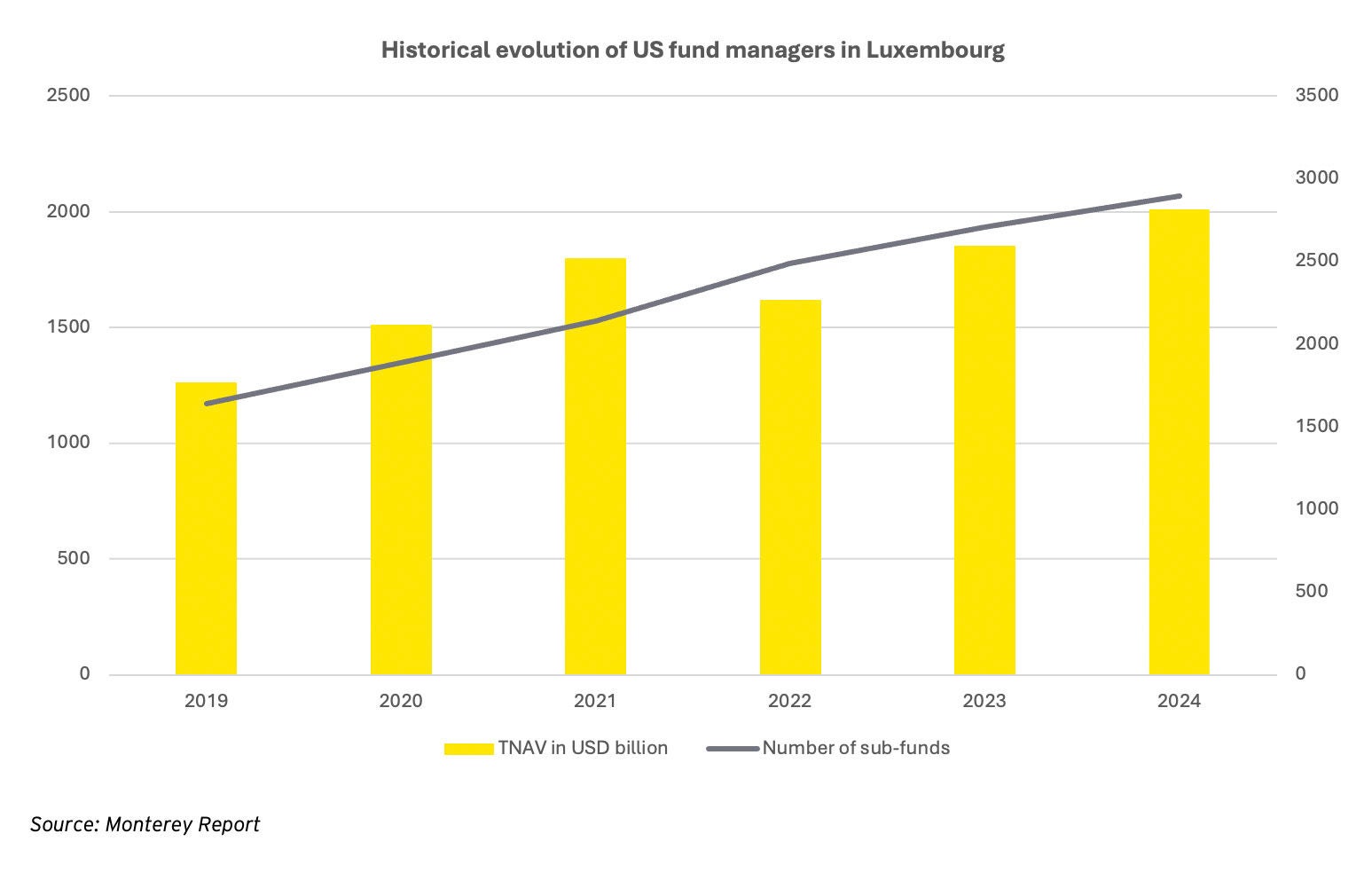
The transposition of AIFMD II and UCITS VI, expected to apply from April 2026, marks one of the most significant updates to the EU fund rulebook in a decade. While the reforms introduce tighter governance and reporting standards, Luxembourg’s approach to implementation suggests continuity rather than disruption for US managers already embedded in the market.
UCITS VI: modernization without undermining scale
The UCITS framework remains the backbone of Europe’s retail fund market and a key entry point for US managers. UCITS VI strengthens liquidity management by requiring funds to select at least two liquidity management tools from a predetermined list. For Luxembourg‑domiciled funds, these requirements largely codify existing supervisory expectations. US managers operating Luxembourg UCITS are unlikely to face structural change, though documentation, policies and internal governance may require updating.
In terms of governance, UCITS VI also codifies substance expectations, but these requirements largely reflect existing Luxembourg supervisory practice. As a result, well‑established US managers operating in the Grand-Duchy are unlikely to face material restructuring challenges.
One area of particular relevance for US firms is ETFs. Luxembourg’s draft law clarifies that auditor reports will not be required for any issue of units in exchange for contributions in kind, provided investors are treated fairly. Combined with earlier reforms granting subscription tax exemptions and greater disclosure flexibility for ETFs, these measures reduce operational constraints and further strengthen Luxembourg’s position as an ETF domicile.
AIFMD II and the harmonization of private credit
If UCITS VI refines the retail rulebook, AIFMD II reshapes the alternative investment landscape, with particular consequences for private credit. The directive introduces harmonized EU rules for loan‑originating funds, covering diversification, leverage, liquidity management and risk retention. It now establishes a clear framework for both direct and indirect loan origination, which on the one hand facilitates cross‑border activity by eliminating national specificities, but on the other hand requires fund managers to reassess their structuring and ensure they comply with the applicable rules depending on whether lending is conducted directly or through intermediary vehicles. In this context, AIFMD II also clarifies the treatment of SPVs used within loan‑origination structures, allowing AIFMs to manage these entities more holistically as part of the fund’s operating model (an approach that, in practice, may streamline oversight and reduce operational burden across multi‑vehicle private credit platforms). For instance, an AIF may originate loans and, at a later stage, transfer those loans to financial or legal structures that are established by, or on behalf of, the AIF for the purpose of holding such loans. Where these structures act as dedicated vehicles for the originated loans, they should not be treated as third parties. Accordingly, transfers of loans to such structures should not be considered as triggering the originate‑to‑distribute prohibition, nor should they be taken into account for assessing compliance with the 5% risk‑retention requirement, provided that the AIF ultimately retains the required economic exposure to the originated loans.
Luxembourg has emerged as the primary European hub for private debt strategies, supported by flexible vehicles such as Part II UCIs, SIFs, RAIFs and unregulated funds (mainly set as SCSp). The Grand-Duchy draft law mirrors the directive closely, avoiding additional national constraints and preserving existing structuring practices.3
For US private credit managers, the result is greater regulatory certainty and cross-border opportunities.
From fund management to platform strategy
AIFMD II and UCITS VI expand the range of permitted ancillary services that AIFMs and UCITS management companies may provide. In this sense, it also allows fund managers to offer a wider set of business support functions to third parties. For instance, these services may include human resources support, IT services, corporate services, domiciliation services, risk management, distribution services and others. In addition, Luxembourg’s draft law adopts a broad interpretation of “third party”, encompassing co‑investment vehicles, carried interest structures, SPVs and group entities. For large US managers, this enables the consolidation of European operational, regulatory and distribution functions in Luxembourg, transforming regulated entities into multi‑service asset management platforms. This development aligns with a wider industry trend towards scale, operational efficiency and regulatory centralization in response to rising compliance costs.
A broader reform agenda
EU directives are only part of the picture. At a domestic level, CSSF Circular 25/901, published in December 2025, consolidates and modernizes the supervisory framework for Part II UCIs, SIFs and SICARs. The circular introduces differentiated investment and diversification limits depending on the sophistication of the target investor, granting greater flexibility to non-retail products.
At the EU level, the European Commission’s Market Integration Package, unveiled also in December 2025, aims, inter alia, to reduce fragmentation in cross‑border fund distribution by streamlining marketing notifications and providing greater regulatory convergence. Even though this package is still subject to negotiation, it could materially lower friction for Luxembourg funds marketed across multiple Member States.
Tax policy has also moved in a supportive direction. Luxembourg’s carried interest reform, adopted in January 2026, introduces one of Europe’s most competitive regimes for performance‑based remuneration, broadening eligibility and providing, under certain cases, tax exemptions. Under the new regime, the tax rate on contractual carried interest is reduced to one‑quarter of the previous level. Participation‑based carried interest will be treated under capital gains rules, meaning that if the interest is held for more than six months and the beneficiary does not hold a substantial participation (i.e., more than 10% of the shares or units of the underlying vehicle), it becomes fully exempt from tax, resulting in a 0% rate.
In a nutshell: what are AIFMD II/UCITS VI main impacts to US fund managers and how they should prepare for that
For US fund managers operating in Luxembourg, AIFMD II and UCITS VI do not represent a disruptive overhaul, as many of their core elements (such as substance and governance requirements) are already well‑established market practice in Luxembourg. That said, US fund managers should anticipate and prepare for targeted enhancements, particularly in the areas of liquidity management, loan origination (where relevant), and disclosure and reporting obligations. At the same time, they should proactively position themselves to leverage the opportunities arising from the reforms, notably the expansion of permissible services and the facilitation of cross‑border fund distribution due to the further harmonization of loan origination.
Key recommendations for US managers:
- Conduct a gap analysis and remediation plan: Identify compliance gaps against AIFMD II and UCITS VI standards and develop a clear roadmap for remediation before enforcement deadlines
- Strengthen governance frameworks: Update governance policies to incorporate enhanced oversight obligations, including risk management, conflicts of interest, (de-)activation of LMTs, loan origination and sustainability considerations under UCITS VI
- Improve data governance and transparency: Establish robust data frameworks to capture detailed portfolio and risk data, enabling accurate regulatory reporting and investor communication
- Upgrade technology for compliance and reporting: Invest in digital solutions that automate regulatory reporting, monitor liquidity, and track leverage metrics to ensure timely and accurate submissions
- Enhance liquidity management capabilities: Select, calibrate, and disclose mandatory LMTs under AIFMD II and UCITS VI, ensuring they are operationally integrated and stress-tested
- Revise fund documentation and disclosures: Update prospectuses, Key Information Documents (KIDs), and offering materials to reflect new requirements on liquidity, costs, leverage and sustainability
- Identify opportunities for new services: For managers with a Luxembourg domiciled AIFM or management company, evaluate business cases for the provision of new non-core services permitted under AIFMD II/UCITS VI, and their impact on governance requirements as well as the operating model
- Evaluate framework for loan origination: Review and update AIFM frameworks for loan originating funds, including risk retention, leverage caps, diversification of risks, transparency and compliance requirements
- Foster collaboration with key stakeholders: Engage depositaries, administrators, and technology providers early to align operational processes with new regulatory expectations
- Invest in staff training and regulatory awareness: Ensure teams are well-informed about AIFMD II and UCITS VI changes through targeted training programs, fostering a culture of compliance and adaptability
Luxembourg: the long‑term home for US fund managers
Taken together, these developments reinforce Luxembourg’s long‑standing positioning as Europe’s principal fund hub. AIFMD II, UCITS VI and Luxembourg’s broader regulatory agenda reinforce a clear message: Luxembourg is not merely adapting to EU reform, it is shaping the future ecosystem for global asset managers. For US fund managers seeking stable access to European investors, operational flexibility and a supportive tax and regulatory environment, Luxembourg remains and is set to remain the natural home for funds in Europe.
Summary
Luxembourg, Europe’s largest investment fund domicile and the second largest globally after the United States, oversees more than EUR 7.45 trillion in fund assets, much of it managed on a cross‑border basis.
Related articles
Why US Asset Managers should turn to Luxembourg
Luxembourg presents strong opportunities for US asset managers, but the regulatory and operational landscape differs from the US. To succeed, US managers must adapt to local requirements, work with trusted advisors, and choose compatible service providers. Understanding these nuances is key to achieving success in the European market.
AIFMD 2.0: what it means for annex IV reporting
Executive summary. AIFMD 2.0 introduces – amongst others - significant changes to supervisory reporting under Article 24, reshaping the Annex IV content, format, and even reporting frequency and timing through new EU level technical standards. These changes will require AIFMs to manage more granular data, implement stronger governance, and adapt to harmonized processes