


EY refers to the global organization, and may refer to one or more, of the member firms of Ernst & Young Global Limited, each of which is a separate legal entity. Ernst & Young Global Limited, a UK company limited by guarantee, does not provide services to clients.
Recent Searches

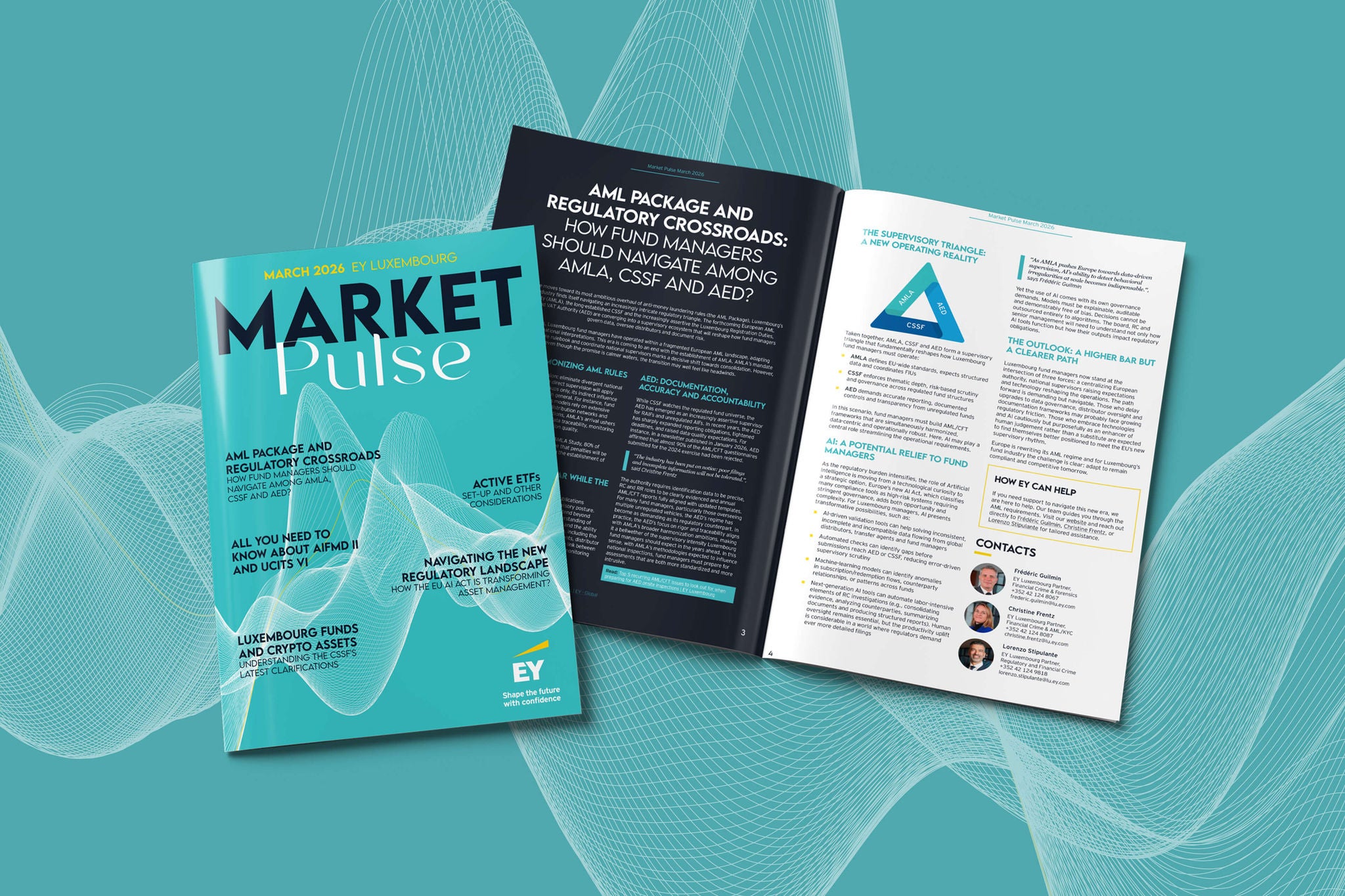
As Europe moves toward its most ambitious overhaul of anti‑money laundering rules (the AML Package), Luxembourg’s fund industry finds itself navigating an increasingly intricate regulatory triangle. The forthcoming European AML Authority (AMLA), the long‑established CSSF and the increasingly assertive the Luxembourg Registration Duties, Estates and VAT Authority (AED) are converging into a supervisory ecosystem that will reshape how fund managers govern data, oversee distributors and document risk.
For decades, Luxembourg fund managers have operated within a fragmented European AML landscape, adapting processes to national interpretations. This era is coming to an end with the establishment of AMLA. AMLA’s mandate to impose a single rulebook and coordinate national supervisors marks a decisive shift towards consolidation. However, even though the promise is calmer waters, the transition may well feel like headwinds.
AMLA: harmonizing AML rules
AMLA has a clear mission: eliminate divergent national practices. Although the direct supervision will apply to selected high‑risk groups only, its indirect influence will touch fund industry in general. For instance, fund managers whose business models rely on extensive delegation chains, global distribution networks and intermediated investor relations, AMLA’s arrival ushers in stricter expectations on data traceability, monitoring consistency and documentation quality.
80%
80%
According to EY AMLA Study, 80% of participants believe that penalties will be increased following the establishment of AMLA¹
CSSF: raising the bar while the ground shifts
CSSF's recent thematic reviews and publications point to an increasingly granular supervisory posture. Expectations for fund managers now extend beyond formal compliance to demonstrable understanding of sector‑specific risks, credible governance and the ability to evidence every step of the control chain, including the oversight of complex delegation arrangements, distributor due diligence in long distribution chains, the link between investor behavior and fund risk profiles and monitoring transactions and counterparties.
AED: documentation, accuracy and accountability
While CSSF watches the regulated fund universe, the AED has emerged as an increasingly assertive supervisor for RAIFs and unregulated AIFs. In recent years, the AED has sharply expanded reporting obligations, tightened deadlines, and raised data‑quality expectations. For instance, in a newsletter published in January 2026, AED affirmed that almost 90% of the AML/CFT questionnaires submitted for the 2024 exercise had been rejected.
The industry has been put on notice: poor filings and incomplete information will not be tolerated.
Christine Frentz
EY Luxembourg Partner, Financial Crime & AML/KYC
The authority requires identification data to be precise, RC and RR roles to be clearly evidenced and annual AML/CFT reports fully aligned with updated templates. For many fund managers, particularly those overseeing multiple unregulated vehicles, the AED’s regime has become as demanding as its regulatory counterpart. In practice, the AED’s focus on rigor and traceability aligns with AMLA’s broader harmonization ambitions, making it a bellwether of the supervisory intensity Luxembourg fund managers should expect in the years ahead. In this sense, with AMLA’s methodologies expected to influence national inspections, fund managers must prepare for assessments that are both more standardized and more intrusive.
The supervisory triangle: a new operating reality
Taken together, AMLA, CSSF and AED form a supervisory triangle that fundamentally reshapes how Luxembourg fund managers must operate:
- AMLA defines EU‑wide standards, expects structured data and coordinates FIUs
- CSSF enforces thematic depth, risk‑based scrutiny and governance across regulated fund structures
- AED demands accurate reporting, documented controls and transparency from unregulated funds
In this scenario, fund managers must build AML/CFT frameworks that are simultaneously harmonized, data‑centric and operationally robust and here AI may play a central role streamlining the operational requirements.
AI: a potential relief to fund managers
As the regulatory burden intensifies, the role of Artificial Intelligence is moving from a technological curiosity to a strategic option. Europe’s new AI Act, which classifies many compliance tools as high‑risk systems requiring stringent governance, adds both opportunity and complexity. For Luxembourg managers, AI presents transformative possibilities, such as:
- AI‑driven validation tools can help solving inconsistent, incomplete and incompatible data flowing from global distributors, transfer agents and fund managers
- Automated checks can identify gaps before submissions reach the AED or CSSF, reducing error‑driven supervisory scrutiny
- Machine‑learning models can identify anomalies in subscription/redemption flows, counterparty relationships, or patterns across funds
- Next‑generation AI tools can automate labor-intensive elements of RC investigations (e.g., consolidating evidence, analyzing counterparties, summarizing documents and producing structured reports). Human oversight remains essential but the productivity uplift is considerable in a world where regulators demand ever more detailed filings
As AMLA pushes Europe towards data‑driven supervision, AI’s ability to detect behavioral irregularities at scale becomes indispensable.
Frédéric Guilmin
EY Luxembourg Partner, Financial Crime & Forensics Leader
Yet the use of AI comes with its own governance demands. Models must be explainable, auditable and demonstrably free of bias. Decisions cannot be outsourced entirely to algorithms. The board, RC and senior management will need to understand not only how AI tools function but how their outputs impact regulatory obligations.
The outlook: a higher bar but a clearer path
Luxembourg fund managers now stand at the intersection of three forces: a centralizing European authority, national supervisors raising expectations and technology reshaping the operations. The path forward is demanding but navigable. Those who delay upgrades to data governance, distributor oversight and documentation frameworks may probably face growing regulatory friction. Those who embrace technologies and AI cautiously but purposefully as an enhancer of human judgement rather than a substitute are expected to find themselves better positioned to meet the EU’s new supervisory rhythm.
Europe is rewriting its AML regime and for Luxembourg’s fund industry the challenge is clear: adapt to remain compliant and competitive tomorrow.
How EY can help
If you need support to navigate this new era, we are here to help. Our team guides you through the AML requirements. Visit our website and reach out directly to Frédéric Guilmin, Christine Frentz, or Lorenzo Stipulante for tailored assistance.
Summary
As Europe moves toward its most ambitious overhaul of anti‑money laundering rules (the AML Package), Luxembourg’s fund industry finds itself navigating an increasingly intricate regulatory triangle.
Related articles