


EY refers to the global organization, and may refer to one or more, of the member firms of Ernst & Young Global Limited, each of which is a separate legal entity. Ernst & Young Global Limited, a UK company limited by guarantee, does not provide services to clients.
Recent Searches

The introduction of the control agent under Luxembourg’s Blockchain IV Law marks one of the most transformational shifts in the country’s fund‑servicing landscape since the move to dematerialized securities. By redefining who maintains the authoritative record of tokenized fund units, the law opens the door to operating models that challenge long‑standing assumptions about transfer agency, custody chains, and the mechanics of fund issuance. As Luxembourg strengthens its position as a global hub for regulated digital assets, the control agent emerges as a potential catalyst for real‑time registries, streamlined distribution models, and more scalable tokenization frameworks. This article explores how this new role fits within the broader sequence of Luxembourg’s blockchain laws — and whether it represents a true turning point for the future of transfer agency.
Overview of the Luxembourg Blockchain Laws
Although blockchain technology has matured over the past decade, its most transformative potential for financial services is only now coming into focus. In particular, tokenization within the wealth and asset management industry stands out as a pivotal use case which could make blockchain technology the future infrastructure backbone of global financial services. Due to Luxembourg’s role in the global financial system – especially in asset management and asset servicing – the country’s financial sector will be heavily impacted by this technology and has therefore initiated laws and regulations to provide a framework in which the technology can be used as well as to address the potential of the technology for the future of the domestic financial center. The first Blockchain Law was adopted by the Luxembourg Parliament on 1 March 2019. Since then, Luxembourg has reinforced its legal and regulatory framework through three additional blockchain laws referred as Blockchain Law II, Blockchain Law III and Blockchain Law IV as illustrated in the overview below.
One of the key changes that has been brought by Blockchain Law IV is the introduction of the Luxembourg-specific concept of the control agent.
The concept of the control agent
According to the Blockchain IV Law, the control agent represents a supervised intermediary mandated by an investment fund to issue, record and deliver dematerialized fund units/shares natively issued on DLT (tokens) and to maintain the single authoritative register for that tokenized share class. It operates independently of the traditional central account keeper model and custody chains.
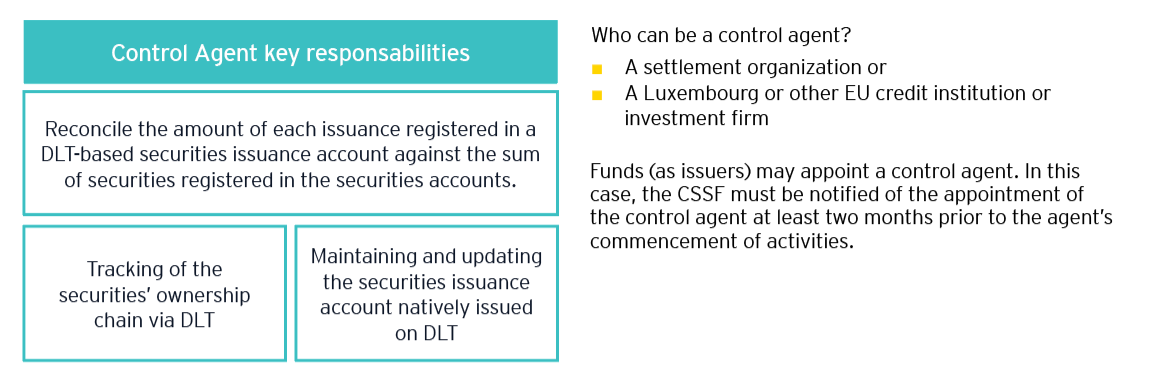
In the traditional set‑up, the central account keeper is positioned at the top of the custody chain, holding the issuance account and acting as top‑tier custodian; by contrast, the control agent does not need to provide centralized custody. Securities accounts may be held with different custodians without a custody relationship with the control agent, provided reconciliation is ensured. This widens the pool of eligible service providers and provides structural flexibility for DLT‑native operations.
Implications for the future of transfer agency
With issuance accounts on DLT and a control agent reconciling the authoritative supply, registrar and transfer agent (TA) functions can pivot from periodic batch files to near real‑time positions and lifecycle events (issues, transfers, conversions/redemptions). This reduces reconciliation friction and shortens cycles.
Many transfer agents already maintain investor registers, perform FATCA/CRS reporting, and own onboarding/KYC workflows. Under Blockchain IV, EU‑authorized investment firms or credit institutions can act as control agents; some TAs within banking/investment firm groups (or TAs partnering with such firms) could credibly expand into that role, leveraging existing oversight capabilities while adding DLT controls, wallet key management and smart‑contract governance.
Issuers can remain on the traditional model (status quo but DLT‑enabled) or adopt the control agent model to simplify layers where appropriate, potentially crediting units directly to investor or nominee accounts on DLT, with the control agent ensuring consistency. The latter can compress time‑to‑market for tokenized funds and reduce dependency on scarce central account keeper capacity.
Luxembourg’s ecosystem is already moving: the first CSSF “control agent” authorization has been reported for a fintech focused on tokenized funds, signalling how registries at scale may be run under the new regime.”
Jens Schmidt
EY Luxembourg Partner, Wealth and Asset Management Consulting Leader
In Luxembourg, a (Digital) Transfer Agent (TA) is responsible for maintaining the fund’s shareholder register, performing investor-level KYC/AML, processing subscription and redemption orders according to the fund’s prospectus rules, executing trades at the applicable NAV, handling investor servicing, and, where applicable, supporting distributionrelated tasks such as trailer fee calculations. A TA may use permissioned DLT to operate a digital register but still performs the full suite of classical transferagency functions. In contrast, a Control Agent focuses on the issuance and delivery of dematerialized securities recorded directly on DLT. It does not perform KYC/AML, cash reconciliation, or order processing. Investor DLT addresses function as “securities accounts,” allowing issuance without a CSD custody chain. Orders are executed only on the primary market, and settlement occurs outside the Control Agent’s scope, typically via “delivery versus payment” (DVP). Thus, the TA acts as a full-service investor registrar and gatekeeper, while the Control Agent acts as a technical issuance authority for DLT-native securities.
Strategic Outlook: does the control agent represent a true turning point for the future of transfer agency?
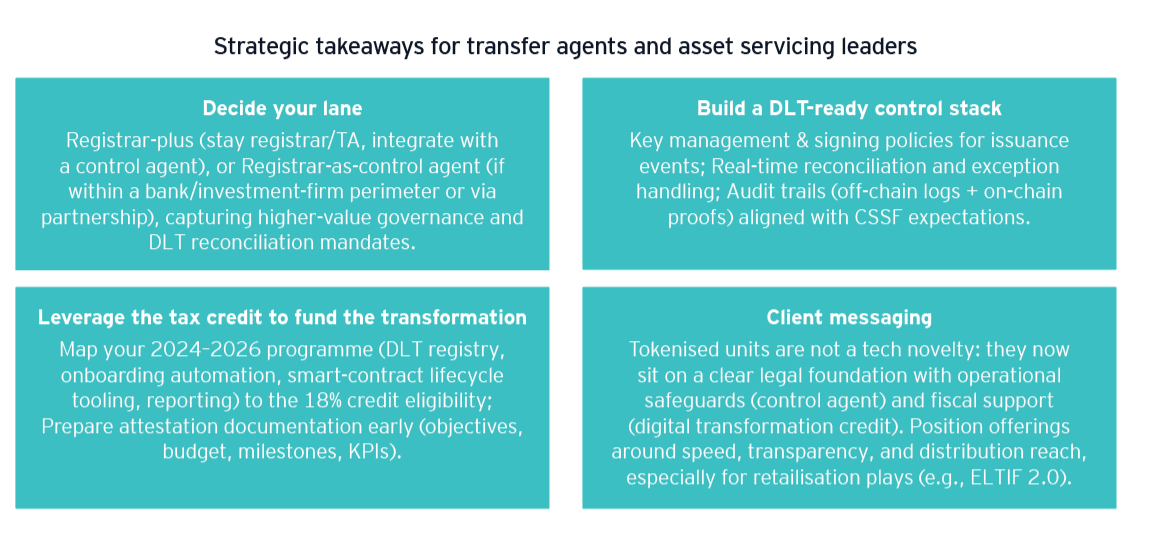
Blockchain IV significantly reshapes the mechanics of fund issuance by lowering the barriers to DLT‑native securities and designating the control agent as the entity responsible for maintaining the authoritative record of tokenized units. Combined with Luxembourg’s strengthened investment tax incentives for digital transformation, the regulatory and financial conditions now align to accelerate modernization across the fund‑servicing ecosystem. For transfer agents, this framework presents both an opportunity and a strategic inflection point. The control agent construct introduces a more flexible and DLT‑aligned infrastructure for securities issuance and servicing. For funds, the model can unlock meaningful efficiency gains, including:
- Faster and more streamlined settlement, reducing friction between order execution and finality
- Greater transparency and traceability through on‑chain records and time‑stamped positions
- Lower administrative overhead thanks to automated reconciliations and programmable processes
- New access and holding configurations, supporting more diverse investor channels and account architectures
These benefits make the control agent an attractive alternative to traditional issuance models, particularly for fund managers exploring tokenized share classes or more digital‑native distribution strategies.
The shift to control‑agent‑based issuance forces transfer agents to evaluate their operating models, technology stacks, and regulatory responsibilities. While the model offers opportunities to evolve into higher‑value registry and data‑governance functions, it also requires deep investment in digital, operational, and compliance capabilities.
Despite the clarity of the new framework, several practical hurdles remain:
Regulatory clarity vs. implementation complexity
The law defines roles, but translating TA obligations, shareholder registry mechanics, and fund‑law nuances into smart‑contract logic requires rigorous legal‑technical design and strong coordination across stakeholders.
Cybersecurity and operational resilience
Control agents must demonstrate robust ICT security, incident‑response frameworks, and third‑party oversight, aligned to EU DORA requirements. Transfer agents partnering with fintech providers will need stronger contractual protections, enhanced SLAs, business continuity planning, and secure key‑management frameworks such as sharding or fallback nodes.
Market fragmentation risk
Traditional central‑account‑keeper models and control‑agent models may coexist for the next years. Interoperability, data‑format standards, wallet/KYC portability, and messaging protocols will determine how smoothly ecosystems connect – and which service providers become preferred partners.
The investment credit tax
Luxembourg Government has added a new tax relief for digital investments. The tax relief rate amounts to 18% for the investments and operating expenses, apart from depreciable tangible investments. The credit amounts to 6% for investments in tangible depreciable assets and 18% for expenses and investments in software and patents. In addition, the rates of the existing tax credit for additional items of investment increased from 8% to 12%, and the complementary tax credit was abolished. For more information, please refer to:
How EY can help
EY supports Luxembourg asset managers and asset servicers in designing and operationalizing servicing capabilities for tokenized funds and share classes, combining deep regulatory insight with product assessment, target operating‑model design and technology delivery.
Leveraging our regulatory expertise and operational use-case experience, we translate fund regulation and TA obligations into robust on‑/off‑chain architectures. We help our clients in clarifying key operational questions such as whether the primary source of books and records can reside on‑chain or requires an off‑chain digital twin, defining delivery vs. payment settlement patterns, and establishing wallet and key‑management policies.
We support with the creation of integrated risk and control frameworks across AML/KYC, technology risk and operational resilience (including DORA alignment), capital and governance impacts, and end‑to‑end auditability of on‑/off‑chain records. Complemented by market insights, a phased delivery roadmap from proof of concept to production (including vendor selection and cutover support), and guidance on leveraging Luxembourg’s investment tax credit, we help you move from concept to a compliant go‑live of your tokenized asset services with confidence.
Summary
The introduction of the control agent under Luxembourg’s Blockchain IV Law marks one of the most transformational shifts in the country’s fund‑servicing landscape since the move to dematerialized securities.
Related articles