





EY refers to the global organization, and may refer to one or more, of the member firms of Ernst & Young Global Limited, each of which is a separate legal entity. Ernst & Young Global Limited, a UK company limited by guarantee, does not provide services to clients.
Recent Searches

Over the past few years, the demand for sustainable investment solutions has grown significantly, driven by increasing awareness of climate change and environmental concerns. As investors seek to align financial returns with sustainability objectives, timber and carbon funds have emerged as alternative asset classes offering both diversification benefits and measurable environmental impact.
Luxembourg: A strategic hub for sustainable investment
Nestled in the heart of Europe, Luxembourg uniquely combines urban sophistication with tranquil countryside. Renowned as a leading financial center. It boasts a robust regulatory framework and extensive expertise in asset management, making it an attractive destination for investors seeking innovative opportunities.
As the global community confronts the challenges of climate change and environmental degradation, investment strategies are evolving to prioritize sustainability and environmental responsibility. Among these strategies, carbon, natural capital, and timber funds have emerged as suggested asset classes for financial players, driven by a need for diversification.
Timber investments, an asset class to hedge against inflation
In recent years, we have witnessed a significant rise in investments in forestry funds. According to the latest data from Agri Investor1, agrifood and forestry fundraising experienced a positive year in 2024, with the market raising $8.4 billion throughout the year. Although this represents a $1.3 billion decrease from the $9.7 billion raised in 2023, it remains well within the average $8 billion annual figure observed over the previous five years. The main arguments supporting this growth include strong market fundamentals, stable cash yield, diversification benefits, a hedge against inflation, and quantifiable climate benefits.
The diversification benefits are evidenced by a recent article from New Forests (2024)2 that indicates that natural capital, impact, and climate represent a growing allocation sleeve. New Forests anticipates that an increasing number of institutions will establish dedicated natural capital allocations with their own risk, return, and impact metrics, whether through a commingled fund, a separate account, or a blended finance vehicle. This is further supported by a risk/return analysis conducted by JP Morgan (2022) for life insurers3, suggesting that a strategic allocation of 1%-5% to timberland could enhance returns and reduce balance sheet risk for a typical European life insurer.
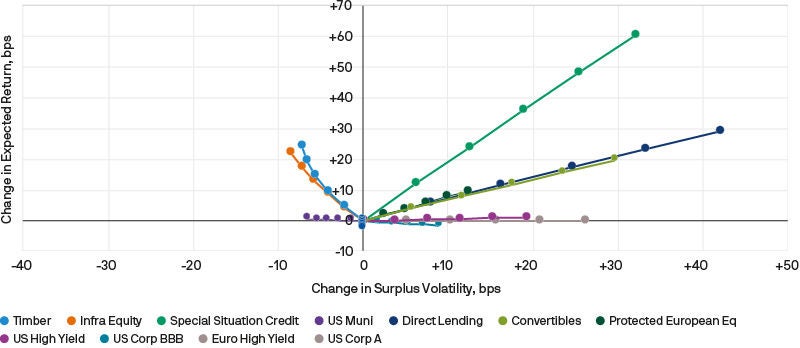
As further evidenced in the TIR White Paper on Inflation Risks and Timberland Investments (2025)4, it has been clearly demonstrated in recent years that forestry funds serve as an effective hedge against inflation.
Expanding of the asset class
While this outlook is indeed promising, there are even greater opportunities for growth that warrant attention.
Rising demand for industrial roundwood
According to New Forests (2024)5, expectations indicate that demand for industrial roundwood, which is the primary concern of investors, will at least double by 2050. This growth will be driven by three key factors:
- Demographics: Population growth increasing wood consumption.
- Economics: Expansion in regions with significant economic growth.
- Technology: The substitution of wood-based materials for fossil fuel-based alternatives and other high-energy or hard-to-recycle materials.
In addition to the increasing demand for timber products, emerging markets in South America and Asia are gaining interest, alongside the established markets of the US, Canada, Australia, and New Zealand.
Revenue streams beyond timber harvesting
Alongside the natural growth factors previously outlined, there is significant potential for additional revenue streams beyond traditional timber harvesting. Investors are increasingly targeting various income sources:
- Carbon credits: As companies and governments seek to offset their carbon footprints, carbon credits have gained prominence. Generating carbon credits from a forest typically involves a process that quantifies the carbon dioxide (CO2) sequestered by the forest over a specific period. Independent third-party appraisers then issue carbon credit certificates, each typically representing one metric ton of CO2 equivalent reduced or sequestered.
- Restoration banks: These initiatives focusing on ecological restoration and conservation, offer further revenue opportunities by enabling investors to sell credits for restored ecosystems.
- Recreational and eco-tourism opportunities: Effective forestry management can create recreational areas that generate income from eco-tourism and outdoor activities.
- Grants and subsidies: Carbon credit funds may also benefit from government and international grants aimed at promoting sustainability and reducing emissions, opening new markets where traditional timber harvesting is less prevalent.
Diversifying revenue streams in this way not only strengthens the financial resilience of forestry funds but also aligns with the growing demand for sustainable and responsible investment practices.
Challenges in expanding revenue streams
However, this development will need to address specific challenges notably in maintaining operational efficiency and successfully executing exits for timber portfolios.
Robust oversight mechanism
Particularly in less mature markets, it is essential to ensure that local providers have the necessary expertise. Robust oversight mechanisms must be in place to ensure compliance with sustainability standards and investment goals. Addressing anti-money laundering (AML) concerns and providing a transparent and controlled environment for investments is also crucial.
Leveraging technology for risk management
Diversification, thorough due diligence, and ongoing monitoring are critical components of a successful forestry investment strategy. The integration of technology and artificial intelligence (AI) is becoming increasingly relevant in this space. For example, to address climate risks, New Forests utilizes AI to monitor bushfires on their managed plantation estates in South Australia, demonstrating how technology can enhance operational efficiency and risk management.
The maturity of carbon credit markets
The carbon credits market has not yet reached maturity. Many carbon credit projects require long-term commitments, and the uncertainty of future market conditions can make it challenging for sellers to commit resources. Additionally, carbon credits must be verified and certified by recognized standards to ensure their legitimacy. The process can be complex, time-consuming, and costly, potentially deterring potential sellers. Some regions may also have limited access to carbon markets or specific regulations that hinder the sale of credits, creating barriers for sellers in those areas.
Regulatory restrictions also pose challenges, as some regions have limited access to carbon markets. For example, the cap-and-trade program of the State of California which is one of the most comprehensive frameworks with the aim to reduce greenhouse gas emissions often causes regulatory and compliance barriers for new market players in the asset class.
Successfully navigating these challenges requires careful planning, robust project management, and a clear understanding of the asset class dynamics. By addressing these factors, investors can unlock the full potential of timber and carbon credit investments while contributing to environmental sustainability.
The Pivotal Role of Luxembourg in the Asset Class
A robust regulatory framework for sustainable Investment
Luxembourg offers a robust regulatory framework that supports sustainable investment. The country has implemented various initiatives to promote green finance, including the Luxembourg Green Exchange (LGX), which facilitates the listing of green bonds and sustainable investment products. This regulatory environment attracts fund managers and investors looking to engage in sustainable investments. Luxembourg also fosters partnerships between public and private sectors to promote sustainable investment. Collaborations with international organizations, NGOs, and research institutions enhance the development of carbon and timber funds, driving innovation and best practices in the sector.
Luxembourg is also home to a wealth of expertise in asset management, with numerous investment firms specializing in sustainable finance. This expertise enables the development of innovative fund structures that meet the needs of investors while adhering to sustainability criteria. For instance, the Luxembourg financial center hosts a diverse range of Natural Capital Funds, rewarding investors not only through financial returns but also with the allocation of carbon credits generated. Over 50 funds are domiciled in Luxembourg, emphasizing sustainability in agrifood, responsible timberland management, and forestry carbon credit projects with some managed by the most influential players in the market.
Access to capital and the growth of impact investing
As a leading financial center, Luxembourg provides access to a diverse pool of capital. Institutional investors, family offices, and high-net-worth individuals are increasingly seeking opportunities, and Luxembourg serves as a gateway for these investments. Many investors are now seeking to make a positive impact with their investments. Carbon and timber funds provide an opportunity to contribute to environmental sustainability while generating financial returns, appealing to the growing impact investing community.
An example of this commitment is the Forestry and Climate Change Fund (FCCF), launched in 2017 by the government alongside key financial institutions, highlighting Luxembourg's strategic role in supporting green and sustainable investment solutions. Luxembourg is also home to a wealth of expertise in asset management, with numerous investment firms specializing in sustainable finance. This expertise enables the development of innovative fund structures that meet the needs of investors while adhering to sustainability criteria.
Future opportunities in forestry and carbon investments
Looking ahead, the future of forestry, carbon credit and natural capital funds appears promising. As global awareness of environmental issues continues to grow, the demand for sustainable investments is expected to rise. Beyond the general increase in demand for timber products and the development of emerging markets, additional opportunities are emerging, such as:
- Technological advancements in forest management.
- New revenue streams like carbon credits, recreational leases, and restoration banks.
Investors who embrace these trends may find themselves at the forefront of a transformative investment landscape. As the market continues to evolve, understanding the dynamics of forestry investments will be crucial for capitalizing on their potential.
The trends in carbon and timber funds reflect a broader shift towards sustainable investing and environmental responsibility. Luxembourg’s strategic position as a leading hub for sustainable finance enhances its role in the growth of these asset classes. As demand for carbon credits grows and awareness of sustainable forestry increases, Luxembourg is likely to play an increasingly significant role in shaping the future of this asset class. By aligning financial goals with environmental stewardship, investors can contribute to a more sustainable future while potentially reaping financial rewards.
Summary
Over the past few years, the demand for sustainable investment solutions has grown significantly, driven by increasing awareness of climate change and environmental concerns. As investors seek to align financial returns with sustainability objectives, timber and carbon funds have emerged as alternative asset classes offering both diversification benefits and measurable environmental impact.
Related articles
What about the S and the G of ESG?
This article does neither intend to put forward a new interpretation of the EU Sustainable Finance Disclosure Regulation (SFDR), nor to explain to fund industry practitioners the compliance requirements the SFDR introduced.
Sustainable finance: are you keeping pace?
Sustainable finance: are you keeping pace?
Integrating biodiversity risks: The future of sustainable finance
Ecosystem degradation poses significant challenges for financial undertakings, pushing them to adapt by integrating biodiversity considerations into decision-making, fostering sustainable practices for a resilient future.