



EY refers to the global organization, and may refer to one or more, of the member firms of Ernst & Young Global Limited, each of which is a separate legal entity. Ernst & Young Global Limited, a UK company limited by guarantee, does not provide services to clients.
Recent Searches
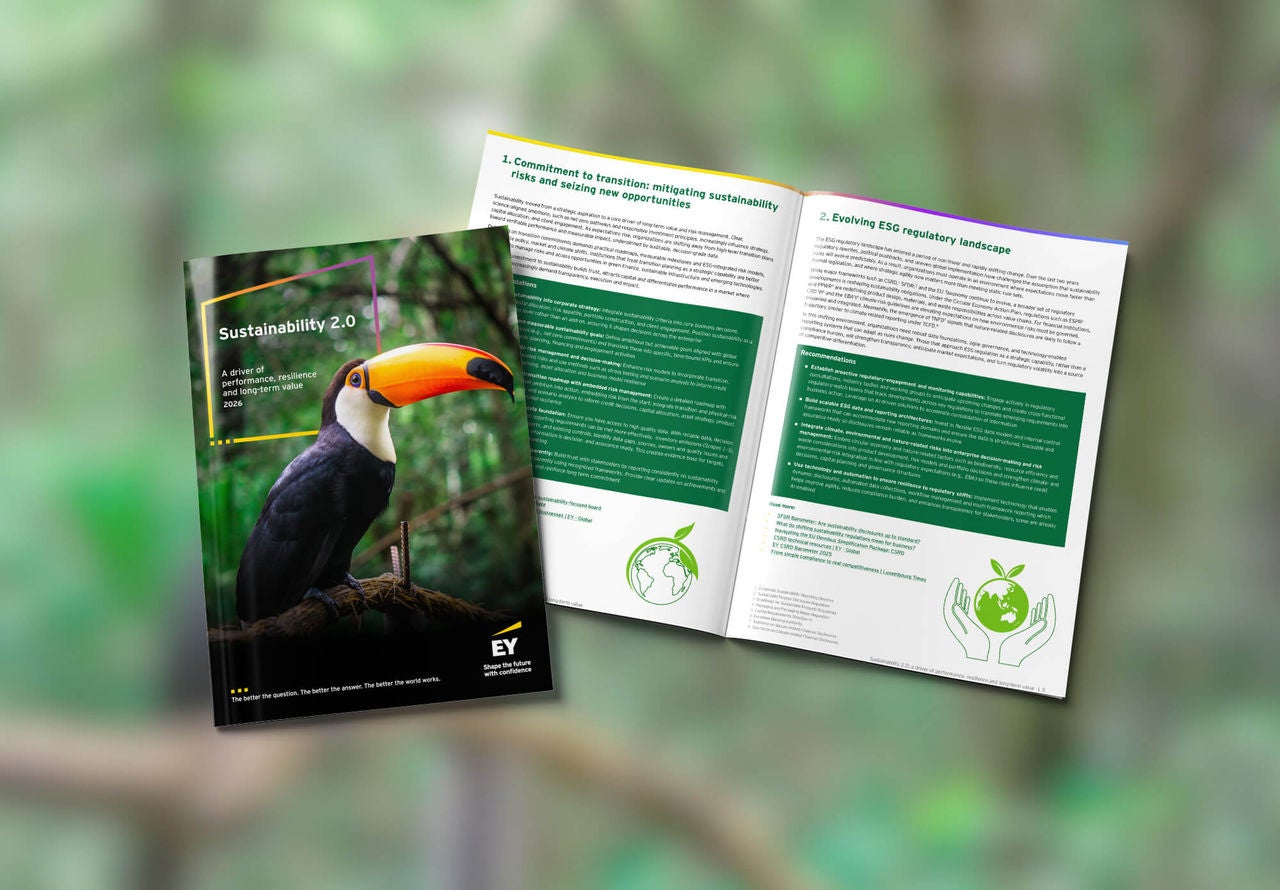
Sustainability has moved beyond broad ambitions and high-level pledges. It is now defined by actionable strategies, measurable progress and performance grounded evidence. Today, momentum is shaped less by regulation alone and more by the forces reshaping global markets:
- Heightened geopolitical fragmentation and security concerns, forcing organizations to rethink market presence, supply chains and investment locations while balancing resilience, national interests, ethical responsibilities and reputational risk in an increasingly polarized global environment
- Rising capital‑allocation pressure amid economic uncertainty, as firms face slowing growth, cost volatility and intensifying investor scrutiny, while needing to fund decarbonization, climate resilience and long‑term transformation in a constrained investment environment
- Acceleration of AI‑driven transformation, shifting from experimentation to enterprise‑wide scaling, which enhances productivity, analytics and reporting but also introduces new risks related to governance, data integrity, energy consumption, talent readiness and operational resilience
Even though regulatory progress slows, market expectations continue to rise. Stakeholders increasingly demand credible action on risk management, transition planning, climate resilience and sustainability performance. Organizations that deliver on these expectations not only reduce risk, but strengthen trust, attract capital and unlock competitive advantage.
This marks the arrival of Sustainability 2.0: a phase where sustainability becomes a strategic lever embedded in governance, data, risk management and value creation — and increasingly operationalized through integrated enterprise frameworks such as EY’s Sustainable Operating Blueprint. Let’s explore what this next chapter means in practice, and how you can turn sustainability into a source of performance, resilience and long term value.
Our Luxembourg Team
Our latest thinking
The message is clear: resilience and competitiveness will increasingly depend on an organization’s ability to embed circularity across its supply chain. As sustainability expectations intensify, circular economy is no longer a choice but a strategic shift for the years ahead.
Preparing for SFDR 2.0: A practical roadmap for fund managers
Published on 20 November 2025, SFDR 2.0 represents a major shift in the EU’s sustainable finance framework by replacing entity-level disclosures with a simplified, product-focused approach.
EY Luxembourg Sustainability Report
Our Sustainability Report is inspired by the available drafts of the EU Sustainability Reporting Standards. Read our interactive report to know more about our commitment on helping society to build a Better Working World.