


EY refers to the global organization, and may refer to one or more, of the member firms of Ernst & Young Global Limited, each of which is a separate legal entity. Ernst & Young Global Limited, a UK company limited by guarantee, does not provide services to clients.
Recent Searches

In brief
- Malaysian employees are rapidly adopting AI but rising workload and limited training are creating strain across the workforce.
- Organizations must redesign roles and build deeper AI skills to turn productivity gains into sustainable performance and employee well-being.
- Strong culture, fair rewards and national upskilling initiatives can help Malaysia transition to a more resilient, future-ready workforce.
Artificial intelligence (AI) is rapidly reshaping the Malaysian workplace and employees are adopting it at a pace outstripping global peers. The EY 2025 Work Reimagined Survey shows that 93% of Malaysian employees are using generative AI (GenAI) at work, with 81% reporting significant time savings and 76% citing improved work productivity.
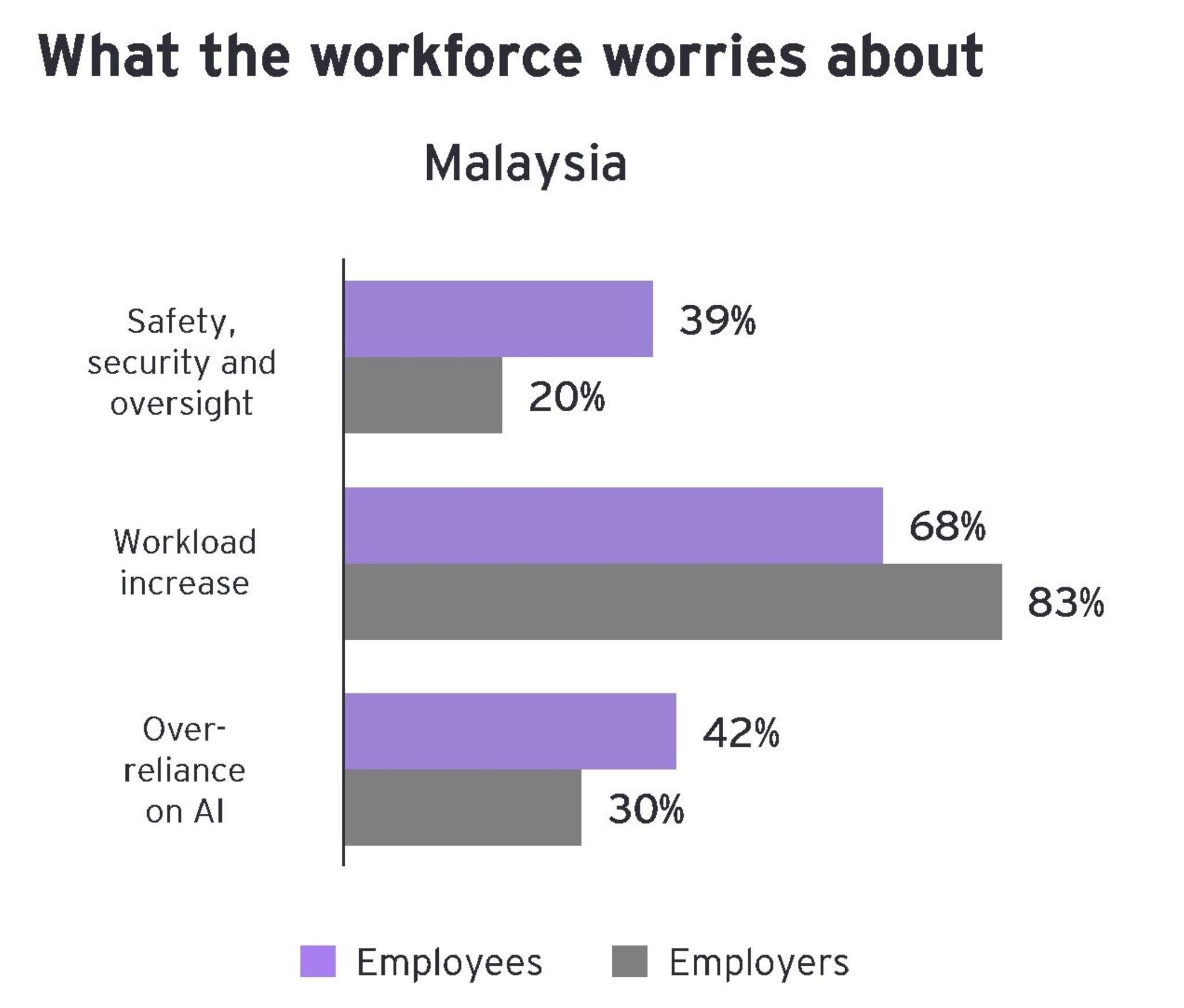
Yet a contradiction is emerging. Even as national statistics show an improving macro picture, with labor productivity per hour worked rising 3.8% to RM45.10 in Q3 20251, the EY survey shows that two-thirds of employees say their workload has increased, even as productivity rises
Work is moving faster, but pressure is building. For AI to deliver its full value, employers must work with employees so that benefits are shared and understood.
A workforce ready to move faster
The EY survey also reveals that Malaysians are embracing AI more actively than their global counterparts, with daily usage nine percentage points higher than the global average. Employees are integrating AI into routine tasks, decision-making and collaboration, contributing to faster delivery and better outcomes.
This readiness is supported by high trust in leadership. As 82% of Malaysian employees believe their leaders have a clear vision for AI, 80% also feel confident their organization’s next transformation initiative will succeed. These foundations enable Malaysian companies to innovate quickly and stay ahead of regional competitors.
However, early enthusiasm is only an advantage if sustained. The EY survey also highlights capability gaps that, if not addressed, may slow Malaysia’s progress.
Bridging the capability gap
Only 12% of Malaysian employees receive sufficient AI training to fully benefit from its capabilities. Although interest is high, structured training has not kept pace with adoption. Organizations continue to focus more on human skills development rather than the deeper technical competencies employees increasingly want.
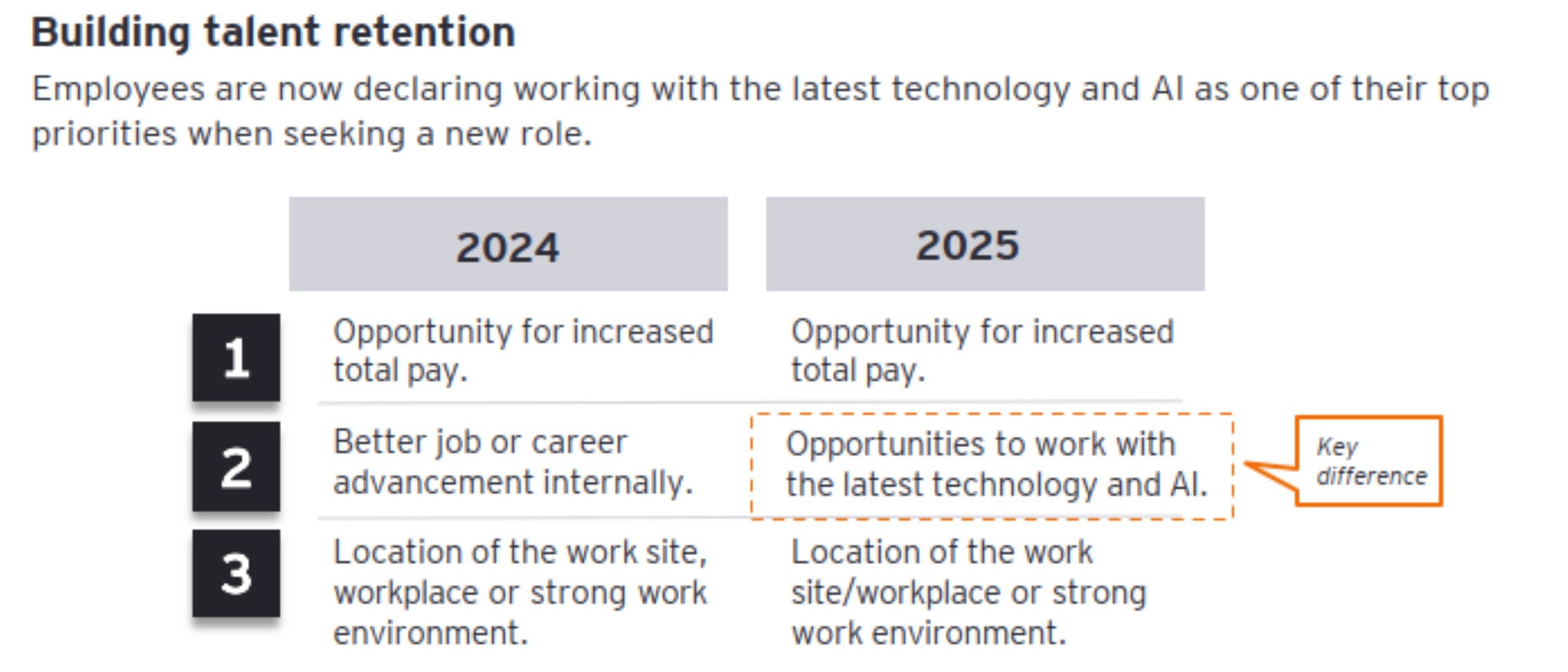
The skills gap matters because the talent most prepared for the future is also the most mobile. Working with the latest technology has become one of the top reasons Malaysians consider changing jobs, surpassing traditional factors like work location.
Though unemployment is at a decade low of 2.9%2, yet skills-related underemployment continues to pose challenges, reinforcing the need to redeploy and upskill workers for higher-value roles.
National research reinforces the urgency. TalentCorp’s Impact Study of AI, Digital, and Green Economy for Malaysian Workforce estimates that around 620,000 jobs could be significantly affected by AI in the next three to five years3, while identifying 60 emerging roles, majority tied to AI and digital capabilities. Furthermore, initiatives such as the MyMahir National AI Council for Industry aim to align industry demand with training pathways, so that Malaysians become not just job-ready but future-ready.
Avoiding the productivity paradox
Despite time savings from automation, many employees feel busier. Sixty-eight percent report increased workloads, suggesting that saved time is being reinvested into new tasks without thoughtful redesign.
Broader market research echoes this urgency. According to Microsoft’s 2025 Work Trend Index4, 83% of Malaysia’s workforce say they lack sufficient time or energy to complete their work, while 86% of leaders express confidence in using AI agents to expand workforce capacity. This highlights both the current strain and the appetite for accelerated automation.
This is a sign that organizations have not yet restructured work for a world where humans and machines operate together. Without rethinking job scopes, decision flows and handoffs, AI could risk accelerating pace without improving sustainability or wellbeing.
Resetting the employee value proposition
The survey also highlights a disconnect between employer assumptions and employee realities. Employers overestimate how satisfied employees are with their compensation and rewards by a gap of 25 percentage points. Even with improved retention trends, one in four Malaysian employees still plans to leave within the next year. Opportunities to work with modern technology, including AI, have become a major motivator for job moves.
Policy intervention offers an important lever. Malaysia’s newly implemented Progressive Wage Policy (PWP) enters full rollout with a RM200 million allocation under Budget 2025, targeting 50,000 workers and tying wage growth to skills and productivity5. Participating employers receive RM200 to RM300 per employee monthly for 12 months, alongside training requirements. This directly reinforces AI-linked upskilling and strengthens the employee value proposition.
Culture as a catalyst for sustainable transformation
The survey shows that organizational culture in Malaysia is trending positively. Seventy three percent of employees say their culture has improved, 67% feel trusted and empowered, as well as 81% feel connected to their teams. Innovation, efficiency and quality are emerging as the top cultural priorities for the year ahead.
AI can support all three if leaders foster open communication, experimentation and cross-functional collaboration. Culture remains one of the strongest predictors of successful transformation because it builds confidence and curiosity in adopting new tools.
Sources:
1Labour Productivity, Third Quarter 2025, Department of Statistics Malaysia, 2025. https://www.dosm.gov.my/portal-main/release-content/labour-productivity-third-quarter-2025
2Malaysia records lowest unemployment rate in 11 years, says Ramanan, The Star, 2026. https://www.thestar.com.my/news/nation/2026/01/13/malaysia-records-lowest-unemployment-rate-in-11-years-says-ramanan
3Securing futures in the AI economy, The Star, 2025. https://www.thestar.com.my/news/nation/2025/06/16/securing-futures-in-the-ai-economy
4Microsoft’s 2025 Work Trend Index: Malaysian workforce and leadership align on intelligent agent integration, Microsoft Malaysia, 2025. https://news.microsoft.com/en-my/2025/05/08/microsofts-2025-work-trend-index-malaysian-workforce-and-leadership-align-on-intelligent-agent-integration/
5Strengthening workers’ rights, enhancing productivity, The Star, 2025. https://www.thestar.com.my/news/nation/2025/07/18/strengthening-workers-rights-enhancing-productivity
Summary
Malaysia has high adoption, strong trust and a workforce eager to learn. To sustain this momentum, organizations must deepen skills, redesign work and recalibrate rewards for a digital era. If firms can turn productivity into progress and technology into meaningful work, 2026 may be remembered as the year AI elevated not just how Malaysians work, but how they grow and compete.
Related articles
Building Trust and Talent in Malaysia’s AI Future
In this episode of the Sembang AI podcast series, Adrian Chew, Malaysia AI, Data and Technology Consulting Leader; and Partner, Ernst & Young Consulting Sdn. Bhd., speaks with Joazral and Choy Huat, both from EY Malaysia. They explore Malaysia’s readiness for the AI era; the importance of trust, governance, and responsible adoption; and how the National AI Action Plan will shape sectors, talent, and opportunities over the next five years.
10m 33s