






Refinery Industry cargo ship

How digital-to-agentic AI is reshaping oil and gas IT operating models

Related topics

Digital and IT operating models must evolve to enable speed, accountability and value from AI at scale.


In brief

  • Despite high digital spend, many oil and gas companies still struggle to scale solutions beyond pilots due to legacy IT and digital operating model constraints.
  • Operating model design — spanning governance, funding, delivery and decision rights — now shapes how quickly digital and AI value is realized.
  • Hub and spoke is becoming the preferred operating model that helps companies prepare for an agentic era where people, platforms and AI agents must operate in sync.

Over the past few years, oil and gas companies in MENA have significantly increased investments in digital technologies. These range from cloud platforms and advanced analytics to artificial intelligence (AI)-driven optimization, automation, and connected operations. Yet outcomes have lagged ambition. While many pilots have delivered results, few organizations have successfully industrialized these solutions or embedded them into core processes at scale. This has resulted in uneven value realization and prompted renewed executive scrutiny of digital returns.

A recurring root cause lies not in technology, but in operating models. Legacy IT structures — optimized for predictability, asset stability and incremental change — are poorly suited to fast-moving digital portfolios that demand speed, experimentation and close business integration. AI is increasing execution capacity faster than legacy governance can approve it, making the operating model the primary bottleneck. As a result, operating model design has moved to the forefront of executive agendas.

Operating models: the hidden constraint and an emerging force multiplier

Traditional IT models were designed to minimize risk and control cost. In today’s context, they often do the opposite — slowing innovation, fragmenting accountability and diluting business ownership.

Across the industry, common challenges persist. Teams remain organized in functional silos, limiting collaboration across IT, digital and business. Delivery approaches are frequently rigid, with long planning cycles and delayed feedback loops that extend time to value. Resource utilization remains inefficient, and talent is stretched thin across competing priorities. Funding models prioritize annual budget control over dynamic reprioritization, while accountability for outcomes is split between central IT and business units. These structural frictions become increasingly visible as the companies’ digital portfolios expand.

At the same time, AI and automation are fundamentally changing what operating models can enable. Agentic AI is already accelerating activities such as requirements synthesis, software development and testing, analytics, and IT operations. This shifts the primary constraint from building capacity to decision-making speed, governance clarity and adoption readiness. In this context, the same operating model that once constrained delivery can become a force multiplier, provided it enables product-centric funding, clear decision rights and strong shared platforms.

With the right operating model, what once slowed delivery can become a force multiplier for scalable digital and AI value.
 

How leading oil and gas companies approach operating model design


Rather than redesigning digital and IT operating models in isolation, oil and gas companies can draw valuable lessons from how their peers structure and govern these capabilities. Examining comparable organizations provides practical insights into what works for others, the trade-offs different models involve, and how operating models evolve as digital and IT maturity increases. Benchmarking against peers is about grounding operating model choices in observed industry practices and real-world experience.


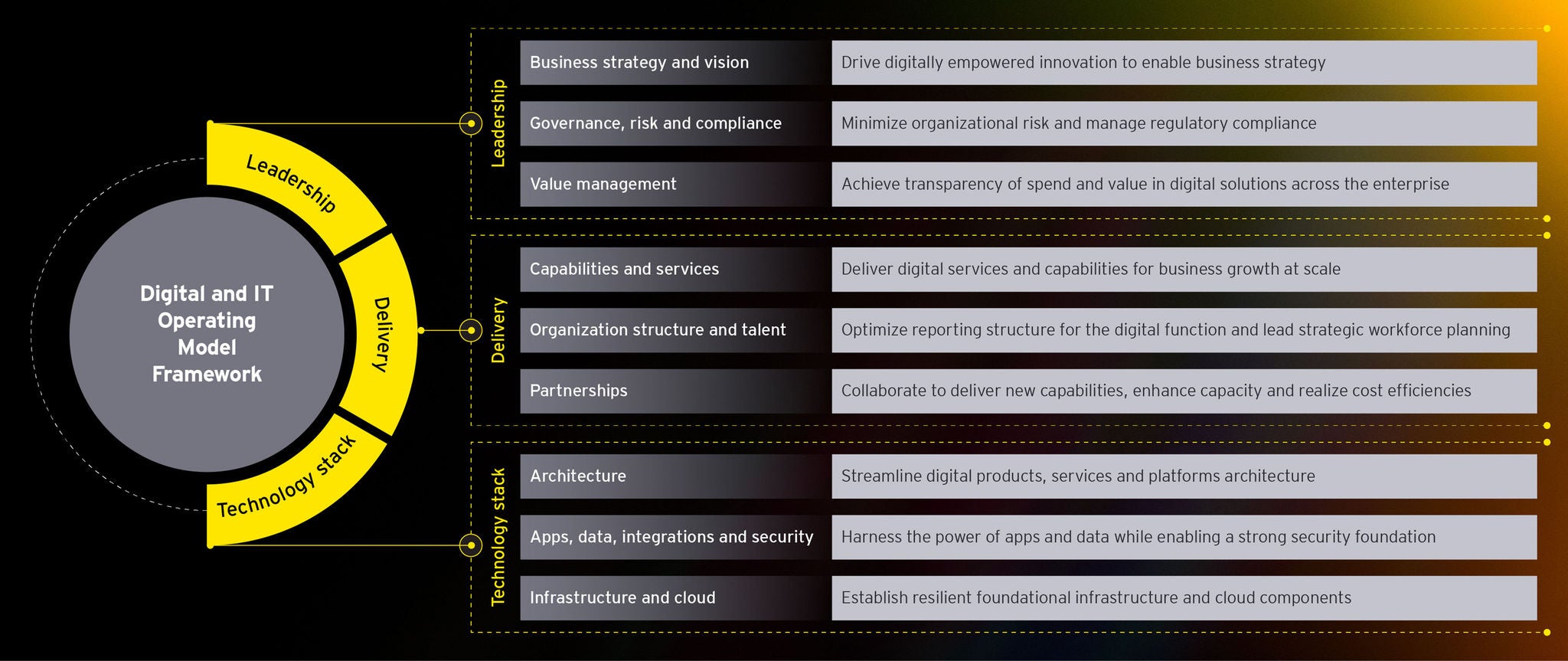
EY MENA conducted a structured comparison of digital and IT operating models across 10 oil and gas companies, including international oil companies (IOCs) and national oil companies (NOCs). Using EY MENA’s digital and IT operating model framework, the team assessed how organizations allocate decision rights, funding, delivery responsibility, governance, and technology ownership. The assessment focused on different levels of centralization, ranging from decentralized and centralized models to hub‑and‑spoke structures. Given its prevalence, the hub-and-spoke model was analyzed in greater depth. Companies were mapped against three common hub-and-spoke variants. These variants range from “thick hub” configurations with strong central control to models that empower business-led spokes within defined guardrails.

Digital-IT operating models graphic

Hub-and-spoke as the dominant model across oil and gas


Across the companies analyzed, hub-and-spoke emerged as the most prevalent operating model. Even organizations historically positioned at the extremes — fully centralized or highly decentralized — are actively moving toward hybrid structures.


Fully centralized and fully decentralized models increasingly reveal their limits. Centralized structures struggle to scale innovation where local context matters. Meanwhile, decentralized models drive duplication, rising costs and inconsistent adoption of emerging technologies.


The appeal of hub-and-spoke is pragmatic and it balances scale with responsiveness. Central teams establish enterprise standards, shared platforms, architecture and governance, while business units retain ownership of prioritization and value delivery. This enables organizations to industrialize digital capabilities without disconnecting them from operational realities.


In IOCs, strategy, architecture and core platforms are typically set centrally, while budgets and outcomes sit with business units. NOCs leverage thick hubs to ensure digital investments directly align with national energy mandates and enterprise-wide scale. In all cases, the direction of travel is clear — away from pure models, toward managed hybrid models .


Increasingly, this structure is evolving into a “hub, spokes and agents” construct. The hub owns shared data and AI platforms, governance, and reusable components. The spokes own business outcomes and compose solutions. AI agents act as a horizontal “digital workforce,” automating routine delivery so our teams can shift from execution to high-value strategic decision-making.


Operating model maturity mirrors IT maturity


A second clear pattern is the relationship between IT maturity and operating model. Organizations with higher digital and IT maturity tend to adopt more structured hub-and-spoke designs, supported by clear governance, shared platforms, and repeatable delivery mechanisms.


In these organizations, the hub plays a critical enabling role, providing common data foundations, reusable components, security and architectural coherence, while spokes focus on business-specific innovation and execution. Crucially, maturity is not limited to platforms and governance. Leading companies also embed product, data and AI literacy within the business. This enables spokes to own outcomes, make informed trade-offs and scale value responsibly — particularly as AI agents become embedded in day-to-day delivery.Organizations with lower digital or IT maturity can sometimes struggle to make hub-and-spoke work in practice. In companies where governance is weak or platforms are immature, the model can lead to confusion rather than coordination. As a result, operating model design and capability maturity must progress together.

Scaling AI in oil and gas starts with the right operating model

Turn AI ambition into enterprise impact. Connect with our oil and gas professionals to shape an operating model that speeds decisions, strengthens governance, and scales adoption.

Design reflects business context, not ideology


Finally, there is no single right hub-and-spoke configuration. Leading oil and gas companies’ design choices reflect business complexity, legacy, regulatory context, and leadership philosophy.


Some organizations favor a thick hub. They focus on governance, platforms and delivery to reduce technical debt, lower total cost of ownership and enable enterprise-wide transformation such as enterprise resource planning (ERP) consolidation. Others adopt more balanced configurations, using guardrails to preserve speed while maximizing reuse. Companies with highly autonomous business units or distinct profit and loss (P&L) cultures often empower thick spokes, enabling rapid, localized digital and AI execution within a clear enterprise framework.


These choices increasingly reflect a broader shift in how value is delivered. The model is moving from “IT delivers for the business” to “the business delivers on shared platforms, augmented by AI.” In this construct, IT focuses on platform ownership, architecture and risk governance, while delivery capacity sits closer to operations and value creation.


What matters most is coherence: clarity on roles, decision rights and accountability rather than the label attached to the model.


Evolving the operating model in practice


Translating these principles into action requires a deliberate, staged approach. While there is no single blueprint, successful organizations tend to follow a set of consistent shifts.


First, leadership teams clarify where value is expected to come from by framing digital and AI investments around products and value streams, with explicit business ownership of outcomes. Without this clarity, structural changes rarely deliver impact.


Second, the hub must function as a true platform enabler — consolidating core data and AI foundations, setting architectural guardrails and strengthening governance for security and reuse. The aim is not to centralize delivery, but to enable the spokes to scale safely and efficiently.


Third, decision rights and funding models need to align with product-based delivery. Clearer prioritization authority, product-centric funding and shorter investment cycles help move the constraint from approval processes to value realization.


Fourth, organizations must build products, data and AI literacy across the business. Spokes cannot truly own outcomes without a baseline shift in digital fluency; literacy is a hard requirement for this model to scale.


Finally, the operating model should evolve over time. Early gains often come from targeted changes in priority areas, with governance and platforms maturing in parallel as digital and AI capabilities scale.


From digital ambition to scalable value


Choosing the right digital and IT operating model is now central to turning digital ambition into sustained business value. As investments rise, legacy structures are increasingly exposed as bottlenecks. Oil and gas companies can draw on learning from their leading industry peers and align their choices with their own business context and maturity. The goal is not to copy a model, but to deliberately design and evolve one that fits your business context and maturity.


Looking ahead, this will matter even more. As agentic AI becomes embedded in operations, operating models — not just architectures — will determine how human expertise, automation and accountability scale together across the enterprise.

Summary 

Oil and gas companies are investing heavily in digital and AI, yet many struggle to scale value beyond pilots. The primary constraint is no longer technology, but operating model design. Benchmarking across peers shows a clear shift toward hub and spoke models that balance enterprise scale with business ownership. As AI accelerates delivery and expands execution capacity, success increasingly depends on clear decision rights, product centric funding and strong shared platforms. In the agentic era, operating models become the mechanism that determines how effectively people, platforms and AI work together to deliver sustained business impact.

Related articles

How the productivity reset will redefine value

Discover how AI and megatrends will transform productivity, drive new value measures, smarter strategies, and human-machine collaboration.

How GenAI and complexity challenge assumptions and business models

GenAI is reshaping business landscapes; companies need to adapt their models and innovate to harness its full disruptive potential. Learn more.

How artificial intelligence can unlock a new future for infrastructure

To unlock the value of AI and truly transform the infrastructure sector, it must adopt a new mindset, skillset, toolset. Find out how in EY’s new report.

About this article

Contributors