






Business people having a meeting in office with laptop and architectural models

How to transform record-to-report to drive strategic value

A continuous close approach can elevate the finance function from a custodian of compliance to a true value creator.  


In brief

  • Traditional record-to-report processes force finance teams to spend more time validating data than generating insights, creating a reactive operating model. 
  • Continuous close provides real-time insights that enable faster and more informed decision-making, more accurate forecasts and more agile planning. 
  • For it to be effective, companies must address key issues, such as treating the close as an end-to-end process and designing an integrated digital ecosystem.

It’s the last day of the month and the finance team is swamped with spreadsheets, chasing down reconciliations and waiting for various systems to provide numbers. The clock is ticking and the business is pressing for insights that it’s not ready to provide. For decades, this has been the reality of record-to-report (R2R) processes. Given that they lead to last-mile reporting to stakeholders, they are driven by compliance, requiring additional checks and balances that may hinder the agility of the close process. But in today’s environment where markets shift overnight and decisions cannot wait, traditional R2R processes may be holding the finance function back. The question is this: What if you could close the books without losing sight of deriving valuable insights that matter? 

The issue with “business as usual” 

While some finance leaders may perceive their current close process to be smooth and efficient, they should question if it is indeed keeping pace with the rest of the organization and their industry peers. In today’s dynamic environment, speed and agility are as critical as accuracy. 

Traditional R2R processes remain heavily manual, fragmented and concentrated at the end of the period. As a result, finance teams spend more time validating data than generating insights — often producing reports that are already outdated by the time they are published. This creates a reactive operating model. Issues such as cash flow gaps, working capital inefficiencies or reporting discrepancies often surface too late, forcing teams into firefighting mode under tight timelines.  

The breakthrough: continuous close 

High-performing finance teams embed financial activities throughout the reporting cycle through a continuous-close approach. Continuous close provides real-time visibility of performance, enabling CFOs and other business leaders to access up-to-date financial data anytime and make faster, more informed decisions. Additionally, with real-time insights, organizations can refine forecasts dynamically, significantly improving accuracy and enabling more agile and responsive planning. 

This shift is not just about speed; it is also about intelligence. Continuous close enables the finance team to move from reporting history to predicting the future, positioning the organization to respond quickly to market changes and seize opportunities as they arise. 

Moving to real-time R2R processes is not just about adding new tools but also about fundamentally rethinking the finance operating model. To do so effectively, organizations should consider four essential areas: treating the close as an end-to-end process, global process governance, an integrated digital ecosystem, and effective AI integration. 


Continuous close enables finance to shift from reporting on the past to anticipating what’s next so that the organization can respond quickly to market shifts and seize new opportunities.


Treating the close as an end-to-end process 

Continuous close cannot be achieved by simply accelerating month-end activities — it requires fundamentally reshaping when and how finance tasks are completed. High-performing finance teams recognize that the traditional last-mile close is not a timing issue but a structural one. By treating the close as an end-to-end process rather than individual tasks, finance teams can uncover hidden interdependencies, bottlenecks and inefficiencies that constrain performance. 

Effective transformation is not about accelerating effort but about focusing on the right work at the right time. High-performing finance functions differentiate between value-adding activities and those that can be simplified, automated or eliminated — actively rebalancing workloads by moving tasks into the early- and mid-reporting periods. They also prioritize early data readiness so that critical inputs are complete and accurate well before the end of the period. This shift helps reduce reliance on last-minute interventions and enables a more predictable, insight-driven close. 

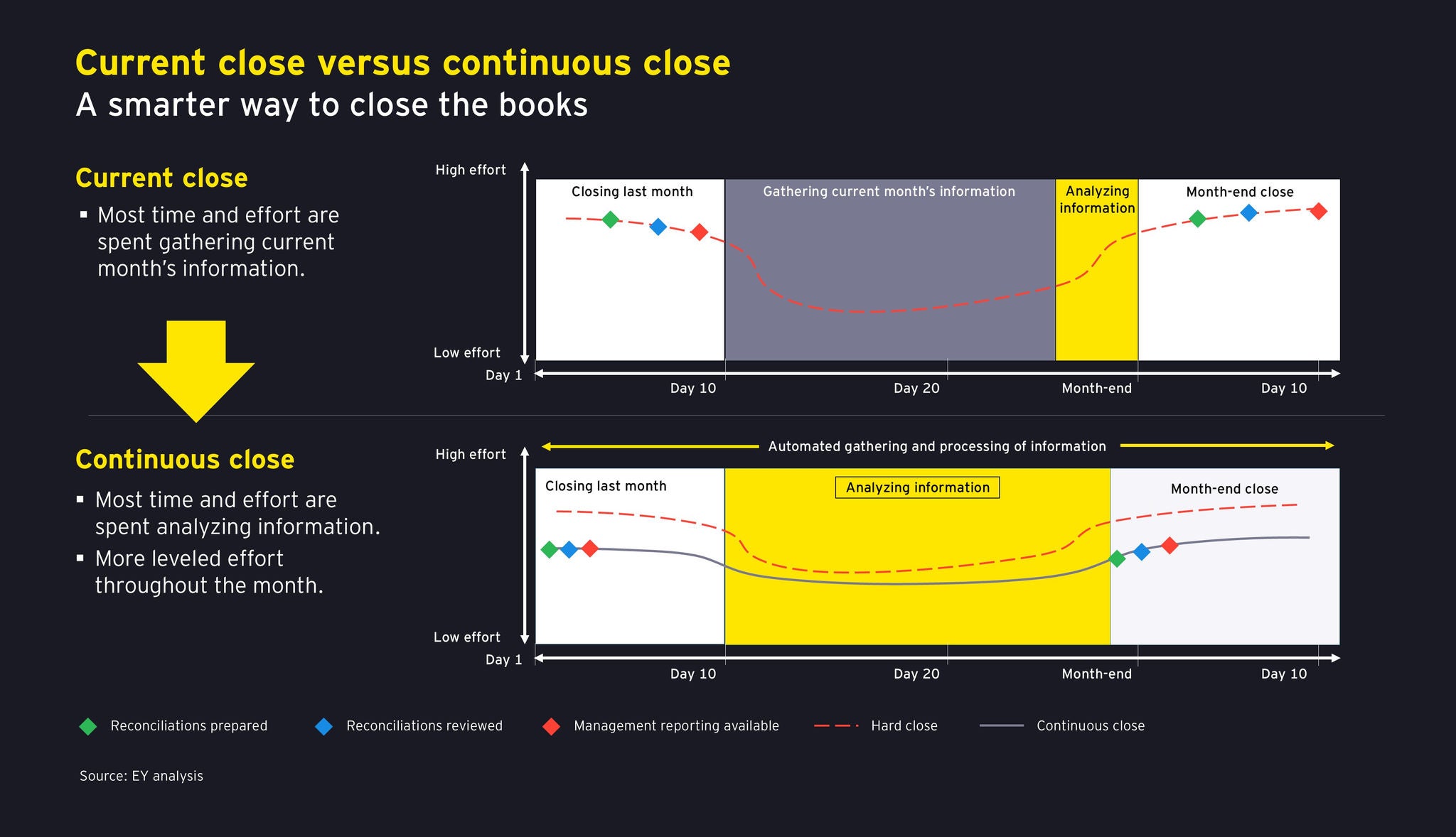
Evidently, moving from the traditional “close-driven” mindset to an always-on finance model where insights are continuously generated rather than retrospectively assembled is critical in driving organizational success. This shift will also distribute efforts more evenly across the reporting cycle. 

Current close versus continuous close

Building a unified finance framework through global process governance 

Fragmented processes across regions and business units remain one of the most significant barriers to real-time finance. Without consistent recording, validating and reporting of transactions, organizations will struggle to achieve both speed and accuracy at scale. 


Establishing global process governance is therefore a foundational step in R2R transformation. This involves defining clear end-to-end process ownership, with designated leaders responsible for driving standardization, enforcing controls and continuously improving performance. Supported by a unified data model and harmonized policies, this approach leads to consistent data quality, clear accountability and streamlined workflows across the enterprise. 


Beyond operational efficiency, strong governance helps enhance transparency and comparability — allowing finance leaders to trust their data, benchmark performance and make decisions with confidence. In this context, governance becomes not just a control mechanism but also a critical enabler of speed, scalability and insights.

Designing an integrated digital ecosystem  

Technology plays a critical role in enabling real-time R2R, but its value can often be undermined when organizations adopt a fragmented approach to digital investments. Implementing multiple disconnected solutions can reinforce silos and introduce additional complexity, limiting the impact of transformation efforts. 

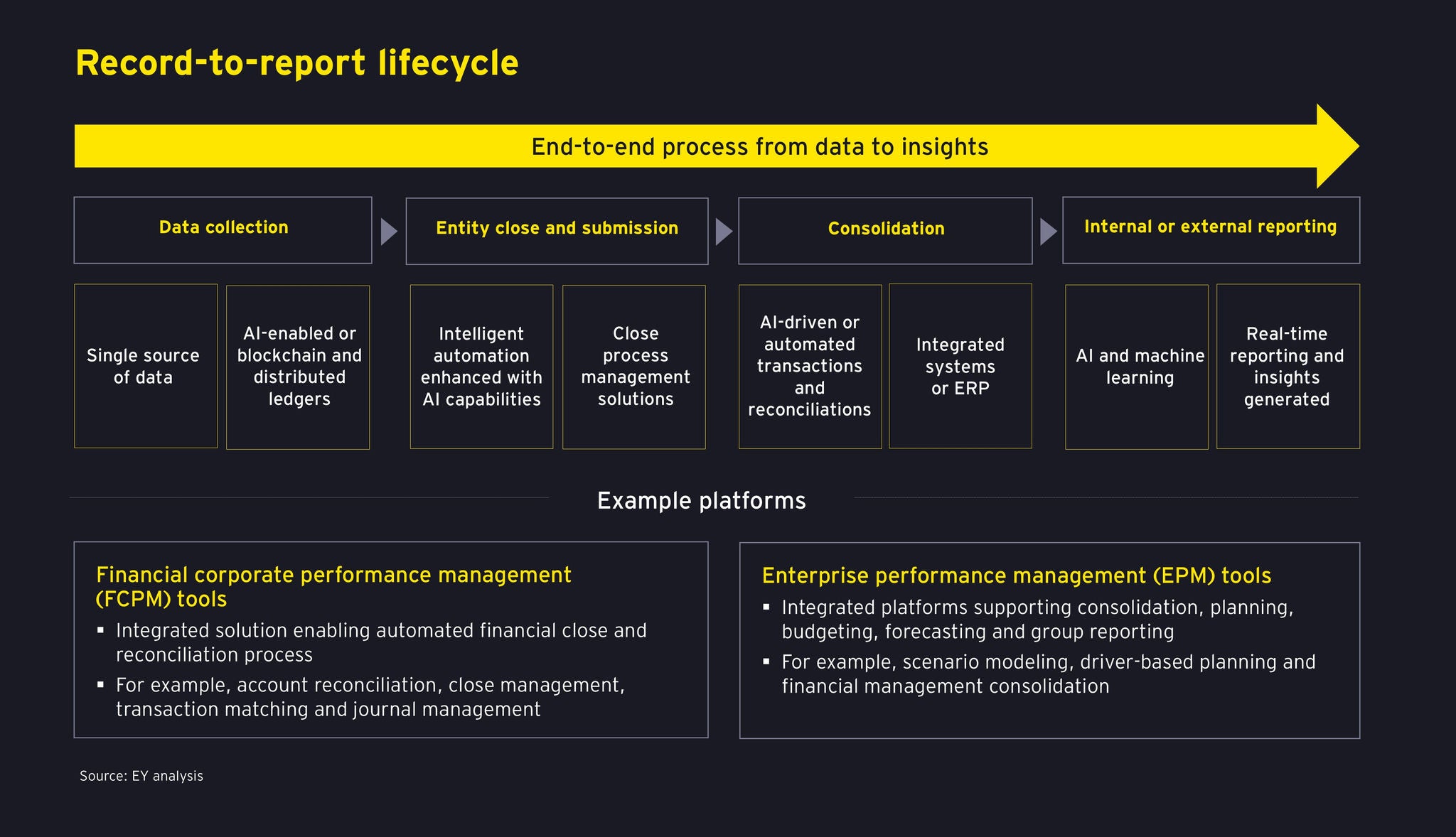
A more effective approach is to design an integrated, platform-led digital ecosystem. By connecting enterprise resource planning, performance management and operational systems within a unified architecture, organizations can enable seamless data flows, reduce manual intervention and create a single source of truth. This not only accelerates processes such as reconciliations, journal entries and intercompany eliminations but also provides real-time visibility into financial performance and the close status. 

Record-to-report lifecycle

Achieving this goes beyond deploying new tools — it demands disciplined architecture design, strong data governance and a commitment to simplifying the technology landscape. When executed effectively, this approach can enable finance processes to operate with little friction, transforming speed and insights across the organization. 

Effectively integrating AI into the operating model

AI has the potential to redefine the role of finance, but its impact depends on how effectively it is embedded within the operating model. Treating AI capabilities as standalone technology initiatives often results in isolated use cases with limited business value. 

AI introduces continuous monitoring capabilities into the close. Anomaly detection tools can proactively flag unusual transactions, account movements or inconsistencies as they occur, rather than at the end of the period. This allows issues to be investigated and resolved earlier in the cycle, reducing last-minute surprises and strengthening overall financial integrity. 

When implemented effectively, AI will not replace existing financial controls. Instead, it reinforces them by enhancing auditability, improving transparency and building greater confidence in reported outcomes. In doing so, AI plays a critical role in enabling continuous close and advancing finance toward a more agile, real-time operating model.  

The payoff: from scorekeeper to strategist  

Moving to continuous close is not a simple technology upgrade — it is a holistic transformation of how finance operates and what it can deliver to the business. Leadership commitment, process discipline and a willingness to embrace change are crucial for its success. 

When finance runs in real time, finance leaders’ roles change dramatically. No longer merely a custodian of compliance, finance leaders will become a true value creator — shaping strategy, driving transformation and influencing outcomes across the enterprise. 

Summary

Traditional R2R processes are very manual, fragmented and concentrated at the end of the period, resulting in a reactive operating model. Continuous close is a shift to an always-on finance model that enables faster and more informed decision-making, more accurate forecasts and more agile planning. For this to be effective, treating the close as an end-to-end process, global process governance, an integrated digital ecosystem and effective AI integration are crucial.

Related articles

How the chart of accounts shapes the future of reporting

A fundamental rethink of the chart of accounts is crucial as stakeholders demand a clearer, more connected narrative of performance. Learn more.

Will the future of finance be shaped by talent or technology?

EY research shows CFOs should align technology, talent and leadership to close the gap between ambition and value creation.

How can treasurers transform to realize new value in a world of uncertainty?

The EY DNA of the Treasurer Survey provides insights for treasurers and senior finance leaders looking to drive success. Learn more.

About this article