


EY refers to the global organization, and may refer to one or more, of the member firms of Ernst & Young Global Limited, each of which is a separate legal entity. Ernst & Young Global Limited, a UK company limited by guarantee, does not provide services to clients.
Recent Searches

Discover how African businesses can thrive amid global volatility by integrating sustainability and leveraging innovative strategies.
In brief
- How can African businesses navigate the evolving global environmental landscape and ensure sustainability amid policy fluctuations?
- What strategies can companies adopt to integrate sustainability into their core operations and drive long-term value?
- How can embracing sustainability help African businesses mitigate risks and seize growth opportunities in a volatile world?
The global environmental landscape is facing increased uncertainty due to shifting US policies, potentially impacting crucial funding and collaborative efforts. How can Africa navigate this evolving environment and ensure a sustainable future despite global policy fluctuations?
The recent Chartered Institute of Logistics & Transportation SA’s (CILTSA) conference, held in Johannesburg provided a crucial local platform to assess and address the integration of environmental, social, and governance (ESG) principles within the transport, logistics, and supply chain sectors.
A shifting global landscape
The world is currently in a state of constant change – a NAVI world, increasingly nonlinear, accelerated, volatile and interconnected. Things are moving fast. In 2021 just 1% of global executives were surprised by political risk events or their impacts “most or all of the time” according to data from EY-Parthenon Geostrategy in Practice surveys. In 2025, this number exploded to 35%.
Uncertainty demands action. While CEOs agree they need to rethink their approach to transformation for sustainability, the majority have yet to make changes as highlighted in the January 2025 EY-Parthenon CEO Outlook survey.
European businesses can’t avoid sustainability
New research from EY shows that those who embed sustainability into their overall business strategy enjoy better business outcomes than those who treat it as a silo, with 40% more confidence in their 12-month business outlook, while boards are 1.5 times more effective in achieving sustainability objectives. As positive results emerge, the heat is on; board and management of European companies are facing pressure from stakeholders to focus on sustainability issues:
80% of investors |
39% of European companies |
91% of European companies |
|---|---|---|
|
Say companies are failing to articulate the rational for long-term sustainability investments. |
Say their reputation has been damaged by a backlash for falling short on sustainability standards. |
Feel pressure from investors to become more sustainable. |
What can be done to embed sustainability into your business?
The sustainability transition is no longer a choice or a “nice to have”, it is a business imperative. Companies that prioritise sustainability are not only ensuring their long-term viability but are also responding to the demands of their stakeholders, their customers, and, crucially, our planet. Organisations that prioritise sustainability are 1.8 times more likely to report higher-than expected financial value from their initiatives according to EY's Sustainable Value Study. Start by ensuring that board and management are aligned on how to integrate sustainability into the overall business strategy, making sure every function understands its commercial benefits. Encourage integration by getting the right finance in place and invest in technology programmes that support delivery of the integrated strategy.
How do CEOs chart a path to growth when the map keeps changing?
Agility is key, especially as the M&A environment is increasingly impacted by tariffs and shifting trade dynamics. While deal-making appetite remains strong, heightened global uncertainty calls for more strategic timing and careful decision-making. In response, leading companies should explore domestic sourcing and rebuild local supply networks. They could mitigate potential impact by accelerating innovation in product design and materials to lessen dependency on tariffed goods and should focus on driving operational efficiencies to offset additional costs. These are among the top approaches to adopt when navigating current challenges to position themselves for future opportunities.
New approaches to transformation are vital
Consider logistics operations. Transportation often accounts for 62,5% of total logistics costs, playing a pivotal role in overall business success[1]. Global volatility has placed immense pressure on logistics due to volatile fuel prices, mismatched capacity and demand, and increasing delivery service expectations. Market complexities and regulatory pressures are driving companies to re-evaluate capabilities, making it crucial for logistics teams to strike a balance between cost management and service quality. The key to overcoming these hurdles lies in a business-driven, technology-enabled strategy that leverages data insights.
Transport-mation, not just a response to disruption
EY’s end-to-end approach reimagines transportation management to unlock long-term value and operational excellence, known as ‘transport-mation.’ It creates an opportunity to redesign the future of logistics, ensuring resilience, agility, and enduring value for businesses ready to embrace change by focusing on projects that deliver immediate, measurable value. When organisations apply this to transportation, studies by EY show operational improvements of 10–15%, resulting in enhanced performance and a distinct competitive edge.
The great automotive value shift
Moving on to an area where strategies are having to be reframed due to great shifts in the automative value chain - away from traditional sources towards emerging technology value pools. Three primary mega-pools related to electrification, software-defined vehicles, and circularity have been identified by EY analysis as representing the greatest growth opportunities. Mobility ecosystem players are now required to manage current operations while innovating for tomorrow’s business in these emerging growth areas.
Mining and metals companies – risks and opportunities
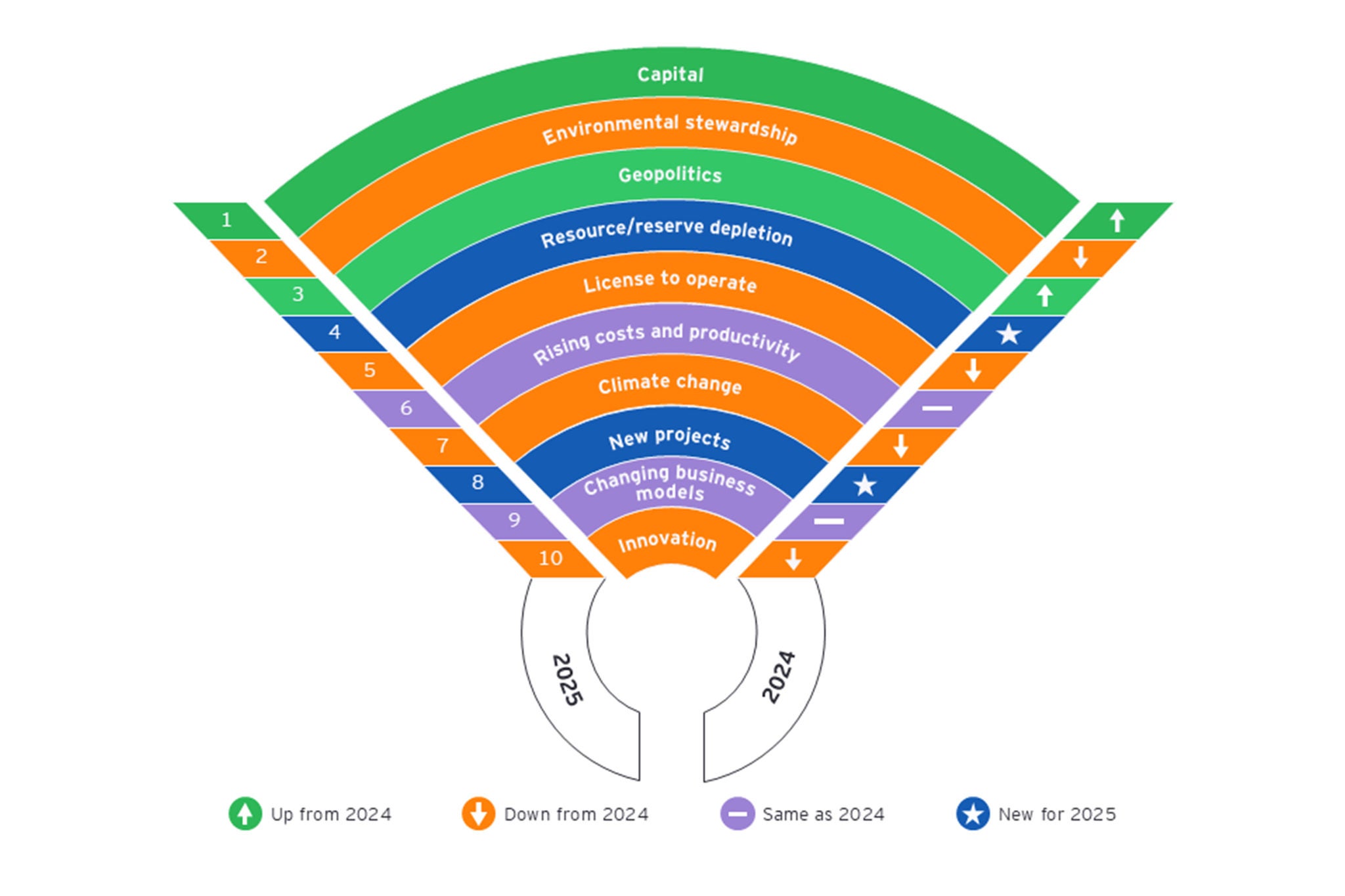
Capital remains the No.1 risk for mining companies as they balance growth and capital discipline to meet the soaring demand for energy transition minerals. Environmental stewardship is at No. 2 with a laser focus on waste management, water conservation, and achieving nature-positive outcomes. The challenge of resource and reserve depletion debuts at No.4, driven by soaring demand, rising exploration costs, and a lack of new discoveries.
[1] 2024 CSMP State of Logistics Report
Top 10 Business risks and opportunities
Decarbonisation – an investment, not a cost
How can slowing climate change accelerate your financial performance?
Companies still view decarbonisation as costly, but in reality, it is driving positive financial impacts with 69% having achieved higher than expected financial value from their climate actions. The world needs a 45% reduction in emissions by 2030 to achieve net zero by 2050 and keep the 1.5-degree scenario on track. With the current trajectory, these goals will not be met. To achieve what seems like insurmountable goals companies should simplify the challenge and clarify expectations, treat regulations as opportunities to advance climate initiatives, integrate decarbonisation into investment decision tools for long-term value, and simplify reporting to stakeholders. Finally, think like an owner, where everyone is aligned and feels responsible for progress.
Rethinking disruption
While it’s true that the reduction or withdrawal of US engagement could pose significant risks to ongoing projects, it also compels African leaders and stakeholders to reassess strategies and seek fresh avenues for partnership and funding. Drawing on lessons from previous episodes of US withdrawal, African stakeholders need to focus on building relationships with a broader spectrum of international partners including Europe and Asia to diversify funding streams.
Africa’s evolving FDI landscape
Foreign direct investment (FDI) in Africa continued to recover by 7% year-on-year in 2023, with significant investment in renewable energy, software & IT services, and business service sectors. Notably, regions like North and West Africa, as well as Egypt, South Africa, and Nigeria displayed strong investment appeal. The continent aligns with global priorities in sustainability, economic resilience, and financial inclusion with an emphasis on green investment, industrial diversification and fintech growth offering a solid foundation for sustained, inclusive development. Abundant natural resources—especially solar, wind, and hydropower - have been a major draw for capital inflows, while investment activity has diversified across a wide range of industries. Notably a youthful, tech-savvy population and an expanding digital infrastructure, position Africa as a key global player in renewable energy, technology, and services.
What if disruption is seen as a catalyst for innovation and progress – a chance, not a challenge? By reframing the narrative, Africa has the potential to not only mitigate risks but build greater resilience and autonomy on its sustainability journey.
Summary
In conclusion, navigating the global environmental landscape's uncertainties requires proactive strategies and innovative approaches. African businesses must integrate sustainability into their core strategies, leveraging technology and data insights to drive transformation. By focusing on resilience, agility, and long-term value, companies can not only mitigate risks but also seize opportunities for growth. Embracing sustainability is not just a response to global volatility but a strategic imperative that ensures business viability and contributes to a sustainable future for the continent.