





EY refers to the global organization, and may refer to one or more, of the member firms of Ernst & Young Global Limited, each of which is a separate legal entity. Ernst & Young Global Limited, a UK company limited by guarantee, does not provide services to clients.
Recent Searches

For two decades, private equity has expanded with near inevitability, buoyed by cheap capital, rising valuations and an ever-growing universe of managers convinced there was always room for one more fund. As we move into the second half of 2026, the industry stands at a turning point, driven not by a single shock, but by a gradual shift in the fundamentals that once supported its growth.

We now face the emergence of a more selective market environment where capital increasingly concentrates around the strongest platforms, while a broader cohort of asset managers face a more gradual, and at times, prolonged pathway to securing new mandates.
But what does this evolving reality mean for the asset class, managers and investors who must navigate it?
This is not a downturn but a structural reset. Scale and discipline will define the next winners.
Laurent Capolaghi
EY Luxembourg Partner, Private Equity Leader, Managed Services Leader
A tougher, more selective market
Fundraising: a market splitting in two
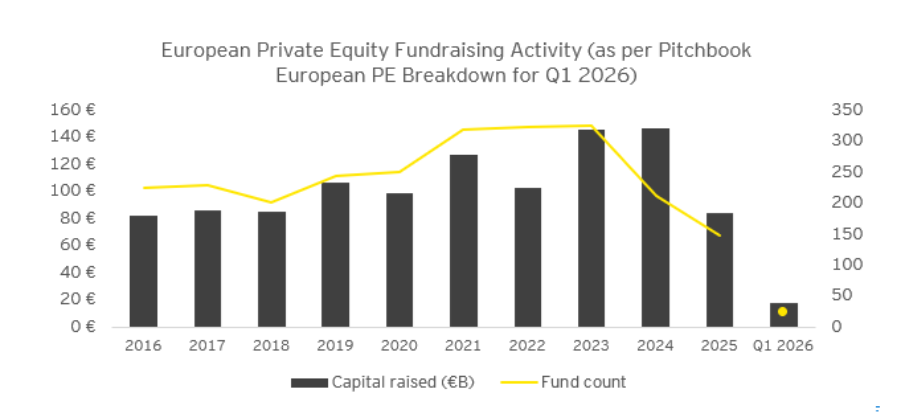
The private capital ecosystem has expanded to more than 15,000 firms, reflecting the sustained attractiveness and depth of the asset class. Yet, in the current environment, fundraising outcomes have become more differentiated, with only a subset of managers raising meaningful funds in the latest cycle. Established platforms continue to raise capital at scale, while smaller and less differentiated managers face growing pressure. What initially appeared to be post-pandemic inertia is increasingly revealing a shift toward greater selectivity and discipline in how capital is allocated. Fundraising reflects this broader shift toward a more disciplined environment in Europe. In Q1 2026, just 23 funds reached final close in Europe, raising approximately €18 billion, pointing to a slower start to the year.
The industry is entering a more transitional phase, shaped by gradual shifts in its underlying fundamentals rather than a single defining event.
Sonia Michel
EY Luxembourg Private Equity Supervising Associate
Deals: momentum meets caution
European private equity entered 2026 with the momentum of a strong second half in 2025, only for that trajectory to be abruptly tested. Deal activity slowed sharply in Q1, with aggregate value falling by 22.5 per cent, quarter on quarter, as geopolitical tensions triggered a broader shift toward caution. Despite the slowdown, scale remains a defining feature of the market. As per Pitchbook, megadeals accounted for 37.7 per cent of total deal value – the highest concentration since 2022 – reflecting transactions largely initiated before the recent deterioration in market conditions. The result is a market that continues to transact, but on more selective and defensive terms.
Exits: recovery at the top only
In Europe, exit activity weakened in Q1 2026, with total value declining 9.5 per cent and volumes falling more sharply, pointing to a fragile recovery in liquidity. That liquidity remains highly concentrated. Just 16 mega-exits accounted for 67.9 per cent of total exit value, underlining a market where large-cap transactions are driving activity while the mid-market struggles to regain momentum. The composition of exits tells a deeper story. Sponsor-to-sponsor transactions represented 76.1 per cent of total value, as IPOs remain effectively closed and corporate buyers have stepped back. For now, private equity is largely dependent on itself to generate liquidity- supporting deal flow, but raising questions over valuation depth and price discovery. *
So who stands to win and who is at risk of being left behind?
The new General Partner (GP) hierarchy
The shifting dynamics are polarizing GPs into three distinct groups with markedly different prospects:
If standing still is no longer an option, what does adaptation actually look like?
GPs are adapting to a new reality
The GP landscape itself is consolidating. This is perhaps the most consequential structural shift underway. The logic is straightforward: in a market where fundraising has fallen for four consecutive years and LPs are concentrating capital with fewer partners, scale has become a survival requirement. Funds below $500 million now capture just 13 per cent of total fundraising, down from 17 per cent five years ago.
The result is a Darwinian sorting process. Large, diversified platforms are absorbing specialist teams, buying distribution networks, and adding asset classes. Mid-market firms face a choice: differentiate sharply by sector or geography, merge into a larger platform, or face a slow fade. The first-time fund has become an endangered species.
A broader investor base through retailization
The investor base will broaden through “retailization”. Private equity is no longer just for institutions. Across the EU, the ELTIF 2.0 framework is opening private markets to a far wider pool of investors for the first time. According to ESMA, 191 of the 300 ELTIFs are marketed to retail. Luxembourg dominates this emerging landscape, hosting 54 per cent of all European ELTIFs, with more than 162 vehicles registered by April 2026.
With traditional LPs constrained by weak distributions and large undrawn commitments, sponsors are increasingly looking to retail and pension capital as a complementary source of funding.
Tax has become a lever in how funds are structured and capital is deployed.
Christophe Joosen
EY Luxembourg Partner, Private Equity Leader in Tax
Sectors where conviction capital is flowing
European defense spending is rising rapidly, driven by the geopolitical situation and the push for strategic autonomy. Digital infrastructure is the other dominant theme. Private equity has invested over $1 trillion in technology since 2020, including $200 billion in data centers and energy systems. The convergence of physical and digital infrastructure is increasingly viewed as the defining investment theme of the coming decade.
AI in venture capital: dominance with downside risk
According to PitchBook, AI accounts for around 60 per cent of European VC deal value in 2026 to date, confirming its dominant position within the ecosystem. However, current AI valuations echo previous technology cycles, suggesting that any correction could have ripple effects well beyond venture capital.
Value creation moves back to the center
With multiple expansion largely gone for the foreseeable future, the only durable way to generate returns is to grow earnings. Buy-and-build strategies are attracting rapidly growing interest, especially in professional and industrial services. Sponsors that arrive at the deal table with a pre-vetted operational plan will win. Those without one will increasingly struggle to raise their next fund.
Continuation vehicles: no longer an exception
Continuation vehicles are becoming a permanent feature of the exit landscape. When sponsors cannot sell and will not IPO, they increasingly roll their best assets into a new vehicle, offering existing LPs the option to cash out while retaining upside for those willing to stay invested. The logic is compelling when holding periods average seven years and traditional exits remain constrained. But the structure places the GP on both sides of the transaction, and governance expectations – independent valuations, transparent processes, and robust LP consent – are rising accordingly.
In a more selective market, transparency and robustness in financial reporting are no longer optional, they are decisive
Marie-Laure Mounguia
EY Luxembourg Partner, Private Equity Leader in Assurance
Conclusion
The coming decade will be one of consolidation, not of decline. Private equity is moving into a phase where capital will increasingly favor firms with clarity, capability and conviction.
This recalibration is not a threat but a maturation, a shift that should strengthen the asset class’s long-term resilience. For both GPs and LPs, the imperative is to anticipate the shift, and to position thoughtfully for the next cycle of growth.
Summary
For two decades, private equity has expanded with near inevitability, buoyed by cheap capital, rising valuations and an ever-growing universe of managers convinced there was always room for one more fund.
Related articles
Family offices evolving into professional private equity investors
In recent years, Family Offices have undergone a profound transformation in the way they allocate capital, manage risk and pursue long‑term value creation. Once discreet and conservative structures focused primarily on safeguarding wealth, they have now emerged as strategic and influential actors within private markets.
Luxembourg: the new command center for private equity value creation
Long seen as a fund domicile, Luxembourg has evolved into Europe’s operational command center for value creation and is becoming the place where that transformation is engineered, monitored, and proven.
Private equity vehicles in Luxembourg: the rise of fund of funds
Private equity (PE) fund of funds (FoFs) structures have long been instrumental in democratizing access to diverse, institutional-grade private equity portfolios. Luxembourg has emerged as a leading domicile for FoF vehicles, driven by its regulatory sophistication, distribution reach, and investor-friendly structuring options.