





EY refers to the global organization, and may refer to one or more, of the member firms of Ernst & Young Global Limited, each of which is a separate legal entity. Ernst & Young Global Limited, a UK company limited by guarantee, does not provide services to clients.
Recent Searches

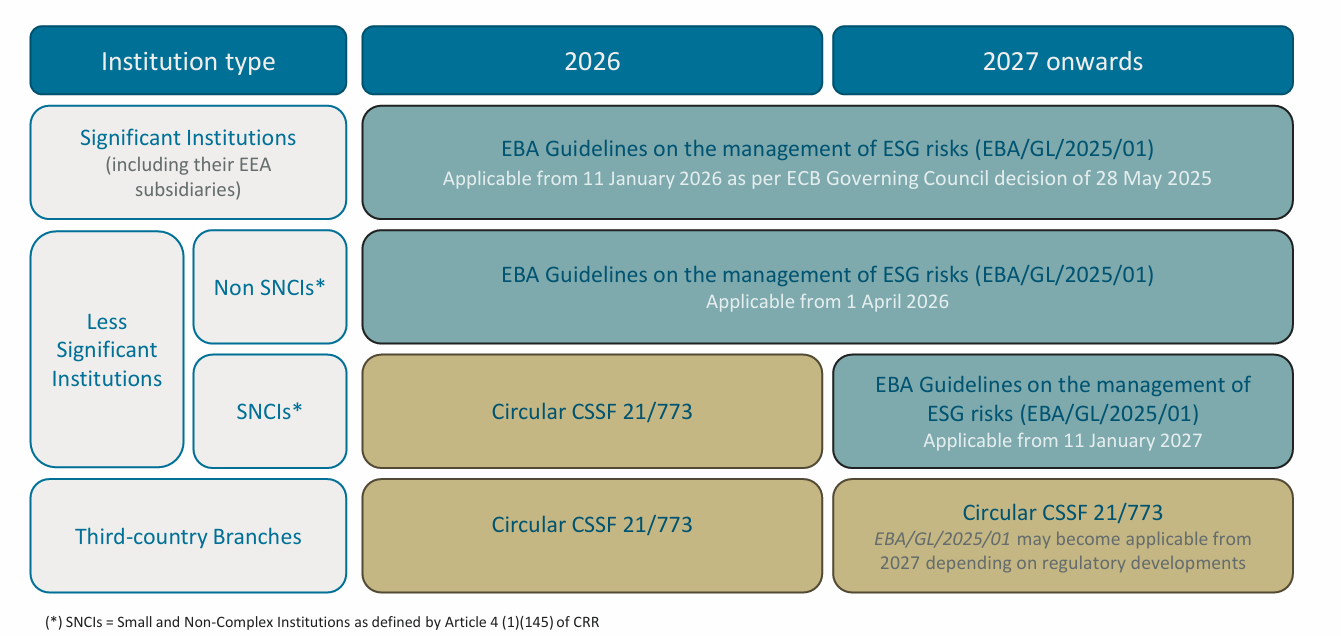
In January 2026, the CSSF reinforced Luxembourg’s sustainable‑finance regulatory framework by issuing Circular 26/905, which formally applies the EBA Guidelines on the management of ESG risks into Luxembourg framework. The Circular applies to all credit institutions designated as Less Significant Institutions under the Single Supervisory Mechanism. Small and non-complex institutions (SNCIs) as well as other non-large institutions may apply the proportionality provisions, where appropriate, allowing them to implement less complex or sophisticated arrangements.
Application timeline
What does the circular require?
Circular 26/905 introduces requirements regarding:
- ESG risk identification processes Methodologies to measure and monitor ESG risks, including physical and transition risks
- Internal governance arrangements that embed ESG considerations into strategy, risk appetite, and internal controls
- Prudential Transition Plans to address risks associated with the shift toward an EU climate‑neutral economy
Overview of Circular’s requirements
Identification and measurement of ESG risks
Circular 26/905 draws sets out a structured and standardized methodology that institutions must use to identify, assess, and measure ESG risks in a consistent and forward‑looking way. This methodology covers the materiality assessment, general principles, data processes and main features of the reference methodology (such as which essential transition and physical risk drivers, data points to collect and which combination of exposure-based methods, sector-based, portfolio-based and portfolio alignment methods or scenario-based methods to develop ).
Minimum standards and reference methodology for the management and monitoring of ESG risks
Circular 26/905 sets out the minimum supervisory standards institutions must meet to ensure ESG risks are effectively managed, mitigated, and monitored throughout their risk management framework. It covers the ESG risk management principles, the strategies and business models, risk appetite, internal culture, capabilities and controls, internal capital adequacy assessment process and internal liquidity adequacy assessment process (ICAAP/ILAAP), policies and procedures for financial risk categories (including credit risk, market risk, liquidity and funding risk, operational and reputational risks, concentration risk), and monitoring.
Transition plans
Circular 26/905 requires institutions to develop prudential transition plans that address the financial risks caused by ESG factors, particularly those linked to the transition toward an EU climate‑neutral economy. These plans are forward‑looking, multi‑year strategies designed to ensure that institutions remain resilient as regulatory, market, and environmental conditions evolve. In this context, the Circular provide rules addressing the overarching principles, governance (e.g., roles and responsibilities, internal processes and capacity, data management), transition planning (scenarios and pathways, time horizons and milestones, materiality assessment basis, metrics), key contents of the plans, monitoring, review and update of the plans.
Proportionality principles
Circular 26/905 explicitly allows SNCIs and other nonlarge institutions to apply proportionate measures, meaning they may adopt simpler processes or less complex modelling approaches where appropriate. This ensures compliance without imposing undue burdens on smaller institutions
Recommendations
- Strengthen governance and oversight
- Address data and methodology gaps
- Prepare for supervisory dialogue
- Apply proportionality wisely (for SNCIs)
- Align ESG risk work with broader strategy
- Embed ESG risks into all existing risk management frameworks
- Upgrade ESG data and reporting capabilities
- Integrate ESG considerations into governance structures
- Enhance stress‑testing, scenario analysis, and transition‑risk modelling to include forward‑looking ESG risk drivers
Circular 26/905 sets out how Luxembourg institutions are expected to govern and manage ESG risks. Early movers will reduce compliance pressure and strengthen their long‑term resilience and market positioning. Institutions, in particular Less Significant Institutions, which must comply with the rules from April 2026 onwards, should begin implementation without delay to meet supervisory expectations and make full use of the strategic opportunities linked to developing a mature ESG risk management framework.
How EY can help
- Diagnostic & Maturity Assessment: impact assessment of the adopted CSSF Circular on ESG risks, market practices and trainings session to specify the requirements and supervisory expectations
- Governance and ESG risk integration: support in ESG risks identification and quantification, materiality assessment, integration in ERM framework, definition of governance, internal processes, policies and controls, setting up of the monitoring framework
- Prudential transition plan development: definition of short-, mid-, long-term goals, climate modelling and scenario analysis, client engagement approaches, alignment with other regulatory requirements
- Reporting & Disclosure: integration in ICAAP/ILAAP and Pillar III reports, preparation of disclosures, documentation of methodologies and assumptions
Summary
In January 2026, the CSSF reinforced Luxembourg’s sustainable‑finance regulatory framework by issuing Circular 26/905, which formally applies the EBA Guidelines on the management of ESG risks into Luxembourg framework.
Related articles
What CSSF’s sustainable finance priorities mean for Luxembourg firms
CSSF will continue supervising sustainability-related disclosure obligations in scope of SFDR, Pillar 3 and related reporting.
Why should financial institutions be on a mission to reduce emissions?
Accelerating decarbonization is urgent. Learn why private sector institutions must play a key role in addressing the current shortfalls in climate finance.
Sustainable Finance Disclosure Regulation: getting ready for “level II” application
Sustainable Finance Disclosure Regulation: getting ready for “level II” application