





EY refers to the global organization, and may refer to one or more, of the member firms of Ernst & Young Global Limited, each of which is a separate legal entity. Ernst & Young Global Limited, a UK company limited by guarantee, does not provide services to clients.
Recent Searches

The readiness of the retail market for semi-liquid alternatives is still evolving, and achieving sustainable growth will require coordinated efforts from all market participants. Download our latest white paper to learn more.
In brief
- Europe has long been characterized as a continent of savers rather than investors. Roughly 40% of EU household financial assets are held in bank deposits, compared with just 16% in the United States.
- Financial education is a central bottleneck for investment in so-called “retail alternatives” with fewer than one in five EU citizens having a high level of financial literacy.
- Cost-intensive entry barriers effectively restrict participation to only the largest or best-capitalized managers.
- The success of semi-liquid products often depends more on brand reputation and track record than on liquidity or returns, as investors typically favor familiar names over potentially better but lesser-known providers.
- Despite frequent discussion, technology has yet to transform semi-liquid product distribution, with most players lacking strong tech solutions, limiting adoption and retail growth.
- There is a common misconception that banks distribute semi-liquid instruments through nominee accounts functioning similarly to UCITS structures, yet this is not the case in reality – the actual order distribution process remains highly fragmented.
- A potentially transformational shift is underway in the US: the opening of 401(k) defined-contribution retirement plans to alternative assets is widely expected to unlock 550-600 billion USD in assets under management. Many stand to benefit from this opportunity, but success is far from guaranteed.
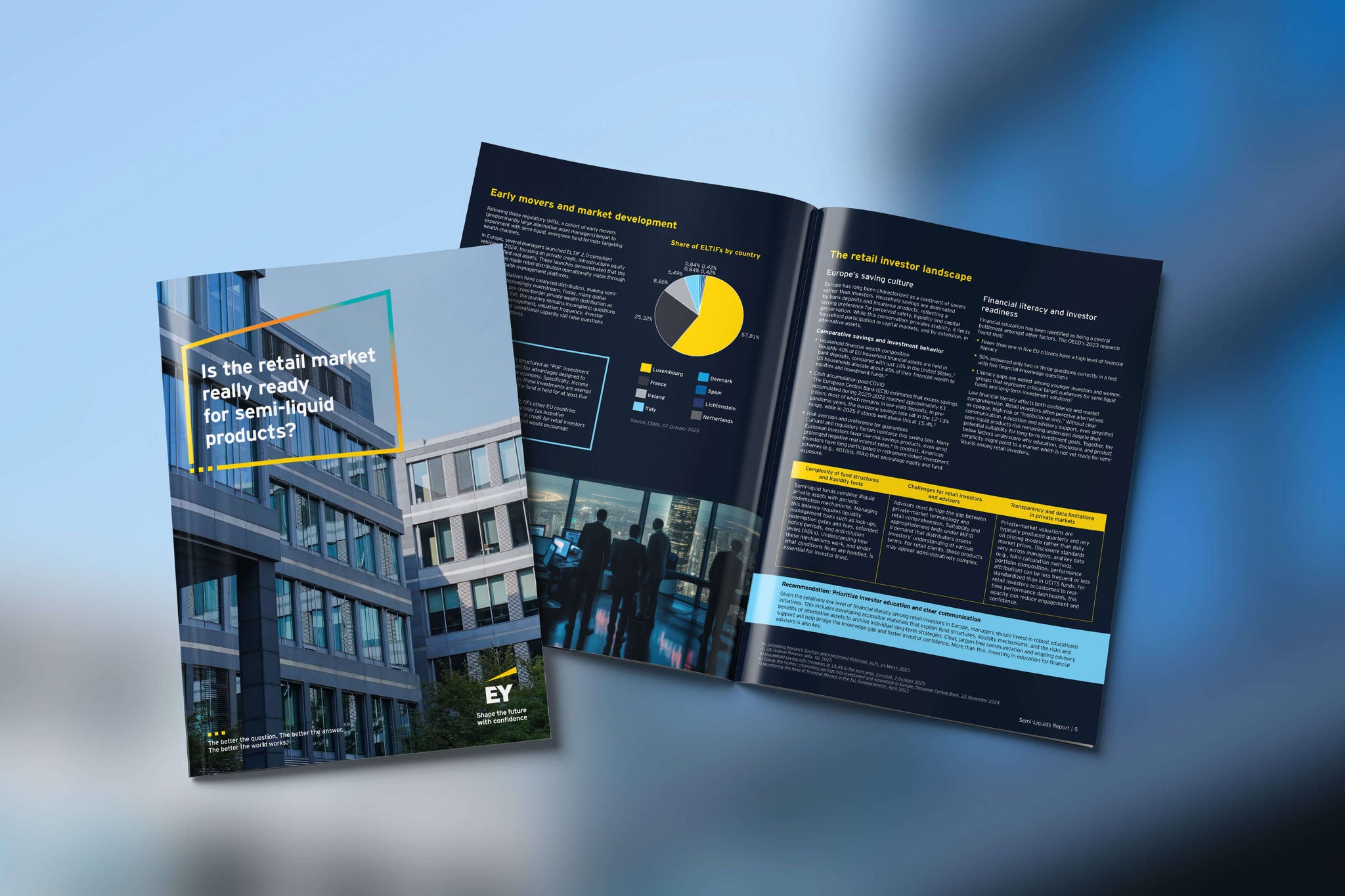
Retail investors are pushing beyond the traditional mix in search of diversification, inflation protection and steadier income. That shift is happening as private markets have scaled dramatically. Record inflows are expected in liquid alternatives and non-traditional equity funds in 2025.
The phrase “retailization of private assets” is well-worn, and while the opportunity is real, the narrative has often leaned heavily on potential upside, overlooking the structural challenges that still constrain progress. This is beginning to shift, as more market participants acknowledge these limitations and actively seek solutions.
In 2025, EY Luxembourg conducted a series of interviews with asset managers, asset servicers and other market participants to gauge the success of semi-liquid products to date. This report assesses whether the retail market is truly ready for semi-liquid alternatives and what it will take to scale them responsibly.
Summary
In 2025, EY Luxembourg conducted a series of interviews with asset managers, asset servicers and other market participants to gauge the success of semi-liquid products to date. This report assesses whether the retail market is truly ready for semi-liquid alternatives and what it will take to scale them responsibly.
How EY can Help
-
Discover powerful new ways to navigate complex transformations in a way that shapes the future, and unlocks innovative paths to growth and value creation. Discover the NextWave of Private Equity.
Read more -
Discover EY's consulting insights, people & services and learn how they can help your business succeed in the Transformative Age.
Read more
Related articles
Navigating challenges in the valuation of semi-liquid funds: Insights from industry experts
The growing interest in semi-liquid funds presents unique challenges for alternative investment fund managers (AIFMs). These challenges formed the foundation of discussions at the recent roundtable organized by EY Parthenon Luxembourg, which brought together a distinguished group of 20 professionals representing AIFMs and depositary banks.
While retail funds under ELTIF 2.0 are only slowly picking up demand due to the current interest environment, the positive longer-term views of the industry have not changed with regard to the allocation of retail investor money into alternative assets. However, an overlooked but crucial element for success lies in the operational readiness amongst asset managers, servicers and distributors.
Retailization of Alternatives - focus on semi-liquid products
Retailization refers to the process of making alternative investments – such as private equity, venture capital, real estate, infrastructure and hedge funds – more accessible to retail investors or non-professional individuals.