




Royal Swinkels

Key insights from EY AI Week: balancing innovation with a human-centered approach


Discover how AI strengthens innovation, human-centricity and leadership, driving sustainable impact and long-term value.


In brief:

  • AI is a partner, not a replacement: humanity remains central.
  • Generative AI and data-ready platforms define success.
  • Focus on adoption, ROI, and AI for Good to drive sustainable impact.

AI is transforming more than just technology—it’s reshaping how we collaborate, create, and deliver value. It’s not just about efficiency; it’s about people, imagination, and a future where humans and machines amplify each other. During EY AI Week, thought leaders, innovators, and hands-on experts came together to answer one central question: how do we keep organizations human while embracing AI and driving sustainable impact?

AI as a human-centered force

EY AI Week opened with a provocative thought from Menno Bonninga, Partner and AI Leader at EY Netherlands: “What we perceive as ‘good’ or ‘bad’ is shaped by our past. It’s time to let go of what we know and embrace what’s new.” Menno emphasized that AI is not just about technology—it’s about people and imagination: “AI isn’t just about code or efficiency. It’s about people, about purpose, and the kind of future we want to create together.” This raises important questions: How do we train people to challenge AI? Where do we draw the line between human and machine? How do we preserve creativity and trust?

From analysis to imagination

Deborah Nas, professor and innovation strategist, explained that AI represents not only a technological shift but a cultural one: “Technology should serve humanity, not replace it. We’ve moved from analyzing what was to imagining what could be.” She offered a striking analogy: “When video games followed books, did we fight that evolution? We often fear what’s new—not because it’s dangerous, but because it’s unfamiliar.” Generative AI is not just a tool—it’s a creative partner. It demands new skills: from prompt engineering to ethical frameworks.

Reliable data as the foundation

Carson Yeung, Director AI & Data at EY Netherlands, delivered a clear message: “When it comes to technology architecture, simplicity always wins. Design and transform in ways that both humans and AI can understand. AI only works with a solid data foundation. Without reliable data, AI is just a buzzword.”

We turn purpose into performance and hype into lasting impact. AI is not a sprint—it’s a marathon.

Purpose-driven strategyRoyal FrieslandCampina embraces a value-driven approach: not blindly chasing trends, but investing in proven solutions. Debaparna Tlalpatra, Global Director of Insights & AI, shared: “Our North Star is accelerating value creation by treating data as a product and enabling intelligent, connected processes.” A lesson in discipline: AI is not a sprint—it’s a marathon. “We turn purpose into performance and hype into lasting impact.”

Scalable data architecture

A global online travel platform demonstrated how scalable data architecture enables AI. Their mission: making the world accessible to everyone. It starts with data: “Our mission to make the world accessible begins with building platforms that scale safely and responsibly.” They work with petabyte-scale data, strict access controls, and a semantic layer that ensures consistency: “Open Semantic Interchange ensures our data speaks the same language across platforms, allowing AI to deliver reliable, intelligent experiences.” AI is not just technology—it’s governance, culture, and accountability.

By automating repetitive tasks, we create space for reflection, creativity and innovation, if we invest in new skills and a culture of continuous learning.

Leadership and AI

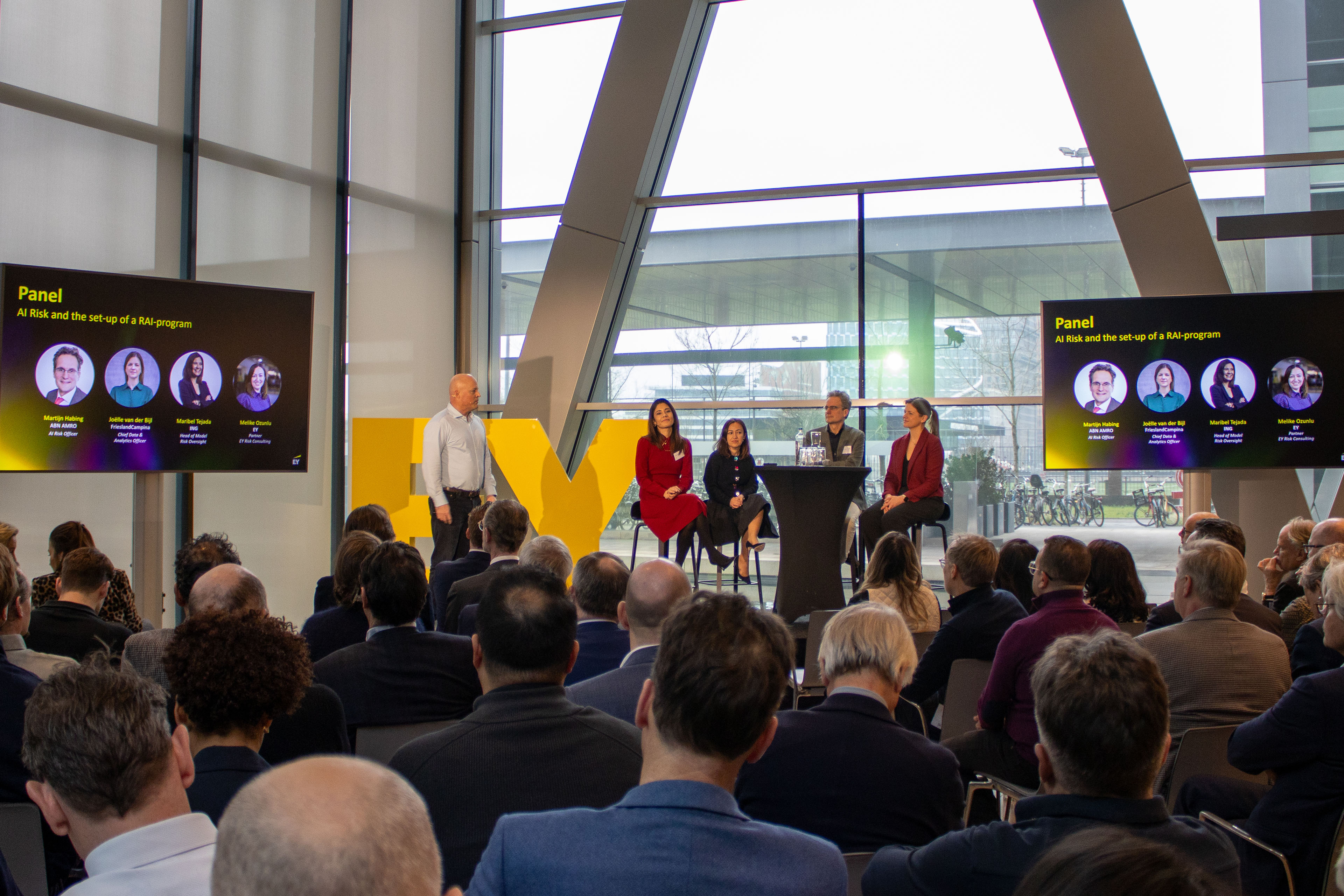
During the panel discussion, Rina Joosten-Rabou (Pera), Isabel Moll (Dell Technologies), Anna van den Breemer (EY), and Maarten Lintsen (EY) emphasized one core message: AI must never replace the human core. Maarten Lintsen set the tone: “It’s not about AI versus humans—it’s about humans using AI. That distinction is crucial.” Organizations face urgent questions: What will the workforce look like in five years? What skills will matter? Can we preserve culture when algorithms guide decisions? These are not abstract concerns—they shape today’s strategy. AI accelerates processes, predicts outcomes, and personalizes experiences. But it cannot replace imagination, empathy, or ethical judgment. These human qualities are what make the difference in an AI-driven world. Isabel and Rina stressed that creativity, empathy, and authenticity remain irreplaceable, while Anna called for courageous decisions—even when they go against the algorithm: “AI can expose cultural gaps and reduce bias, but values must remain human. Leadership is key: technology only works when leaders create safe environments and clearly communicate the need for change.” Isabel envisioned a future where humans and AI collaborate as partners. By automating repetitive tasks, space is created for reflection, creativity, and innovation—provided organizations invest in new skills and a culture of continuous learning.


ROI and adoption from hype to value

Many organizations struggle with the question: where is my return on investment? Joe Depa, EY’s Global Innovation Leader, offered three criteria to stay focused: value, scalability, and differentiation. Adoption is equally critical: “No one has ever said they overinvested in training. Training must be dynamic, personalized, and practical—not a mandatory course, but a relevant and enjoyable experience.”

AI for good purpose over hype

EY uses AI to drive societal impact: improving access to healthcare, strengthening food chains, protecting water sources, and advancing sustainability. Inclusivity and skills upgrading are central. “We want everyone to have an equal chance to succeed in this market,” said Joe. “Generative AI is mainstream—but what’s next? Agentic AI: autonomous agents performing complex tasks. Physical AI: robots combining physical capabilities with AI intelligence—already a top investment category. Quantum computing and smart currency are emerging trends. These developments demand trust, governance, and robust data. Physical AI without proper simulation and ethical frameworks? That’s a risk no one wants to take.”


AI demands vision and action

Menno Bonninga closed EY AI Week with a personal reflection: “The pace at which AI evolves is impressive. Robot-as-a-service is a domain we need to watch closely.” He stressed that AI is not just a technology issue—it’s a leadership challenge: “Don’t rely solely on junior talent to drive innovation. Leaders must show vision, allow room for failure, and reward the right behaviors.” According to Menno, AI is not a hype—it’s a lasting undercurrent that requires continuous investment in people. “We’ve had POC fatigue. Now it’s time for enterprise-wide AI.” His call to action: keep learning, keep connecting, and dare to embark on the journey—even if the destination is still unknown.


Experience innovation at the EY.ai Lab

In the EY.ai Lab you can experience immersive, hands-on tailored workshops with your team that apply AI to core business processes. Guided by EY practitioners, you’ll explore real-world use cases, learn practical methods and tools, and shape solutions tailored to your needs. Leave with actionable next steps and a clear view of how AI can drive efficiency, innovation, and measurable value across your organization.

EY AI week event

Summary

EY AI Week 2025 revealed how AI transforms organizations—from generative AI and data foundations to human-centric leadership and ethical frameworks. EY emphasizes AI for Good, adoption, and ROI as keys to sustainable impact. Learn how leading companies leverage AI to create value, trust, and a future-ready culture.


About this article

Related articles

How FrieslandCampina’s Data Platform paves the way for AI innovation

FrieslandCampina's data platform enables AI innovation and drives transformation from reporting to prediction and automation.

How multidisciplinary collaboration on Responsible AI shapes a future with confidence

Discover insights from our EY AI Talks event on Responsible AI.

How data quality makes the difference in successful AI applications

Discover how to build a trustworthy, enterprise-ready GenAI strategy by mastering data quality, infrastructure, and responsible implementation.