EY refers to the global organization, and may refer to one or more, of the member firms of Ernst & Young Global Limited, each of which is a separate legal entity. Ernst & Young Global Limited, a UK company limited by guarantee, does not provide services to clients.
Recent Searches
Energy transition needs more than technology — it demands trust, collaboration and modern contracting to overcome delays and drive success.
In brief:
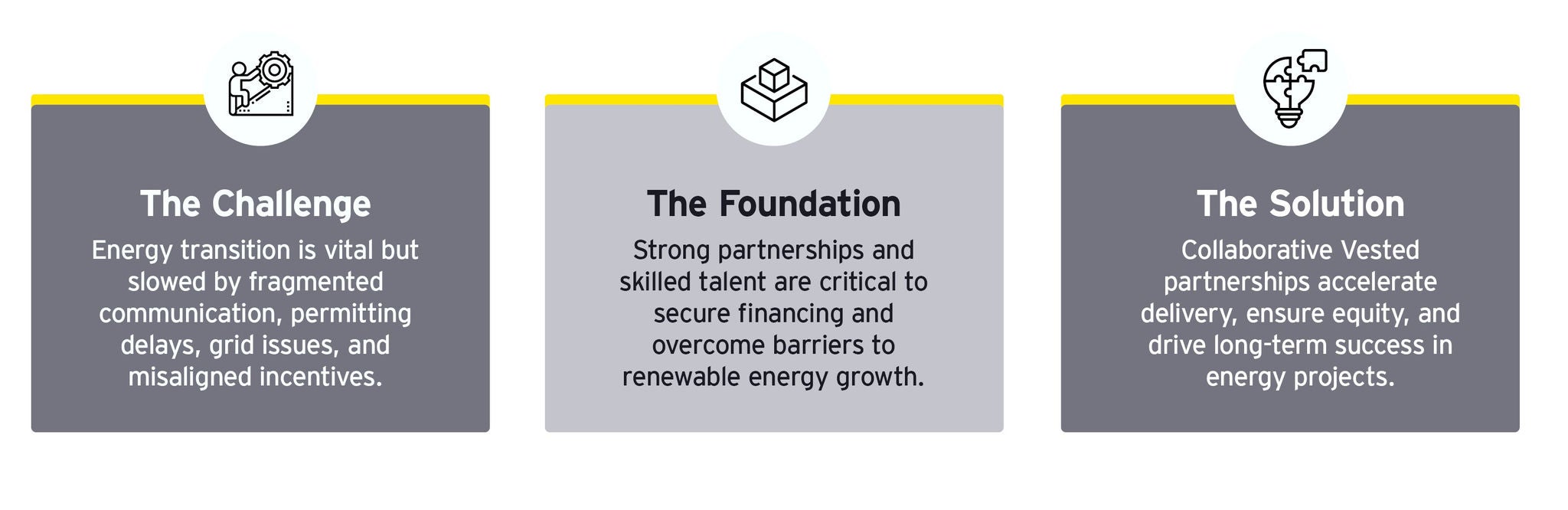
- Energy transition is vital but slowed by fragmented communication, permitting delays, grid issues and misaligned incentives.
- Strong partnerships and skilled talent are important to secure financing and overcome barriers to renewable energy growth.
- Collaborative Vested partnerships accelerate delivery, facilitates equity and drive long-term success in energy projects.
The global energy transition — from fossil fuels to renewables — is essential, but fraught with complex challenges. Projects are often delayed by fragmented communication, slow permitting, grid congestion and misaligned incentives. Meanwhile, public support, skilled labor and equitable financing remain critical pressure points.
This article makes a compelling case that collaborative partnerships, enabled by modern contracting models like Vested, are not merely beneficial but essential for navigating the complexities of the energy transition. Through real-world examples and practical frameworks, it demonstrates how shifting to long-term, value-based cooperation can accelerate project delivery, facilitate equitable outcomes and drive sustainable success in energy initiatives.
Chapter 1: The urgent call for collaboration in the energy transition
The transition from fossil fuels to renewable energy is no longer a distant aspiration. It is an urgent necessity. Rising emissions, climate commitments and the mounting costs of fossil dependency have pushed governments, industries and societies into a decisive moment. Solar and wind energy capacity has grown rapidly across Europe, but the challenges facing solar and wind park operators highlight that technical growth alone is not enough. Many projects struggle with falling revenues due to fluctuating energy prices, delays from grid congestion and rising operational costs that erode profitability. What once looked like a straightforward path toward green energy has become a complex, high-stakes puzzle.
At the heart of this complexity lies the interconnected nature of the energy system. Unlike fossil power plants, renewable infrastructure is deeply dependent on local contexts, technological innovations and a wide range of actors. Transmission system operators must balance a 99.8% uptime obligation with the urgent need to modernize an aging grid, all while coping with a flood of new renewable projects.
Grid operators not only manage billions in long-term investments under political and organizational pressure, but are also highly dependent on contractors and scarce technical expertise to upgrade the grid. With demand far exceeding supply, contractors and skilled personnel hold the upper hand, choosing the clients and projects that best suit them. Meanwhile, scale-ups are installing solar systems on rooftops across Europe, but warn that inconsistent regulations and lack of government vision hinder scaling solutions such as local energy hubs.
Adding to the technical and institutional complexity is a profound human challenge: alignment among stakeholders. Energy companies, regulators, investors, contractors and local communities all hold pieces of the puzzle, yet too often they approach it with conflicting agendas. Traditional contracting, rooted in mistrust and rigid risk allocation, has created perverse incentives and even lawsuits, rather than shared progress. What is critically needed is a shift from transactional thinking to relational partnerships, where risk, reward, and accountability are distributed fairly, and long-term focus and value creation take precedence over short-term gains.
Perhaps most critically, the energy transition must earn its legitimacy not only in boardrooms but also in neighborhoods. Large-scale projects such as wind farms, solar parks and high-voltage grid expansions reshape landscapes and lives. Public acceptance, or its absence, can make or break these projects. Tools like visualization software demonstrate how engaging communities early, by showing the real impact of turbines or solar arrays in their environment, can build trust and reduce opposition. Without a “social license to operate,” even the most technically sound projects risk delays, litigation or outright rejection.
The picture that emerges is one of urgency and interdependence. The energy transition is not simply a technological substitution; it is a transformation of systems, institutions and relationships. Unlocking success will depend less on hardware and more on collaboration: aligning stakeholders across sectors, building trust in supply chains, and engaging the public in transparent, constructive dialogue. These collaborative partnerships can take many forms, for example, between grid companies and their contractors working to expand capacity, or between investors and operators of wind and solar parks aligning on long-term value rather than short-term returns. Local communities, too, play a role, as seen in citizen cooperatives that co-own renewable projects and ensure benefits are shared fairly. Only by fostering such partnerships across the ecosystem can the energy transition move beyond incremental progress and deliver the systemic change that climate goals demand.
Chapter 2: The current state of energy projects
All across Europe, the energy transition is easy to spot: wind turbines turning in the North Sea, solar panels spread across fields, new heating networks in cities and test projects using hydrogen as a clean fuel. But behind this impressive picture lies a mix of progress and problems.
Wind energy has been growing fast, but lack of grid capacity is becoming a serious bottleneck. In the Netherlands, offshore wind projects are not delayed because of technology but because the onshore grid can’t absorb the extra electricity.1 For example, TenneT and regional grid operators recently found that many regions of the Netherlands have almost zero additional space for new feedin capacity from wind and solar, unless customers agree to provide flexibility.2
In Sweden, Vattenfall recently put its Kriegers Flak offshore wind project on hold because providing a reasonable connection to Sweden’s national grid remains unclear.3 Svenska Kraftnät is also working on “Open Door” investigations to identify suitable onshore connection points for offshore wind along Sweden’s coast, signaling that the planning for capacity is underway but not yet resolved.4
District heating is becoming an important part of how cities move away from natural gas. Many municipalities are trying out networks that use geothermal energy or waste heat, but the projects are often fragmented and complicated. In practice, getting local utilities, building owners and residents to work together is usually more difficult than the technical side. On top of that, current laws or local regulations often tie homeowners to a single district heating provider. This lack of competition can lead to high costs and makes residents less willing to support the system.
Hydrogen pilots show big ambition, from making steel to powering heavy trucks, but most are still in the testing phase. They face high costs, unclear business models, and a lack of pipelines and fueling stations. For example, the PosHYdon project in the Dutch North Sea is producing hydrogen offshore using wind power, but like many pilots it remains small scale and experimental.5
Energy storage is another critical bottleneck. Large-scale batteries and hydrogen storage facilities are being tested, but they remain too costly to deploy at scale. Without flexible storage and demand-side solutions, the system struggles to balance intermittent solar and wind power.
Subsidies are a key tool to help the energy transition by bridging the financial gap for low-carbon technologies, making projects that reduce emissions more cost-competitive. For instance, the Dutch government recently awarded €551 million through the SDE++ scheme to RWE for a 100 MW electrolysis plant at Eemshaven, aimed at producing green hydrogen.6 Also, under the OWE subsidy scheme, 11 green hydrogen projects with a combined electrolysis capacity of 602 MW were awarded over €700 million, to help cover the cost difference between renewable hydrogen and fossil-based hydrogen.7
The outcome is a paradox: while new projects are popping up quickly, the energy system is coming under growing strain. Whether it’s a solar park or a district heating network, each project depends on close coordination with grid operators, regulators, investors and local communities. Without that alignment, progress can slow down sharply. This leads to the deeper challenge explored in the next chapter: not primarily technology, but the critical need for effective collaboration and new contracting models.
Chapter 3: Collaboration breakdown – challenges and consequences
If the energy transition is a relay race, too often the baton is dropped between stakeholders. Developers, contractors, regulators and communities each hold critical roles, but misaligned incentives and fragmented execution create costly delays.
Consider a grid expansion project: the operator struggles to secure permits across multiple jurisdictions, while municipalities resist new substations in their neighborhoods. Contractors face labor shortages and choose more profitable projects, leaving others understaffed. Investors push for fast returns, while policymakers prioritize short-term visibility over long-term resilience. The result is a perfect storm of delays, rising costs and public frustration.
Public opposition makes these challenges even bigger. Wind turbines and solar parks that look good on paper often face strong “not in my backyard” resistance once construction begins. When communities feel left out of the planning, they push back against projects that change their surroundings, and even well-meant initiatives can end up in protests, lawsuits, or costly redesigns if trust and transparency are missing. At the same time, more and more local energy initiatives are being set up, such as the Dutch civilian initiative Burgers met Energie in Voorst, which helps residents and farmers with energy scans and develops local solar projects or local smart energy hubs.8 However, such local initiatives often run into local rules, grid limits and political hurdles that make it hard for them to move forward or grow. Often, local rules don’t match a broader national or European vision, so what’s possible in one municipality isn’t in another. The result: many small-scale efforts never scale up or are delayed more than they should.
Policy coordination makes things even harder. Municipal, provincial and national authorities often have different priorities, which creates delays in permits and spatial planning. What one level of government approves, another may hold up. On top of that, national authorities regularly push decisions down to local governments without offering a clear, long-term national or European vision and roadmap. This leaves municipalities to figure things out on their own, leading to very different and sometimes conflicting approaches across regions. In some cases, short-term opportunism drives choices, rather than a shared long-term vision. The result is a patchwork of policies that slows down even the most promising projects, or local initiatives.
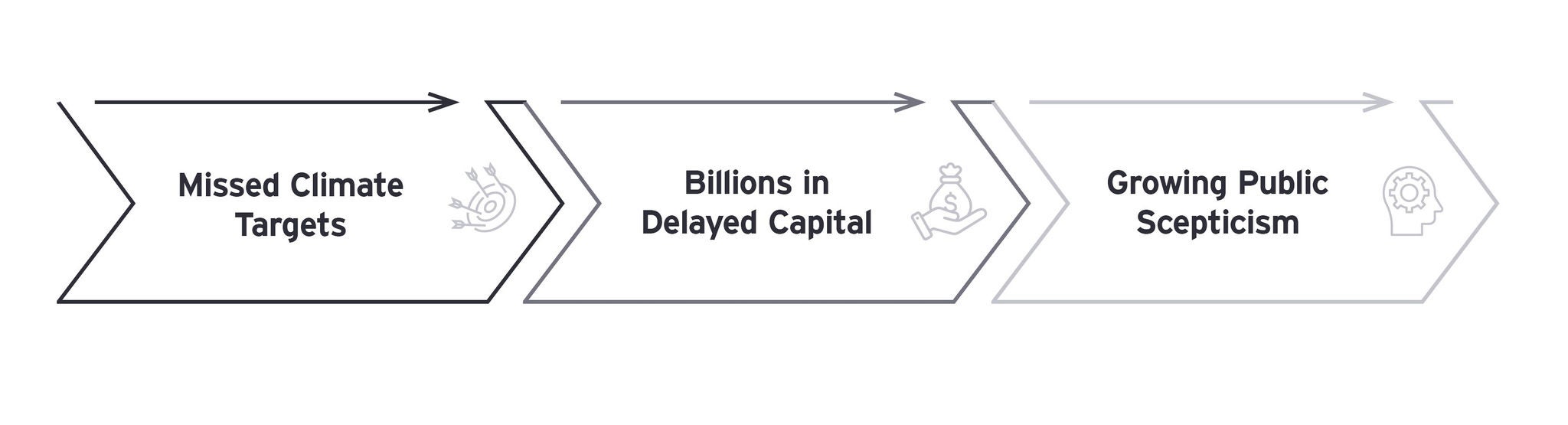
The consequences are systemic: missed climate targets, billions in delayed capital, and growing public skepticism about the transition itself. This is not just a technical failure, it is a relational one. The absence of shared goals, aligned incentives and collaborative governance turns ambitious plans into fragmented outcomes. The solution lies in developing a unified long-term vision and fostering purposeful, systemic collaboration. This begins with a political vision that brings all key stakeholders in the energy transition to the table. While collaborative initiatives between the public and private sectors and educational institutions are increasing, they remain insufficient in scale and integration to meet the challenge ahead.
The message is clear: technology alone cannot deliver the energy transition. Success depends on transforming how stakeholders work together. To break free from the cycle of mistrust and misalignment, contracting models must evolve from transactional control to true partnership. Although achieving this requires a political long-term vision that unites all key actors around shared goals, such a vision can be further strengthened by integrating relational contracting principles, such as those embedded in the Vested model, which foster systemic collaboration through aligned incentives, shared outcomes and joint governance. While this broader political dimension extends beyond the scope of this article, the next chapter explores a critical enabler of this transformation: rethinking the very foundation of agreements to build trust-based, outcome-oriented partnerships.
Chapter 4: Rethinking contracting – from transactions to partnerships
The energy transition requires not just new technologies, but also a fundamental shift in how projects are structured and managed. Traditional contracting models — such as FIDIC contracts (based on international engineering and construction standards), Engineering, Procurement and Construction (EPC) agreements, Design–Bid–Build (DBB) structures, Build–Operate–Transfer (BOT) models, or simple Fixed Price contracts — are mostly cost-driven and rigid. While these approaches have worked in conventional infrastructure, they are poorly suited for the fast-changing and high-stakes environment of today’s energy projects. They often focus too narrowly on delivering a defined scope at the lowest cost, leaving little room for flexibility, shared value or long-term collaboration.
These models often prioritize short-term cost control and a “what's in it for me” foundation over long-term value, reinforcing siloed behaviors and discouraging the flexibility needed to navigate uncertainty. In all these models, success is defined in transactional terms: delivering a set scope at a set price. What gets lost is the relational perspective, where success means achieving shared outcomes such as project performance, decarbonization, resilience or community benefit. This leads to:
- Siloed incentives: Each party optimizes for its own KPIs, not the system’s performance.
- Change resistance: Contracts penalize flexibility, making it costly to adapt to new information or conditions.
- Trust erosion: Oversight mechanisms are designed for control, not collaboration, fostering defensiveness rather than joint problem-solving.
To unlock the full potential of collaborative partnerships, energy stakeholders should rethink the very foundation of their agreements. This means moving beyond transactional contracts toward models that enable co-investment, adaptive governance and shared accountability. In particular, the financing burden and the need for equitable cost-sharing highlight the limitations of rigid, winner-takes-all approaches. It’s a familiar problem: many parties, especially investors, speak of “partnership,” but once the contract is signed, the focus quickly shifts to “what’s in it for me”. Instead, contracts must be designed to distribute risk and reward fairly, fostering trust and long-term alignment.
Modern contracting approaches, such as relational contracting, alliance models and Vested, offer compelling alternatives. These models emphasize outcomes over inputs, and relationships over transactions. They create space for innovation by allowing parties to adapt to changing conditions without triggering costly renegotiations. Importantly, they embed governance mechanisms that promote transparency, joint decision-making and continuous improvement.
In the context of the energy transition, such models are not just preferable, they are essential. Yet today they are still not widely applied, often because they are less well known, misunderstood, or seen as complex compared to traditional, transactional contracts. Many organizations fall back on familiar models, even if these lead to misaligned incentives and delays, simply because procurement teams and legal departments are more accustomed to them. Overcoming this gap requires awareness, training, and practical examples that show relational models can be both effective and compliant. Whether coordinating multi-stakeholder permitting processes, integrating new technologies or managing complex supply chains, success now depends on the ability to collaborate across boundaries. Contracts must therefore evolve from instruments of control into enablers of cooperation. By embracing this shift, energy actors can build the resilient, adaptive partnerships needed to deliver on the promise of a sustainable future.9
Chapter 5: Vested – a model for collaborative success
As the energy transition speeds up, traditional contracting models can no longer handle the scale, complexity and uncertainty of today’s capital-intensive energy projects. The Vested model offers a powerful alternative — one that fosters strategic coordination, risk-sharing and long-term value creation across stakeholders. Developed by the University of Tennessee and based on extensive research, Vested is rooted in win-win economics and a focus on the relationship rather than the transaction.10
This well-tested methodology provides templates, frameworks and tools. Companies jointly develop contracts built on five guiding rules that shape how they work together and create lasting value:
- Build a business model that is outcome-based rather than transaction-based.
- Focus on the “what,” not the “how”; let the experts decide how best to deliver.
- Define clear and measurable outcomes that all parties commit to.
- Use a pricing model with smart incentives that drives joint success.
- Set up governance for insight, not oversight, to enable flexibility, transparency and trust.
In contrast to adversarial, cost-driven contracts that often pit parties against each other, Vested encourages collaboration by aligning incentives around mutual success. This is particularly critical in decarbonizing industry and infrastructure, where investments are large, timelines are long and risks are shared. Whether it’s electrifying industrial processes, deploying green hydrogen or upgrading grid infrastructure, Vested enables stakeholders to jointly navigate uncertainty and adapt to evolving conditions. It also offers a chance to restore a level playing field in markets where the balance of power has shifted, since equality is essential and win-win financial outcomes lie at the heart of relational contracts.
The model’s emphasis on outcomes ensures that all parties are committed to achieving strategic goals, such as reducing emissions or improving system flexibility, rather than merely fulfilling transactional obligations. Shared value creation allows partners to co-invest in innovation and efficiency, unlocking benefits that would be unattainable in siloed arrangements. It shifts the focus beyond simple cost savings and transactions, toward broader value drivers such as sustainability, customer satisfaction and benefits for local communities. By replacing rigid oversight with mutual insight, Vested builds trust and empowers teams to solve problems collaboratively, rather than defensively.
Transparent governance mechanisms, such as open-book accounting and joint performance reviews, further reinforce accountability and adaptability. These features are especially valuable in addressing financing challenges, where equitable cost-sharing and long-term affordability are essential. Vested’s approach also supports integrated planning across project phases and stakeholders, helping to overcome permitting delays and policy fragmentation. Just as importantly, the flexible nature of a Vested agreement allows partners to pivot when project scopes or circumstances change, without triggering conflict or costly renegotiations.
Ultimately, Vested is more than a contract; it’s a mindset shift. It transforms energy projects from transactional engagements into genuine transformation partnerships. By embracing Vested, stakeholders can unlock the full potential of collaboration, accelerating the energy transition in a way that is resilient, sustainable, and strategically coordinated, fostering shared success and increased stakeholder satisfaction.
Chapter 6: Vested in action – case studies from the energy sector
In this chapter, we present two real-life case studies that demonstrate how relational contracting, and specifically the Vested model, delivers tangible benefits and measurable outcomes in practice within the energy sector.
1. Case study 2023: NAM’s decommissioning project – successful decommissioning through relational partnership
When NAM (Dutch petroleum company – a joint venture between Exxon and Shell) faced the challenge of safely decommissioning hundreds of wells, facilities and pipelines, it realized that traditional, transactional contracting would not be enough. The task was too complex, the timeframe too long, and the need for innovation and trust too urgent. Instead, NAM and two key service partners, Arcadis and WellGear, decided to build their partnership around the Vested outsourcing model.
Rather than forming a joint venture, the parties co-created two fully aligned (and almost identical) contracts based on relational principles. This design gave each partner autonomy in their own scope, while anchoring them to shared outcomes and joint accountability. Governance was built for transparency and trust: open-book accounting, joint performance reviews, and an integrated organizational framework ensured that subcontractors and local stakeholders could and would be engaged consistently.
To support this transformation, Yellow Everest guided the joint team of NAM, Arcadis and WellGear through a series of co-creation workshops. Together, they built a shared culture, defined their way of working, established a common vision with clear desired outcomes, and designed a financial model that rewarded and incentivized true win–win behavior.
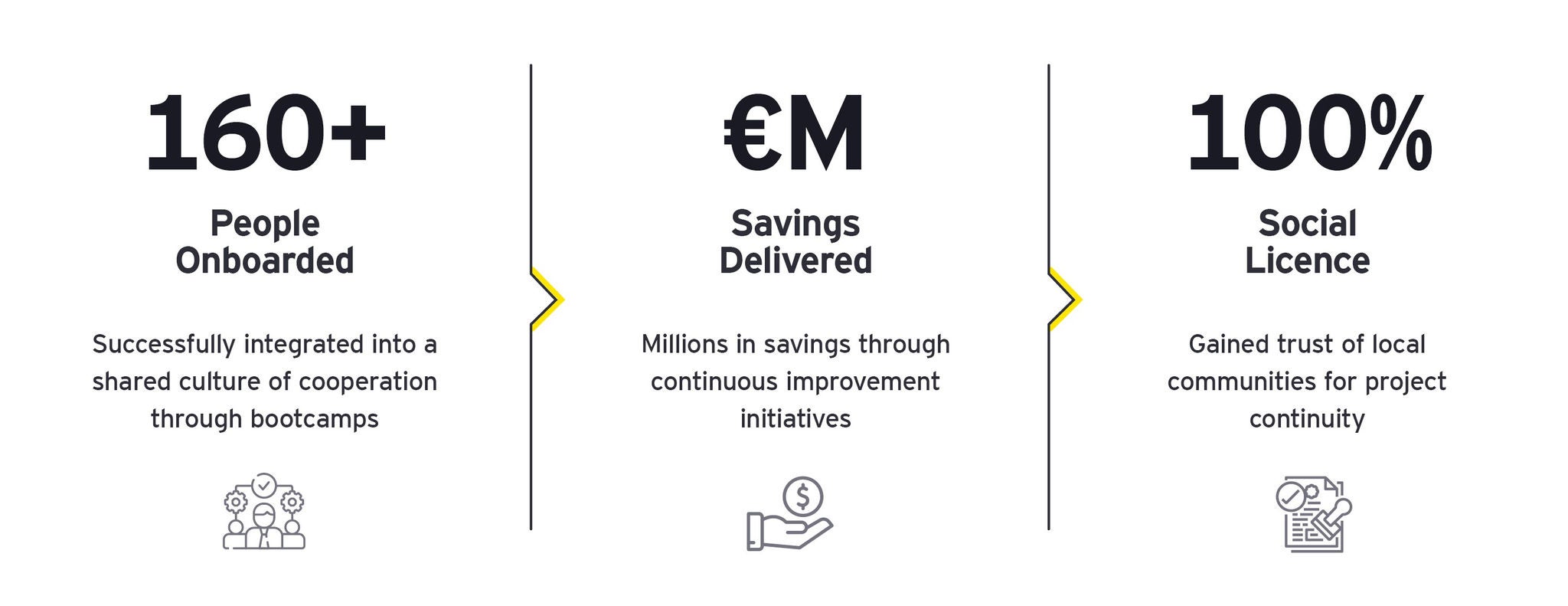
The initial years of their collaboration demonstrate the accelerated progress achievable with a relational, win-win approach. Onboarding bootcamps successfully integrated over 160 people into a shared culture of cooperation. Continuous improvement initiatives have already delivered millions of euros in savings, while new well-abandonment technologies and “innovation funnels” were tested to speed up and de-risk the work. Importantly, the Vested model helped the partners gain the trust of local communities, a crucial step in earning a social license to operate and ensure project continuity.
By focusing on outcomes rather than activities, NAM, Arcadis, WellGear and their subcontractors collectively transformed a difficult technical challenge into a platform for broader value creation. This approach not only reduced costs and improved safety but also demonstrated how relational contracting enables systemic change. In doing so, they contribute directly to the energy transition: ensuring the responsible closure of fossil infrastructure while creating space — physically, financially and socially — for sustainable energy solutions.
2. Case study 2025: ElectricityCo’s11 grid projects – strategic sourcing to navigate supplier market overheating
With an overheated supplier market and mounting pressure to deliver on grid expansion targets, ElectricityCo initiated a strategic sourcing transformation for its capital projects in the grid segment. The challenge was clear: traditional procurement models were failing to attract capable suppliers, leading to delays, cost overruns, and limited innovation.
In collaboration with EY, ElectricityCo launched a series of workshops and sourcing strategy sessions in early 2025, aimed at rethinking its approach to supplier engagement. The strategy emphasized moving away from transactional contracting toward partnership-based models, including Vested principles. These models were designed to foster long-term collaboration, shared risk, and joint value creation — critical in a market where suppliers were increasingly selective and capacity-constrained.
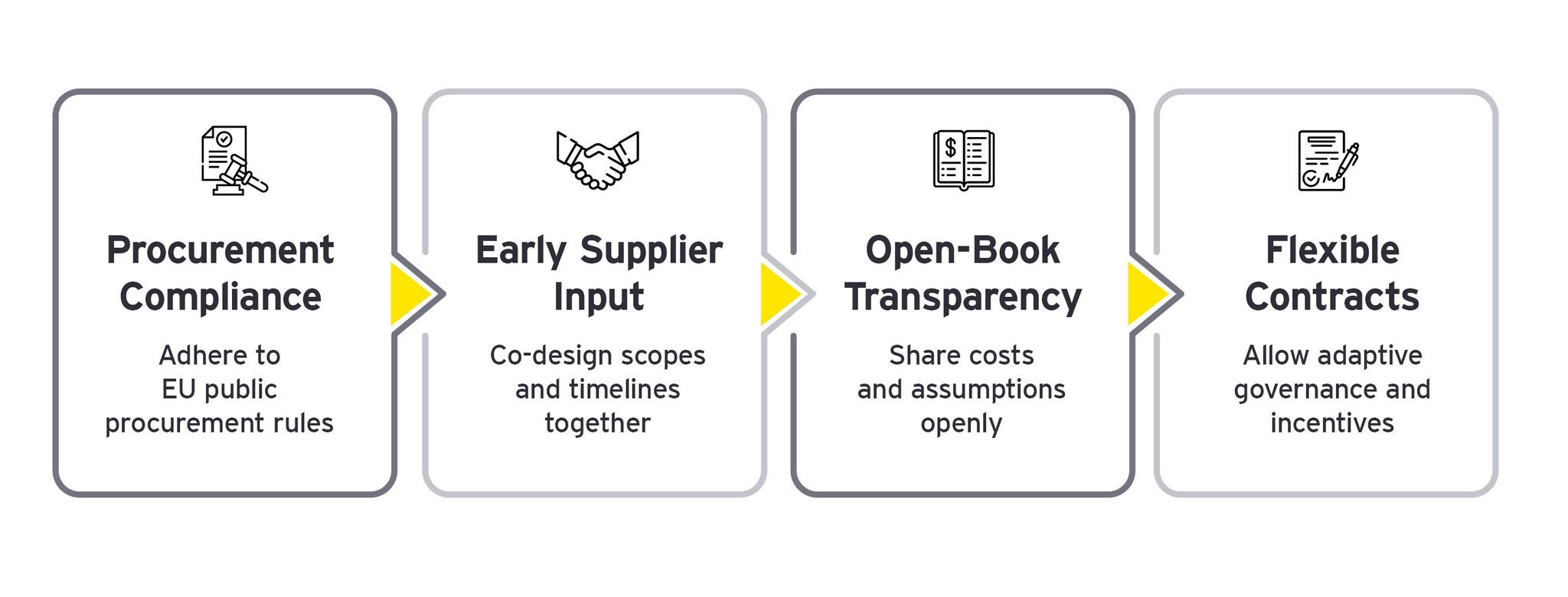
Key elements of the strategy included:
- Compliance with European Public Procurement regulations
- Early supplier involvement to co-design project scopes and timelines.
- Open-book principles to ensure transparency and trust.
- Flexible contracting structures that allowed for adaptive governance and innovation incentives.
The workshops also addressed common pitfalls of traditional sourcing — such as the “activity trap” and “zero-sum game” ailments — and introduced design principles for RFX processes that aligned economic and relational goals. ElectricityCo’s internal teams were trained on these models, and pilot projects were identified to test the new approach in live procurement scenarios.
This case demonstrates how strategic sourcing, grounded in relational principles like Vested, can help utilities like ElectricityCo overcome critical market constraints and build resilient supply ecosystems. By shifting the focus from adversarial price control to collaborative value creation, ElectricityCo positioned itself to efficiently deliver on its grid modernization goals while strengthening supplier relationships and unlocking innovation.
Chapter 7: The path forward – building a collaborative energy future
The energy transition is one of the greatest collective challenges of our time. Across this article, we have seen that technology alone is not enough. Grid congestion, complex permitting, public opposition and fragmented policies cannot be solved by wind turbines, solar panels or hydrogen pilots in isolation. They require something deeper: genuine collaboration among the players in the energy transition ecosystem.
Key barriers remain clear. Governance and permitting processes are still too slow and fragmented, often creating a patchwork of rules that discourages progress. Investment strategies are frequently designed in silos, with public and private actors pushing their own agendas rather than co-creating balanced, long-term funding models. Meanwhile, shortages of skilled labor and the lack of flexible capacity continue to slow down deployment, even where the technology is ready to scale.
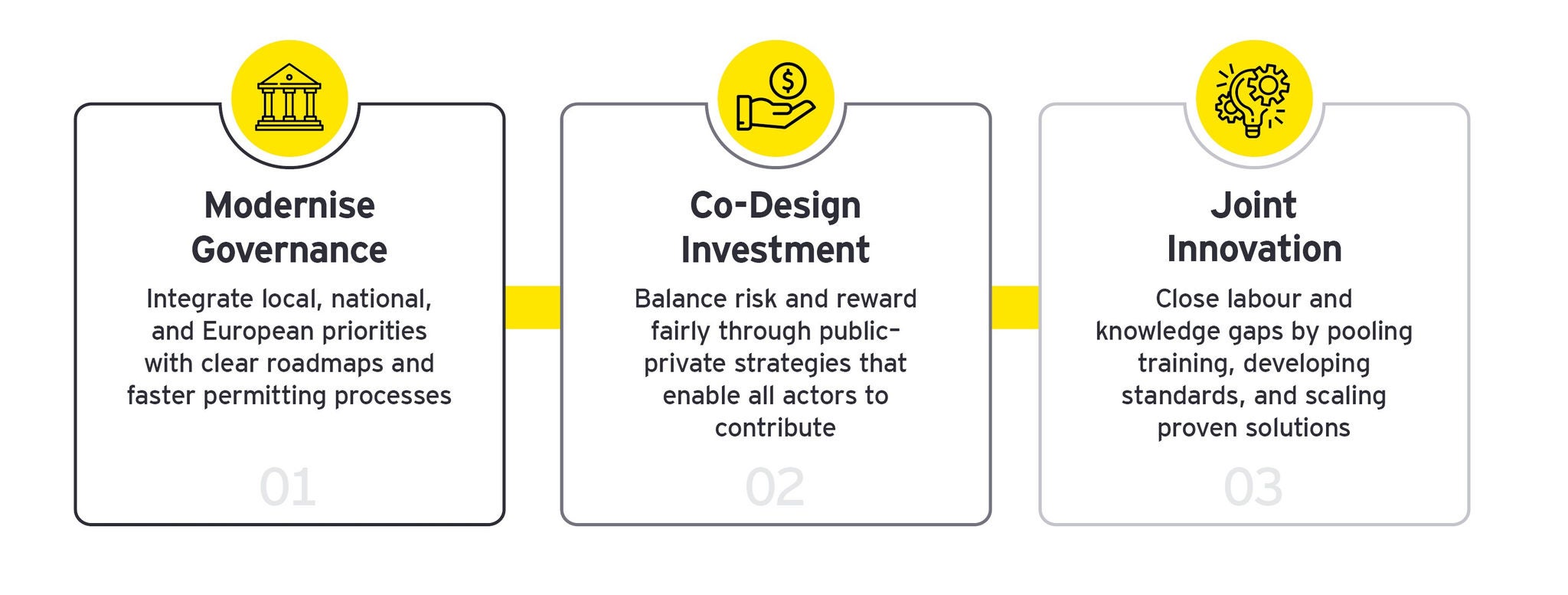
Collaborative solutions are within reach. Governance must be modernized to integrate local, national, and European priorities, with clear roadmaps and faster permitting processes. Public–private investment strategies should be co-designed to balance risk and reward fairly, ensuring both incumbents and innovators can contribute. Finally, joint innovation programs can help close labor and knowledge gaps, for example, by pooling training, developing new standards or scaling proven solutions across borders.
The common thread running through these solutions is not technology, but trust. Relational contracting models, such as Vested, show that when parties align on outcomes, embed transparency in their agreements, and commit to shared value creation, they unlock results no single actor could achieve alone. Trust and collaboration shift the focus from competing against one another to jointly solving the challenge at hand.
The call to action is simple yet urgent: move beyond traditional transactional contracting and embrace win-win relational contracting models, like Vested, that turn projects into true partnerships. These models are not abstract theories; they are already working in practice, as the preceding case studies have clearly shown. By scaling them, the energy sector can significantly accelerate the transition, reduce costs, strengthen public support and build resilience against future uncertainty.
Special thanks to Sibrecht Diender, founder of Yellow Everest and a certified Vested coach, for significantly contributing to this article.
Summary
The final message is clear: the energy transition will only succeed if it is built on trust, shared value and collaboration. The choice is ours — to stay locked in old models that divide and delay, or to embrace new models that enable us to transform together.