Strategic imperative 3: Reimagine user experience through AI‑assisted interactions
Beyond productivity gains, AI is reshaping how users interact with enterprise systems. Traditional SaaS applications have relied on structured, form-driven interfaces and predefined navigation paths. This model is increasingly being supplemented ― and in some cases replaced ― by more intuitive, conversational interactions.
Users can now engage through natural language, expressing intent rather than following prescribed steps. Instead of navigating multiple screens, they can ask questions, initiate processes, or request insights more directly, with AI interpreting intent and guiding actions.
This shift does not replace structured processes; it changes how they are experienced. Interfaces become more flexible and intent-driven, while execution remains anchored in governed workflows.
Leading platforms are already demonstrating this shift. ServiceNow’s Now Assist, SAP’s Joule and Pega’s AI-powered decisioning and conversational capabilities enable users to interact with enterprise workflows through natural language. Employees can initiate requests, retrieve insights, or resolve issues without navigating multiple screens, while the underlying platforms continue to execute governed processes.
Over time, enterprise systems will evolve toward more intent-driven experiences, where users focus on outcomes rather than process navigation.
Leaders should redesign user experiences within applications to be more intuitive, AI-assisted and outcome-driven.
Strategic imperative 4: Accelerate integration through AI‑enabled approaches
Integration remains a complex and costly aspect of enterprise SaaS ecosystems. The importance of integration extends beyond technical efficiency. Recent research by the global EY organization 11 suggests that up to 75% of enterprise value remains trapped across organizational and functional silos. Agentic AI can help unlock this value by orchestrating workflows, decisions and actions across systems, enabling organizations to operate around end-to-end value streams rather than discrete applications. Organizations often operate dozens of interconnected systems, requiring significant effort in API development, data mapping and workflow orchestration.
AI introduces meaningful opportunities to reduce this effort; however, it does not eliminate the underlying complexity.
AI-driven tools can automate aspects of integration, including generating API mappings, creating connectors, and supporting low-code orchestration. These capabilities can accelerate implementation timelines, reduce manual effort and lower total cost of ownership. For example, AI can infer data mappings across systems, suggest integration patterns, or generate boilerplate code that developers can refine.
However, core challenges remain ― data semantics, governance, security and consistency. Integration should still be designed to support traceability, controlled data flows, and clear ownership of system boundaries.
Organizations should treat AI to accelerate integration, helping teams deliver faster while continuing to invest in API-first design, standardized interfaces and modular architectures.
Leaders should adopt AI to accelerate integration while continuing to invest in API-first, well-governed architecture.
Strategic imperative 5: Prepare for AI as the primary interaction layer
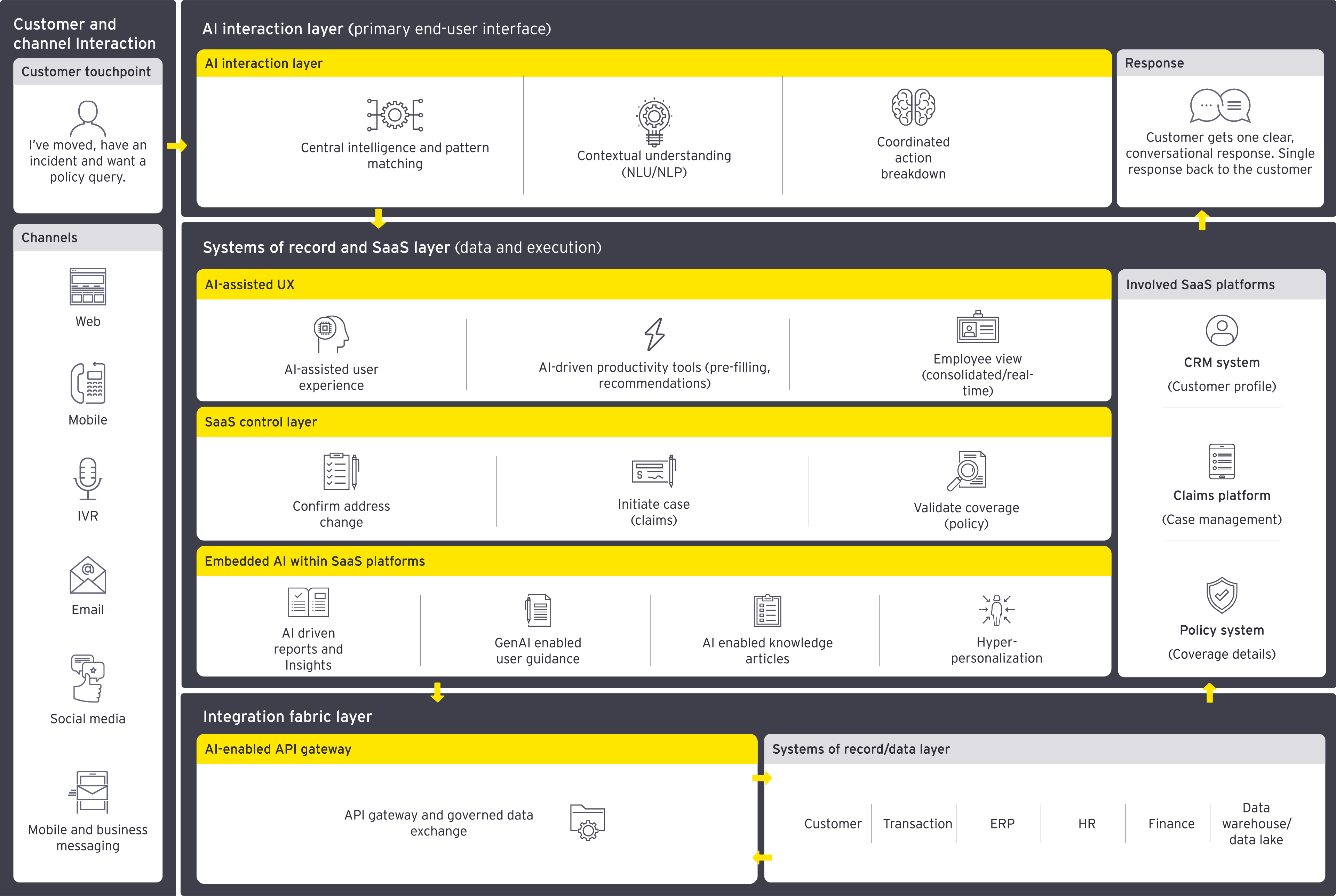
A significant shift driven by AI is the gradual disintermediation of the traditional SaaS user interface. As AI agents become more capable, they are increasingly serving as the primary interface through which users interact with enterprise systems.
Instead of logging into multiple applications, users may engage through a unified AI layer that spans systems and processes.
This does not eliminate SaaS platforms. However, it does change how they are experienced. Enterprise applications increasingly operate behind the scenes as API driven engines that execute transactions, enforce rules and maintain records. The user-facing layer becomes more abstract, with AI orchestrating interactions across systems.
This shift should be carefully managed. While a unified AI interface can improve usability and efficiency, it cannot obscure accountability or control. Every action initiated through an AI layer should still be traceable to governed workflows and systems of record.
For CIOs, this shifts the focus from improving individual application interfaces to building platforms that are modular, API-driven and accessible.
Leaders should prepare for AI-led interaction models by making platforms modular, API driven, and ready to operate behind unified AI layers.