









EY refers to the global organization, and may refer to one or more, of the member firms of Ernst & Young Global Limited, each of which is a separate legal entity. Ernst & Young Global Limited, a UK company limited by guarantee, does not provide services to clients.
Stay ahead with Managed Services
Register to receive a curated series of emails with articles and insights, exploring how organizations can turn change into value.

Application managed services turn complex application landscapes into continuously evolving business capabilities.
In brief
- Application managed services are evolving from post–go‑live support to continuous value creation.
- SAP‑led environments require ongoing optimization as business priorities and technology change.
- A value‑led, AI‑enabled AMS model helps organizations sustain transformation over time.
For many organizations, a large SAP transformation is treated as a milestone marked by go live and the transition into support. Yet this moment is rarely where value is fully realized. Instead, value is created over time through how applications are operated, improved and adapted as business priorities evolve.
This is where application managed services (AMS) play a critical role. Once seen primarily as a stabilization function, AMS has become a key lever for sustaining transformation. Managed Services are no longer about keeping the lights on; they are about turning transformation into a living, evolving capability that delivers impact every day.
Why application managed services are under pressure
Traditional application managed services models were designed for predictability and cost efficiency. They focused on ticket resolution, labor optimization and system availability. While these foundations remain important, they are no longer sufficient in today’s environment.
Organizations now operate under constant pressure from cost constraints, regulatory change, geopolitical uncertainty and rising expectations around data, automation and AI. In SAP‑led landscapes, where applications underpin finance, supply chain, workforce and customer operations, these pressures are especially visible. As a result, AMS is expected to do more than react. It must actively contribute to performance, control and adaptability across the enterprise.
From support function to value engine
EY’s approach to application managed services is built on a simple but decisive principle: value creation matters more than cost alone. Rather than positioning AMS as something that begins after transformation ends, it is treated as a continuation of the transformation journey itself.
What is designed and implemented during an SAP transformation does not stop at stabilization. Through structured optimization cycles, continuous improvement and close collaboration with the business, AMS helps organizations enhance how their applications perform over time — operationally, financially and strategically. The focus shifts from managing technology in isolation to unlocking measurable business outcomes.
This requires a partnership mindset. Effective AMS is not just about executing tasks, but about building trusted relationships, transparent governance and delivery models tailored to the organization’s operating context. When AMS is aligned to business priorities rather than technical metrics alone, it becomes a driver of sustained value rather than a background service.
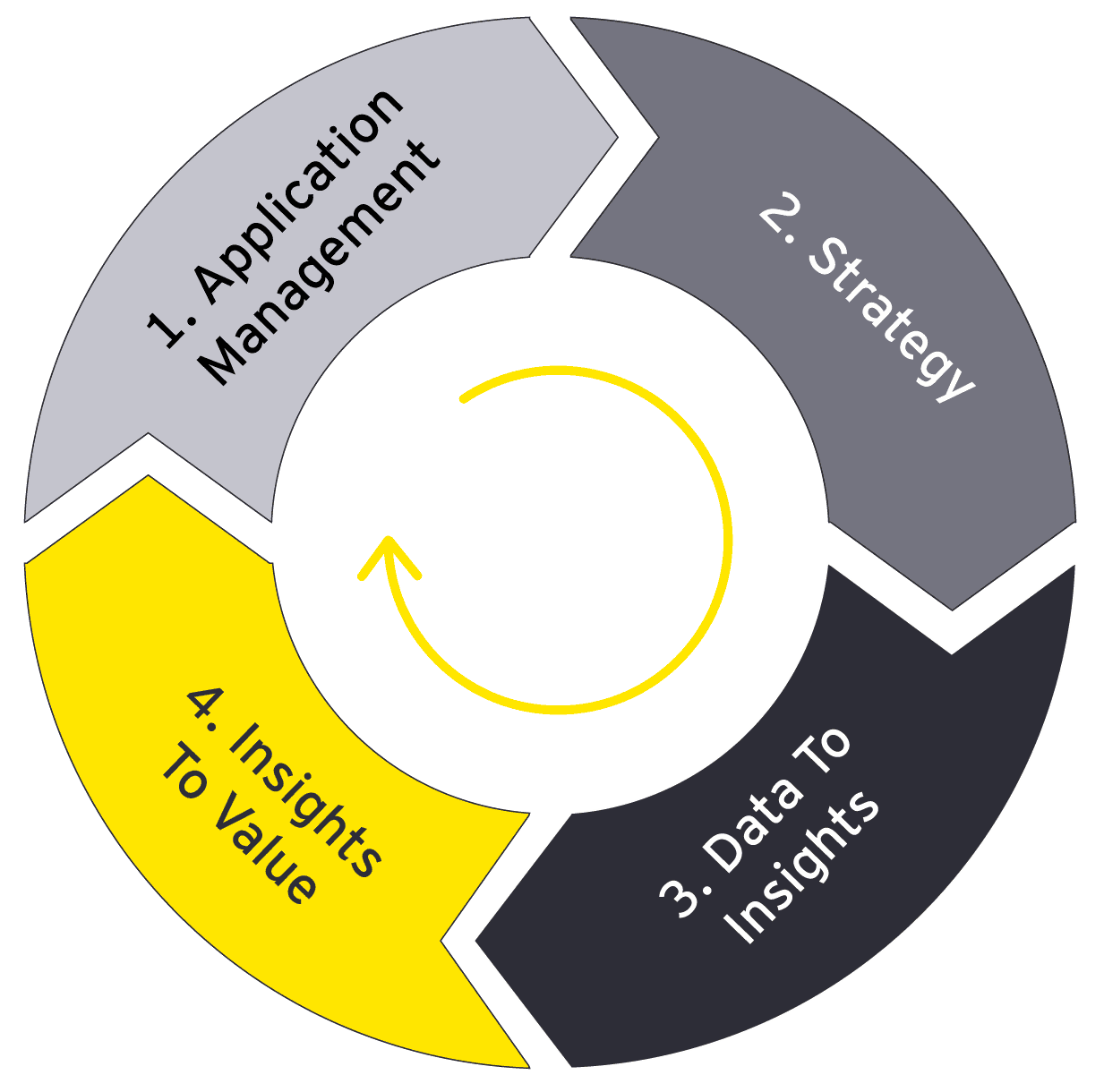
EY approach to delivering both
cost reduction and business value
Embedding AI and automation into daily operations
A defining characteristic of modern application managed services is how innovation is embedded into day‑to‑day delivery. EY integrates automation, analytics and AI directly into AMS through its AMS.ai framework.
Rather than treating AI as a standalone initiative, it is operationalized within service delivery itself. Repetitive activities are automated, application performance is continuously monitored, and analytics are used to anticipate issues before they escalate. In complex SAP environments, this enables more proactive decision‑making, faster resolution and greater resilience, while freeing up teams to focus on higher‑value work.
This approach accelerates digital maturity in a practical way. AI is not applied for experimentation’s sake, but to reduce operational overhead, improve service quality and turn data into insights that support better business decisions.
A value led AMS model built on five pillars
EY’s application managed services are built around five interconnected pillars that work together to deliver sustained impact.
Together, these elements shift application managed services from a cost center into a strategic capability that supports both run and change.
Turning application managed services into a sustained advantage
Sustained value from application managed services does not come from scale or efficiency alone. It comes from treating AMS as an extension of transformation, embedding continuous improvement into operations and using innovation to improve outcomes over time.
Organizations that succeed with this approach align application operations to business priorities, not just service levels. They embed automation, analytics and AI into everyday service delivery. And they work with partners who understand both the SAP landscape and the broader operating model in which it sits.
Application managed services are where transformation is sustained, innovation is operationalized and value is realized over time. The opportunity now is to make AMS work harder for the business – not just for the systems that support it.
Related articles
Why Belgian financial services must rethink their operating model now
Regulatory pressure, rising costs and talent scarcity are pushing Belgian firms toward managed services to modernize delivery.
How managed services are reshaping operating models in financial services
A continuous transformation mindset embeds resilience and innovation into financial services operations.
Sovereignty, trust and control in managed services
Embedding sovereignty and control by design helps financial institutions scale managed services with confidence and credibility.
Why managed services are key to continuous value creation
Managed services help organizations turn constant change into sustained value by embedding transformation, AI and accountability into everyday operations.
How can your cybersecurity partner deliver business resilience
As AI-driven cyberattacks accelerate, organizations are rethinking how cybersecurity is operated and continuously strengthened.
From periodic compliance to continuous tax confidence
Why tax compliance is evolving from a periodic obligation to a continuous capability embedded in data, processes and daily operations.
Five design principles for managed services in financial services
EU digital, cyber, and resilience regulation is forcing a redesign of managed services in financial services.
Nearshoring as a resilience lever for mid-sized financial institutions
For mid-sized banks, nearshoring has become a strategic lever to scale operations, access talent, and strengthen resilience.
How innovation moves from pilots to performance in financial services
Innovation creates its greatest value when automation and AI are embedded in Managed Services and scaled through everyday operations.
A foundation for continuous transformation in financial services
Managed services help banks and insurers evolve operations continuously while staying compliant, resilient, and in control.
Summary
Application managed services play a critical role in sustaining the value of SAP transformations. When designed around continuous improvement, embedded innovation and business outcomes, AMS evolves from a support function into a strategic capability. By rethinking how services are delivered and governed, organizations can turn application operations into a lasting source of business value.