EY refers to the global organization, and may refer to one or more, of the member firms of Ernst & Young Global Limited, each of which is a separate legal entity. Ernst & Young Global Limited, a UK company limited by guarantee, does not provide services to clients.


On 19 September 2026, the EU published the reformed Union Customs Code (UCC). Ten years after the current UCC started to apply, this fundamental reform will reshape the EU customs landscape and have significant practical implications for businesses engaged in international trade. Below, we highlight where the most fundamental changes lie, so you can assess what they mean for your organization and start preparing in time.
Join us to find out more
Want to learn more about the impact of the reformed EU customs legislation means for your business? Meet our team at one of our upcoming events:
- 19 November 2026 – Breakfast session at EY Diegem, with a special focus on e-commerce
- 26 November 2026 – Afternoon session at Corda Campus, Hasselt
If you cannot join us at one of these dates, you may also register for our webcast on 27 October 2026.
Also our latest issue of TradeWatch includes multiple articles about the expected impact of the UCC Reform.
A new importer concept as a central figure in the new customs framework
A first fundamental shift is the introduction of the importer as a central figure in the new customs framework. Whereas the current rules revolve around the declarant as the person lodging the customs declaration, the reformed UCC places responsibility for compliance with the importer/exporter.
Both the importer and exporter will be subject to fiscal (e.g., payment of duties) and non-fiscal (regulatory) obligations. These obligations include ensuring compliance with other legislation applied by the customs authorities. Just as was already the case for the exporter, now also the importer must be established in the EU customs territory (subject to certain exceptions). Indirect customs representation will still be possible for non-EU established importers or exporters but in that case the customs representative will be considered as importer or exporter and assume all liabilities. This may fundamentally change market conditions and impact pricing, liability clauses and the need for data-sharing arrangements.
A new Trust and Check trader status opens the door to simplifications
Another novelty introduced by the reformed UCC is the Trust and Check trader status. The Authorized Economic Operator (AEO) status will continue to exist, but the Trust and Check trader status adds a further layer on top of it: building on the AEO criteria, it offers an additional layer of simplifications in return for an additional layer of requirements. In exchange for providing near-real-time data on their supply chains, Trust and Check traders will, in essence, benefit from customs facilitations such as the possibility to share certain data only after the release of the goods, releasing goods on behalf of customs authorities and deferred and periodic payment of customs duties. Moreover, the competent authority for placing goods under a customs procedure is the customs authority of the Member State where the Trust and Check trader is established. This will also be the customs authority responsible for the coordination of customs controls and recovery of customs debt incurred.
New rules for low-value e-commerce consignments
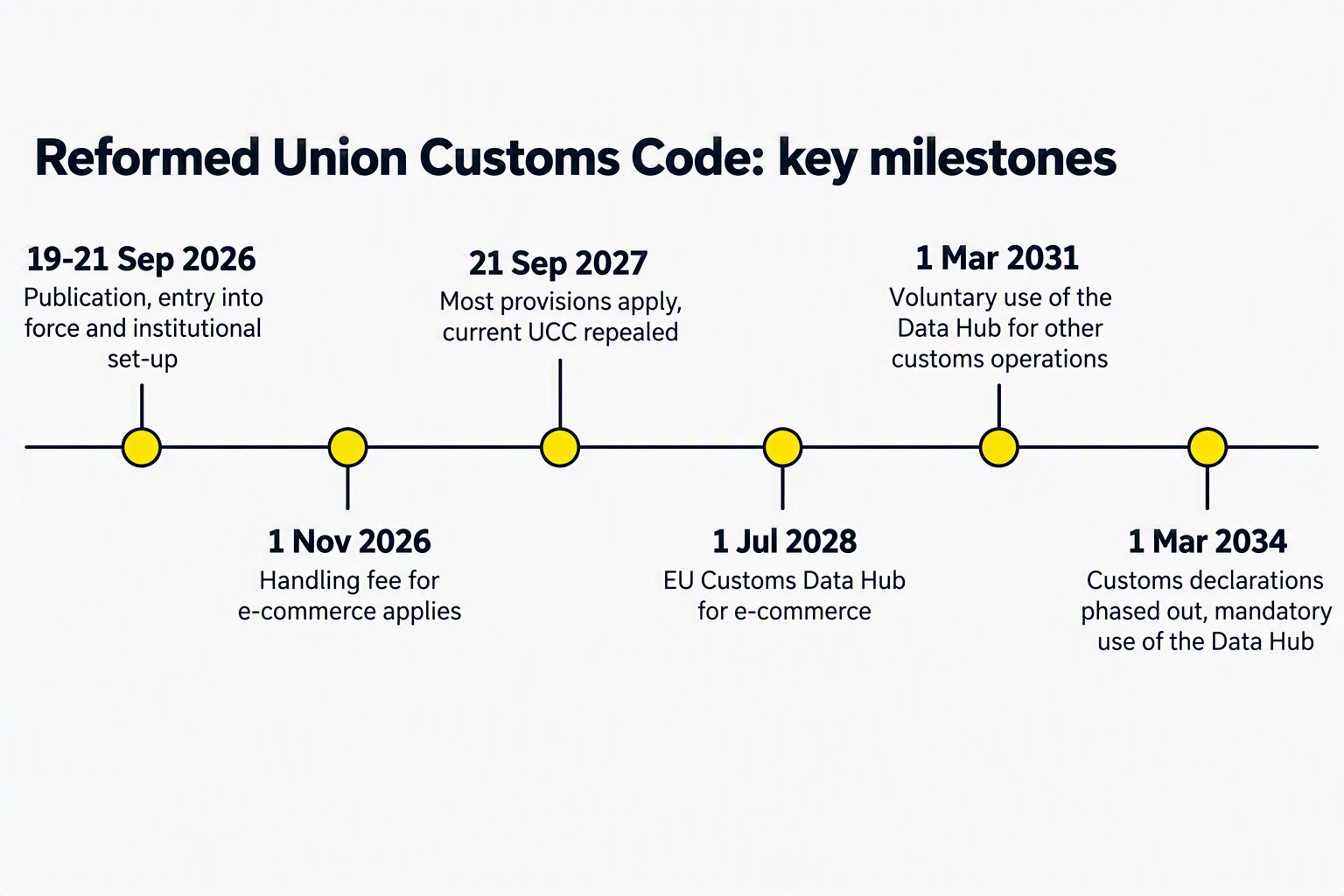
The reformed Union Customs Code introduces a dedicated framework for e-commerce imports. The EUR 150 customs duty exemption for low-value consignments had already been abolished and replaced by a fixed customs duty of EUR 3 per item. In addition, a Union handling fee of EUR 2 per item for distance sales is scheduled to be introduced starting on 1 November 2026.
The reform also introduces the concept of the “importer for distance sales”, under which online platforms facilitating sales to EU consumers become responsible for customs formalities, duty payment and compliance obligations. New Product Identifier (PID) requirements further require additional product-specific information, including merchant, manufacturer and standardized product identifiers, to be provided as part of the customs process.
Finally, the reformed UCC contains specific anti-fraud measures aimed at addressing undervaluation, misclassification and other compliance risks associated with e-commerce imports and introduces a penalty framework for systematic non-compliance.
Shift from customs declarations to the sharing of data
The reformed UCC will also establish the EU Customs Data Hub, which will replace all national customs IT systems with one single EU-wide digital environment. It will be the vehicle to move away from filing customs declarations towards the continuous sharing of data relating to a given movement of goods.
The use of the EU Customs Data Hub will become mandatory for e-commerce operators in July 2028 and will be phased in from 2031 (voluntary) until 2034 (mandatory) for the remainder of the customs operations.
As a result, businesses will have to share more data, and at an earlier stage, while other parties involved in the movement of goods may also be required to provide certain data. Once submitted, data can be consulted by all relevant competent authorities across the Union, which should support more consistent risk management and faster clearance.
A phased rollout of the reformed UCC
Turn reform into readiness
The UCC reform is an operating-model transition, not simply a future compliance deadline. Businesses should start by assessing which entities and flows are affected, how importer and exporter responsibilities will be allocated, and whether their customs strategy remains fit for purpose. This provides the basis for a phased roadmap covering governance, supply chain arrangements, data quality, systems connectivity and implementation — allowing organizations to address short term exposure while preparing for the EU Customs Data Hub on their own terms and not against the 2034 deadline.