


EY refers to the global organization, and may refer to one or more, of the member firms of Ernst & Young Global Limited, each of which is a separate legal entity. Ernst & Young Global Limited, a UK company limited by guarantee, does not provide services to clients.
Recent Searches

Discover how data spaces are reshaping business dynamics by enhancing efficiency, fostering collaboration, and unlocking new opportunities for innovation in a global context.
In brief
- Definition and Importance: Data spaces are collaborative platforms that enhance operational efficiency and drive innovation by enabling organizations to share information and resources.
- Global and Local Initiatives: Examples like Germany's Catena-X and Japan's Ouranos Ecosystem illustrate how data spaces can create efficient supply chains and promote digital transformation across industries.
- Challenges to Overcome: Key obstacles include data security, privacy concerns, and the need for standardization and interoperability among organizations.
- Strategic Focus: Companies should prioritize sustainable operations, promote data sharing, and establish clear use cases to fully leverage the benefits of data spaces for future competitiveness.
What is a Data Space?
A data space, or data-sharing ecosystem, is a concept that is rapidly gaining importance in today's business landscape. It provides a foundation for different companies and organizations to collaborate and grow together. In our increasingly digital age, sharing information and resources has become essential. These platforms not only streamline operations but also create an environment conducive to the emergence of new ideas and services, which expands business possibilities.
The advancement of digital transformation serves as a driving force for companies to operate more efficiently and deliver superior services to customers.
According to Mr. Yukihide Seki from NEC's Public Policy Relations Office and Mr. Shinji Abe from NEC’s Platform Technology Services Division, "As part of NEC's initiatives, we are participating in the Strategic Innovation Promotion Program (SIP) Third Phase, which aims to develop an information-sharing platform for plastic recycling. By promoting digitalization and conducting information analysis, we are achieving more efficient recycling. Streamlining the process for plastic waste - from collection to decomposition and reuse - contributes to addressing environmental challenges."
Data spaces play a crucial role in accelerating this trend of digitalization, becoming a key tool for companies looking to adopt new technologies and develop innovative business models.
Germany's Catena-X Automotive Network is gaining global attention as an initiative for creating a data space specifically for the automotive industry. Catena-X is intended to enable automotive manufacturers and suppliers to share data and build a more efficient supply chain1. This is expected to not only enhance productivity but also facilitate sustainable manufacturing practices that consider environmental impact, as well as new business models such as on-demand manufacturing.
In Japan, the Ministry of Economy, Trade and Industry is promoting the Ouranos Ecosystem initiative, which aims to accelerate digitalization across the entire Japanese industrial sector and facilitate data sharing among companies2. The anticipated outcome should enable Japanese companies to leverage the Ouranos Ecosystem to establish a solid foundation for boosting their global competitiveness.
In this article, we examine why data spaces are important for business and how they are impacting the economy and society. Our detailed analysis of global trends and Japan's initiatives will provide insights into the future direction and outlook for business. Data spaces are key elements that encourage the creation of new business models and the transformation of industry structures: business leaders need to understand how best to utilize them moving forward.
Data spaces also serve as a means for companies to deepen relationships with their customers. They allow for the real-time collection of customer needs and feedback, which can be utilized to improve products and services. In addition to this customer focus, they hold the potential to foster collaboration across different industries, creating new value for companies.
In a recent "EY CEO Outlook Pulse Survey" (Figure 1), 100% of CEOs in Japan's Technology, Media, Entertainment, and Telecom (TMT) sector responded that building a digital ecosystem within their industry is the most important strategic action for transforming emerging technologies into business opportunities. This is significantly higher than the global average of 75%. The results suggest that Japan's TMT CEOs recognize the potential value of data spaces, which raises the likelihood of their expansion.
Figure 1
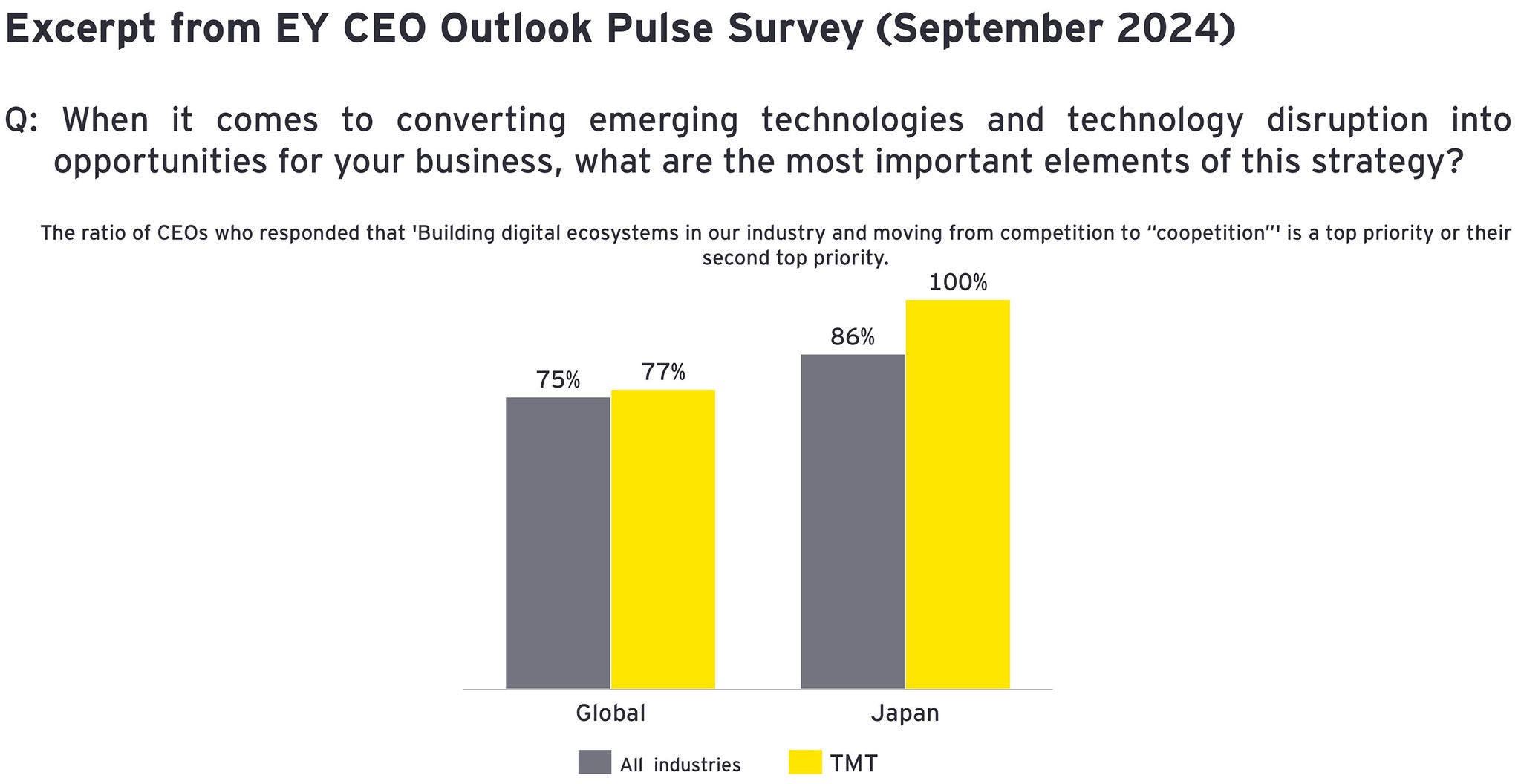
Source: EY CEO Outlook Pulse Survey, September 2024
Figure 2 illustrates an ideal vision for achieving effective data sharing with data spaces in Europe and Asia, based on the Data Free Flow with Trust (DFFT). In this initiative, rule adjustments would be agreed between governments, while the private sector would play a crucial role in promoting connectivity. This division of responsibilities would enable international connectivity on both regulatory and technological fronts, creating an environment where data can flow smoothly across countries. The Ouranos Ecosystem is being promoted by Japan's Digital Architecture Design Center (DADC) and the Ministry of Economy, Trade and Industry. These collaborations would enhance data connectivity, leading to increased transparency and efficiency across entire supply chains.
Figure 2
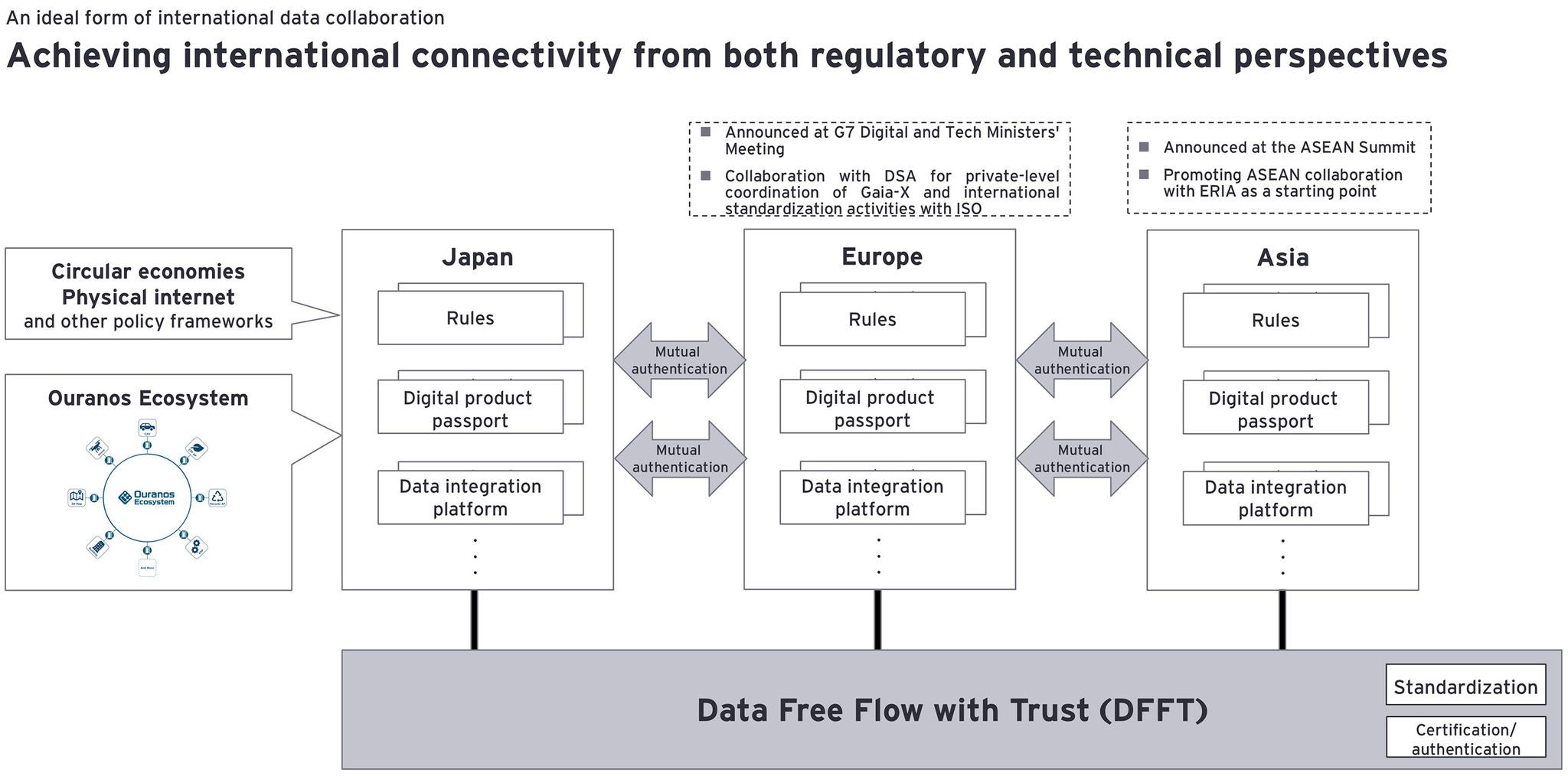
Source: Created by EY using METI resources
Challenges for data spaces
While data spaces are powerful tools for promoting cooperation and innovation among companies, there are several challenges associated with their implementation and operation. Ensuring data security and privacy is the most important concern in a data space that facilitates data sharing.
NEC’s Mr. Seki and Mr. Abe explain that, "NEC is utilizing blockchain technology to ensure data reliability but challenges remain in verifying reliability in real-time. As a consequence, we are developing a system that provides database providers with electronic signature capabilities to guarantee the authenticity of data sources. This aims to ensure the reliability of data independently of blockchain."
Protecting confidential and personal information requires robust security measures and privacy protection guidelines, including the use of encryption technology and enhanced access management. However, these measures can impose significant burdens, particularly on small and medium-sized enterprises (SMEs), due to the need for technical expertise and operating costs.
Standardization and connectivity are also essential for smooth data sharing between different companies and industries. However, the current situation, where each company uses its own systems and standards, makes standardization difficult. Industry associations and regulatory bodies need to establish and promote common standards, which requires consensus among many stakeholders and can be a time-consuming process.
Cultural and organizational barriers also pose significant challenges to the development of data spaces. Maintaining a competitive edge and adherence to existing business models hinder data sharing, and Japanese companies, in particular, tend to be conservative about disclosing information externally. Overcoming these barriers requires a transformation in organizational culture, demonstrating top-down leadership, and promoting awareness of the benefits of data sharing throughout industries, sub-sectors and individual companies.
Mr. Masato Komiya, President of d-strategy, Inc. and Associate Professor at Tokyo International University, remarks, "In Japan, there is often resistance to data sharing with other companies due to competitive concerns. However, this was also the case in Europe and Germany during the early stages of promoting the data space concept. They cultivated a common vision among executive leaders about how data sharing could change industry and individual company strategies, while also collecting smaller success stories and real examples to heighten motivation for sharing data across industries and between companies."
In addition to these challenges, there needs to be a mutual understanding among participating companies about the purpose of data sharing: in concrete terms, the principle that shared data is limited to "non-competitive areas" and that each company can specify the scope of its shared data. This is vital for maintaining trust between companies while enhancing overall industry efficiency and transparency. Data sharing is a tool but, without a clear understanding of its underlying purpose, expanding the number of participating companies will be difficult and the network effect will be limited. This could lead to increasingly negative outcomes where the accumulation of data is restricted, making it harder to achieve the intended benefits of cost reduction and innovation creation. Clarifying the purpose and vision of the data space is essential to ensuring that participating companies resonate with this purpose and build a culture of self-motivated and proactive data sharing.
Keys to Success in Data Spaces: Solutions to Challenges facing Companies
The success of data spaces hinges on how these challenges are overcome. How can companies navigate these obstacles and operate an effective platform?
Data spaces are a crucial foundation for companies to create value and achieve efficient operations. However, various initiatives are essential to maximize any benefits. Companies need to have an understanding of the following five key principles and take action based on them to regain competitive advantage in the global arena and to drive innovation:
Sustainable practices and operational efficiency: For companies, sustainable practices and operational efficiency are essential strategies in the future business landscape. In Europe, environmental regulations, such as the "EU Battery Regulation," are becoming stricter: companies that do not adapt face a higher risk of losing valuable business opportunities. In this context, leveraging data sharing can promote operational efficiency, enabling reduced costs and faster decision-making. In supply chains, sharing data with business partners allows for more accurate production planning and adjustments to orders based on changes in demand. By applying digital transformation to the existing strengths of Japan's traditional supply chains, companies can maintain competitiveness and build a foundation for sustainable growth. Mr. Komiya explains that, "Japan has historically built supply chains that share people and know-how across companies, including keiretsu3. We need to adapt these efforts to the data space and digital era. Ensuring flexibility through Scope 3 CO2 emissions sharing in the supply chain, collaborative inventory and supply planning, and developing data/AI solutions using on-site know-how from our company and partner companies are essential across all manufacturing sectors, not just in the automotive and battery sector. In Japan, the Robot Revolution and Industrial IoT Initiative (RRI) Council is participating in the International Manufacturing-X Council, a global initiative for data spaces in manufacturing. There is an expectation that Japan will create proposals and value on a global scale in the future."
- Facilitating data sharing: Businesses can reduce R&D and supply chain costs by sharing data with other companies. Establishing shared infrastructure promotes efficient resource utilization. Normalizing data sharing has the potential to fundamentally change the future of business. Mr. Seki and Mr. Abe explain that, "NEC aims to prevent data tampering and facilitate inter-company authentication using digital trust technology. In particular, we can ensure data authenticity by utilizing encryption and distributed ledger (blockchain) technologies. This initiative plays a crucial role in advancing the implementation of data spaces."
- Strengthening risk management: Utilizing information sharing within the ecosystem helps predict risks related to market fluctuations and technological advancements, allowing for proactive measures. Collaborating with partner companies helps diversify risks and enhance business stability.
- Defining specific use cases and value: While it is important to have a grand vision for building data spaces, it is equally essential to clarify specific use cases and value. Mr. Komiya comments that, "When deploying data spaces, it is common for there to be agreement between participants on the overall concept but not on the specifics. Instead of abstract discussions focused on themes, it is crucial to specify which scenarios and use cases will emerge, which benefits data sharing will bring to upstream supply chain companies and SMEs, what type of cooperation is needed from each player in those scenarios, and which data we want them to share. Current discussions around data spaces primarily revolve around use cases that benefit downstream companies, such as final product manufacturers and IT vendors, without clearly defining the benefits for the suppliers and SMEs who are central to data provision. I expect that Japan, with its many SMEs that possess competitive advantages, will present ‘supplier-first data space use cases’ to the world."
- Building global networks and promoting innovation: By deepening collaboration with overseas companies and markets, Japanese businesses can acquire new customer segments and create business opportunities. This initiative not only targets market expansion but also promotes the establishment of a comprehensive ecosystem around data. As a further upside, as data sharing among companies gains momentum, new business models utilizing data are expected to emerge, in parallel to accelerated innovation.
In Europe, the automotive industry is pioneering data spaces and enjoying first-mover advantages in improving supply chain management. In contrast, Japan is supporting various industry data sharing projects through the Ouranos Ecosystem initiative. In particular, there is an anticipation by industries that the use of advanced technologies such as drones, autonomous driving and digital twins in the TMT sector will bring about changes and innovations across a wide range of fields. TMT companies have an opportunity in the short term to deploy strategies and gain the advantages that their European counterparts have already achieved by leveraging these technologies. By advancing strategic initiatives, they can maximize the potential of data spaces and strengthen their position against international competition. These movements will contribute to promoting innovation and building sustainable business models, which are crucial elements for becoming leaders in the global market.
- “Catena-X: driving digital transformation and sustainability in the automotive industry,” EU Chemicals Platform, transition-pathways.europa.eu/initiative/catena-x-driving-digital-transformation-and-sustainability-automotive-industry (Accessed on 30 May 2025)
- DX SQUARE: What is the "Ouranos Ecosystem" system integration platform? Aiming to facilitate data sharing and utilization across industries and national bordersdx.ipa.go.jp/ouranos-ecosystem (Accessed on 30 May 2025)
- Keirestu is a Japanese term referring to a business network made up of different companies
Summary
Embracing data spaces is essential for organizations to enhance collaboration, drive innovation, and achieve sustainable growth in a competitive global landscape.