




How financial services firms can succeed amid Japan’s changing society

How financial services firms can succeed amid Japan’s changing society


Japan’s changing demographics are influencing investors’ behaviors. We estimate that this represents a potential JP¥4t revenue opportunity


In brief

  • Changing demographics will drive significant changes in demands of financial products and services.
  • Financial services firms have several strategic options to capture a share of this expanding market and serve the evolving needs of Japan’s population.

A lot has been made about Japan’s declining population and the challenges it poses for the Japanese society. The declining population, along with other demographic and social trends, will challenge Japan’s future. However, we are certain that Japan will address those challenges and in doing so, agile and forward-thinking financial services firms will be presented with significant opportunities to succeed in the new financial environment.

Several trends will force the Japanese to adapt the way they live, work and retire. These trends include:

  • Decline in birth rates, resulting in a declining population and a labor shortage (OECD)
  • Longer life spans, resulting in longer retirements (OECD and Japan MHLW)
  • Decline in savings rates, resulting in less resources available for longer retirements (OECD)
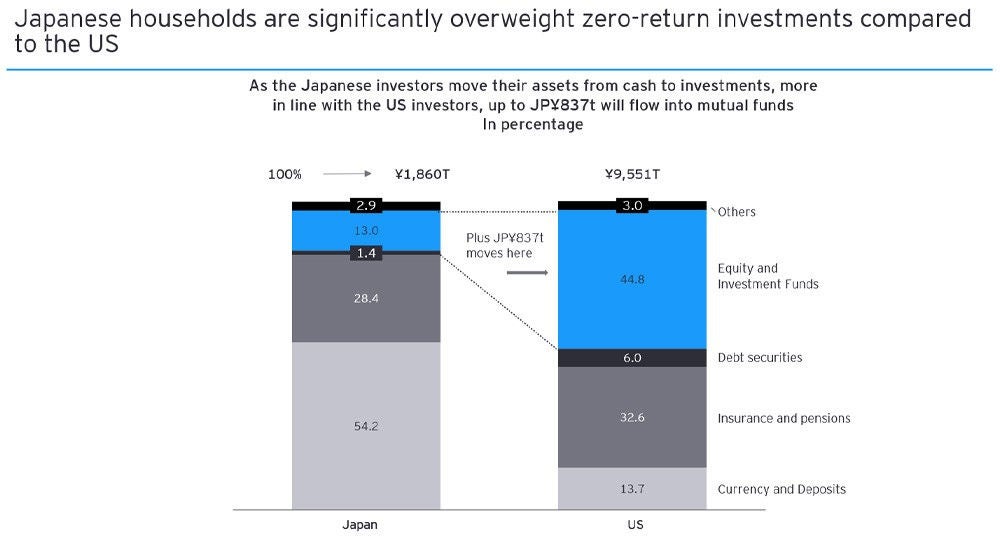
  • Strong preference to keep savings in bank accounts rather than investments, resulting in a low rate of asset accumulation — adding to the retirement-funding gap (World Economic Forum and BOJ)

Japan and Japanese society will need to adapt to meet these challenges.

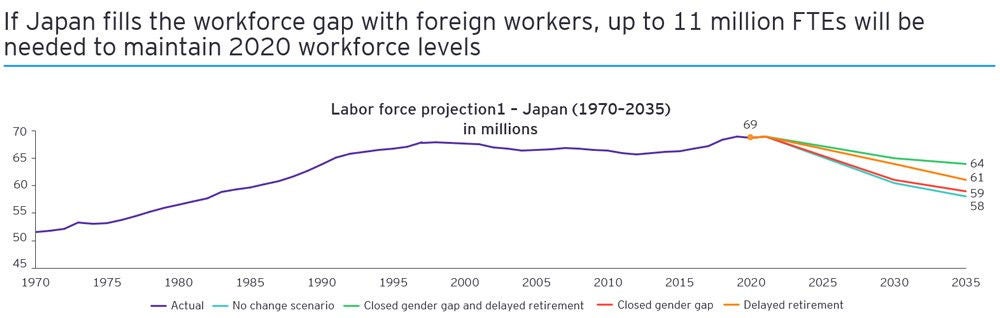
The labor shortage will be addressed by increasing the retirement age and improving women’s rate of participation in the workforce. However, even then, the labor gap will need to be addressed by welcoming more foreign workers to participate in the Japanese economy.


ey-how-financial-services-firms-can-succeed-amid-japans-changing-society

Source: "Labour Force Statistics: Population projections", OECD Employment and Labour Market Statistics (database), accessed via https://doi.org/10.1787/data-00538-en, EY-Parthenon analysis.


As people live and work longer, it is unlikely that they will spend their career with one company or even within the same industry, requiring time out of the labor force to re-educate and retool. The typical work pattern will evolve from the current education-work-retirement pattern to a pattern of education, followed by periods of work, interspersed with periods of sabbaticals and a much later final retirement.

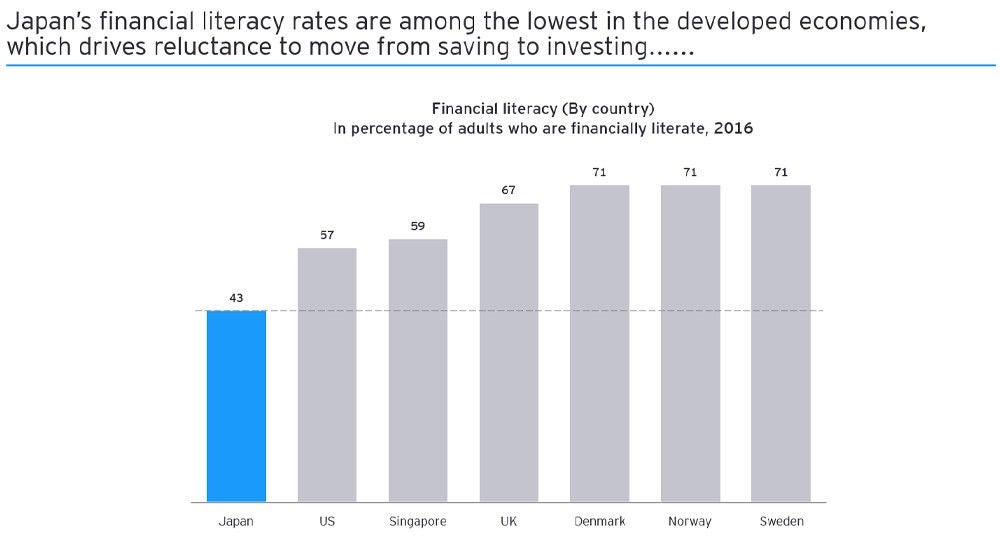
Japanese public policy and the population will evolve to move retirement funding from a “pay as you go” (defined benefit) to a “pay your own way” (defined contribution) approach, which will necessitate individual citizens taking charge of their own retirement funding. The financial literacy of the population will rise — coming into alignment with other advanced economies — and funds will shift from low/no interest savings accounts into higher-return investments.

ey-how-financial-services-firms-can-succeed-amid-japans-changing-society

Source: Financial Literacy Around the World S&P; 2016.


Japan’s financial literacy rate is seen as a contributor to the nation’s current retirement-savings gap. The current low level of financial literacy in Japan has numerous impacts, including:

  • High rate of use of bank deposits to accumulate retirement savings, despite ongoing low-rate environment
  • Overreliance on the public pension system to provide for retirement
  • Aversion to investing
  • Mistrust of financial institutions

Financial firms will have opportunities to serve the labor force and investors in Japan as the Japanese society evolves. Such opportunities will arise due to several factors, including:

  • The international labor force will have new cross-border savings, investing, insurance and simple cash-movement needs. 
  • Longer work lives and greater female participation in the workforce will increase the pool of assets available for investments.
  • Flexible accumulation and de-accumulation products will increase in demand, to meet the needs of people entering and leaving the workforce at several points in their professional life. 
  • As the Japanese become more financially literate and discerning, high-performing, fair and transparent investment products will attract the bulk of investment flows, as they move out of bank accounts.

All these changes could result in an incremental annual revenue of over JP¥4t for financial firms that adapt along with the Japanese society.


ey-how-financial-services-firms-can-succeed-amid-japans-changing-society-03

Source: Flow of Funds – Overview of Japan, the United States and the Euro Area, Bank of Japan August 20, 2021.


Strategic options for financial services firms

While the details and timing may not be clear, the Japanese policymakers and the Japanese society will change to address the new demographics, and the work and retirement requirements. 
 

When they are addressed, financial firms will be able to take advantage of new opportunities to bring value to Japan’s financial markets


1. Increases in addressable assets will be accompanied by increased demand for advisory and wealth management services by the growing population of investors. Strategic options for financial services firms include:

  • Establishing strategy for building wealth management service delivery through:
    • Digital platforms
    • Financial advisor channels
    • Blended or hybrid advisory offerings
  • Creating and executing ecosystem or partnership strategy

2. As investing and spending behaviors change, Japan’s population will increase demand for decumulation products; flexible or targeted objective products (other than retirement products); and bespoke, higher-margin products and services. Strategic options for financial services firms include:

  • Investing in product or solution innovation and rapid development capabilities
  • Investing in customer relationship management (CRM) and digital client engagement tools
  • Developing digital marketing and client servicing capabilities

3. Increased diversity within Japan’s workforce — particularly a significant increase in foreign workers — will create strong demands for cross-border transactions, multicurrency products and solutions, and multilingual or multicultural platforms. Strategic options for financial services firms include:

  • Developing cross-industry or FinTech partnerships
  • Developing product solutions which work seamlessly across borders
  • Creating M&A strategy, including selective investments in leading firms with needed capabilities and clients

There is no question that Japan’s changing society will present opportunities for innovative, forward-thinking firms. It is also clear that only innovative firms will thrive, as Japan’s financial needs change.


Summary

Financial firms that anticipate Japanese investors’ changing needs driven by demographic changes and innovate to meet those needs, will be well positioned to secure a part of the incremental JP¥4t annual revenue.


About this article