

EY refers to the global organization, and may refer to one or more, of the member firms of Ernst & Young Global Limited, each of which is a separate legal entity. Ernst & Young Global Limited, a UK company limited by guarantee, does not provide services to clients.
Recent Searches
The landscape of the data center industry and advances in AI are both evolving rapidly. This article explores the future of data centers in the context of the accelerated expansion of hyperscalers and the growing need for innovative energy efficiency solutions.
In brief
- The data center industry is undergoing a major transformation, driven by the growing demand for AI and GPU servers.
- Energy efficiency and cooling technology have become significant factors in purchasing decisions.
- Data center operators must navigate the impact of geopolitical challenges.
- Data centers serve as a model of sustainable growth.
Overview of the data center industry and market trends
In recent years, the data center (DC) industry has undergone rapid changes, shaped by the growing demand for hyperscalers and graphics processing unit (GPU) servers. In particular, GPU use has surged with the advancement of artificial intelligence (AI). This is driving major changes in data center operations.
Hyperscale data centers, often referred to as hyperscalers, are large-scale facilities designed and operated by major cloud service providers and internet companies to meet substantial data processing needs.
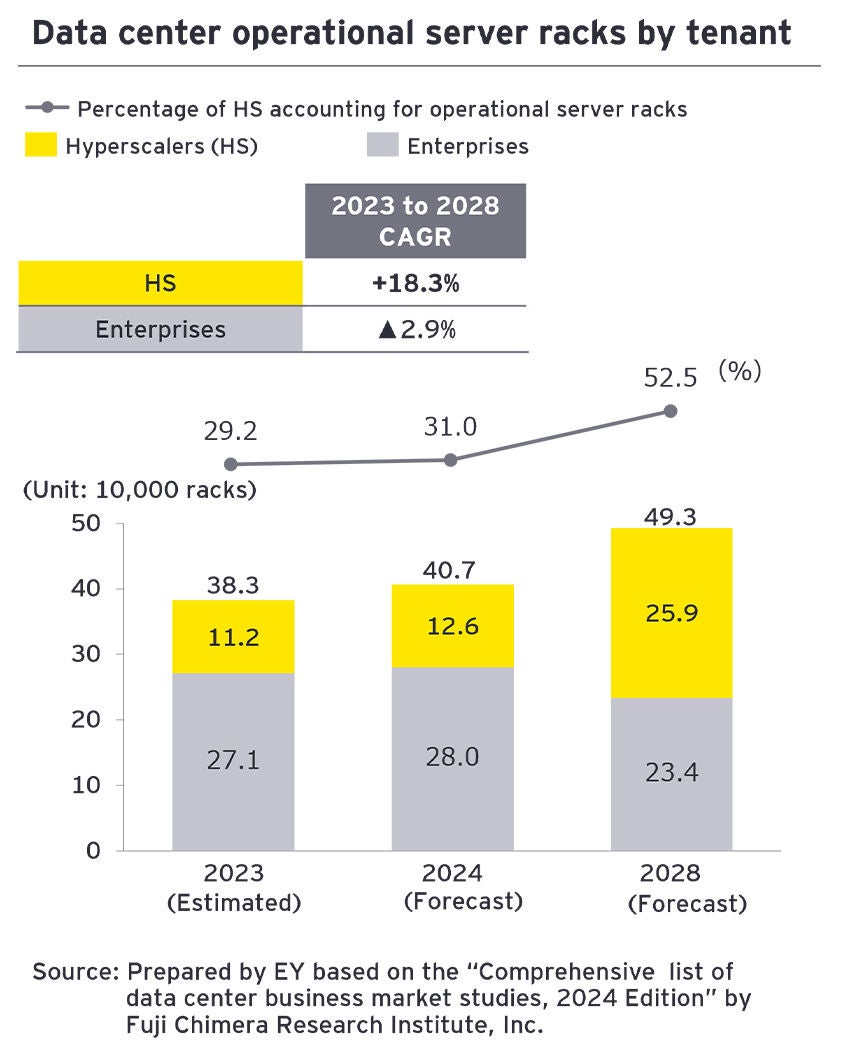
According to data from Fuji Chimera Research Institute, Inc., the number of operational server racks for hyperscalers is projected to grow at a remarkable compound annual growth rate (CAGR) of 18.3% through 2028.
Figure 1
Hyperscalers are also fueling a huge surge in the demand for GPU servers to offer AI-related applications and services. GPUs are particularly well-suited to AI training and inference tasks due to their exceptional parallel processing capabilities, especially in the areas of machine learning and deep learning. As a consequence, the GPU server market is swiftly expanding.
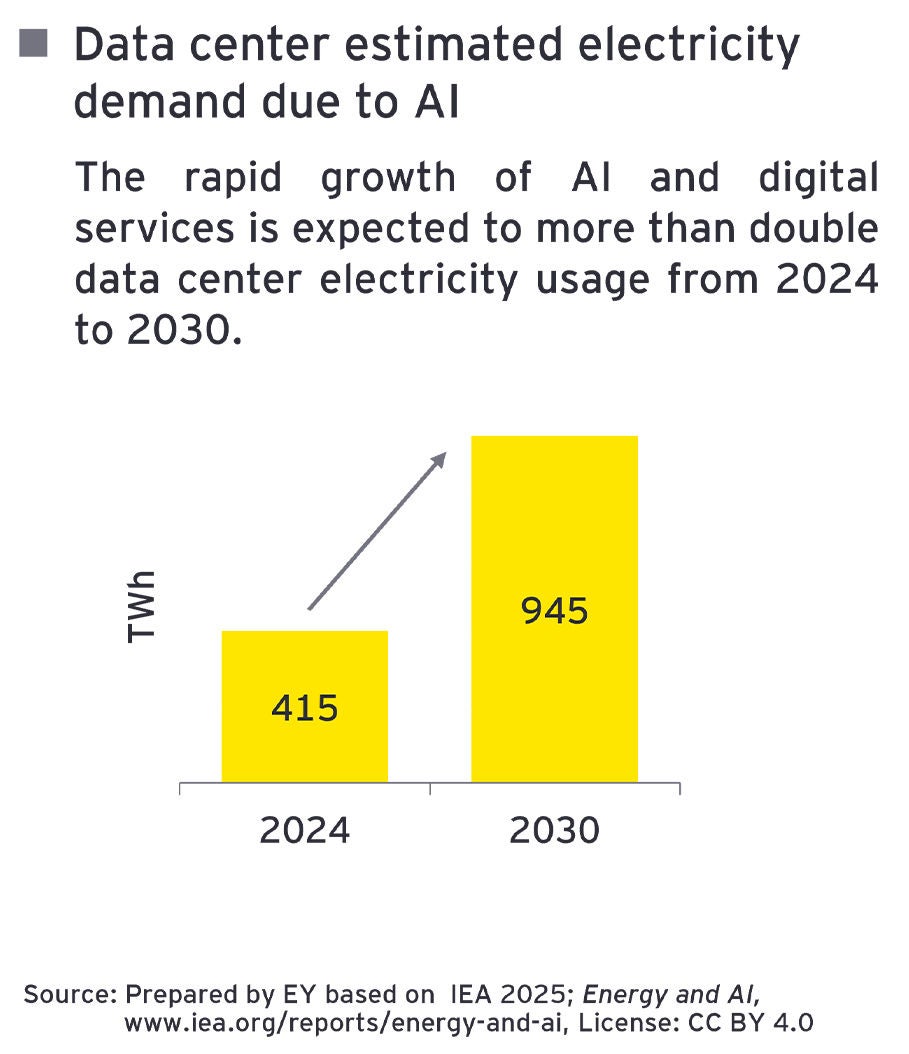
However, the nature of GPUs presents the challenge of a dramatic increase in power consumption by processors. AI requires a significant amount of computing resources and, therefore, consumes a substantial amount of electricity. The International Energy Agency (IEA) projects that the electricity demand from data centers around the globe will double from about 415 TWh in 2024 to around 945 TWh by 2030, accounting for 3% of global energy consumption by that same year. The rapid increase in power consumption is raising operational costs for data centers, while there are also concerns about their impact on the environment. As environmental concerns increase, data centers need to be energy efficient as their growing power consumption has become a critical issue.
Figure 2
This is now affecting key buying factors. Previously, cost and space optimization were the key buying factors for data centers, but now priority is given to energy efficiency and cooling technology. Hyperscalers need to adopt energy-efficient cooling systems and renewable energy to reduce operational costs. There is also a growing demand for cooling solutions specifically designed for GPU servers. As an example, new technologies—such as liquid cooling solutions and water-cooled racks—are being implemented to address the overheating issues that traditional air-based cooling systems struggle to manage.
In addition, innovations in energy supply are also important. Stable power supply is crucial for data centers: hyperscalers, in particular, require a reliable power supply due to their large scale. This may facilitate a shift towards the adoption of microgrids and decentralized energy systems. Industry players are already working to transition to renewables and diversify the power supply to reduce environmental impact while ensuring stable operations.
As a consequence, the rapid growth of hyperscalers and GPU servers is leading to a shift in the key buying factors within the data center market. With the increase in power consumption, innovations in both cooling equipment and energy supply are crucial. In light of this, businesses will need to adopt a strategic approach that integrates advancements in both cooling technologies and energy supply.
Geopolitical challenges and Japan’s positioning as a key player
Challenges confronting the data center industry extend beyond technological advancements and market dynamics. Geopolitical factors also have a significant impact. In particular, international trade friction and the intensifying rivalry between the US and China are prompting businesses to reassess their strategies for data center operations and investments. These geopolitical issues are bringing a new perspective to the key buying factors necessary for companies to tap into hyperscaler demand.
It is appropriate to begin by highlighting Sino-US rivalry. As technological competition intensifies, both countries are imposing stricter regulations, particularly concerning semiconductors and AI technologies. This may lead to an unstable supply of the necessary hardware and software for data centers. More specifically, as the demand for GPU servers surges, hyperscalers will need to explore new sourcing strategy roadmaps if the supply of these components becomes constrained. If so, businesses will need to reinforce cooperation with local suppliers and bolster domestic production.
In addition, cybersecurity threats are increasingly recognized as a geopolitical challenge. Escalating international tensions are being accompanied by the rising threat of cyberattacks. In particular, data centers store and process large amounts of confidential information, which necessitates robust security measures to protect against various threats. Companies are increasingly prioritizing tight security measures as a critical factor in selecting data center, impacting the key buying factors. More specifically, data centers must strengthen both physical security and network defenses.
Addressing these challenges may allow Japan's data center industry to leverage its position more effectively. Japan is generally considered to be geographically stable in terms of politics and economy. Additionally, the country’s well-established legal and regulatory frameworks offer a dependable operating environment for companies. Japan also plays a particularly crucial role as a key connectivity hub in the Asia-Pacific region, which may lead to an increase in multinational companies establishing data centers in the country.
Japan is now pursuing a transition to renewable energy sources and the development of energy-efficient data centers. Given wider geopolitical challenges, Japan's data centers may emerge as a model for sustainable growth in an age that prioritizes environmental awareness. This will likely lead hyperscalers to place greater importance on energy efficiency and environmental concerns as key buying factors when selecting data centers in Japan.
While geopolitical challenges are introducing complexities to the data center industry, Japan's stable political and economic environment provides a strong foundation with opportunities to navigate these challenges. Companies need to take these considerations into account when reassessing their strategies to meet the demand of hyperscalers.
In light of this context, which strategic roadmaps should businesses adopt to fully leverage data center growth?
Strategic roadmaps to fully leverage data center growth
Enhance energy efficiency and pursue sustainability
Organizations must embrace innovative technologies and methodologies to optimize energy efficiency in both the design and operation of data centers. To respond to the needs of hyperscalers, data center operators must broaden the application of the latest cooling technologies and renewable energy, ensuring sustainable operations. Furthermore, the utilization of micro-reactors, also known as small modular reactors (SMRs), is expected to play a significant future role in ensuring a stable power supply and reducing carbon emissions.
Acquire and develop talent
Companies must recruit and retain personnel with specialized knowledge. They should partner with educational institutions and industry groups to develop curricula related to data centers and establish a pipeline for acquiring talent by providing real-world experience through internships and training programs.
Strengthen and diversify supply chains
Companies must strengthen and diversify their supply chains to address current geopolitical challenges and supply shortages. They need to adopt a multi-sourcing procurement strategy and bolster domestic manufacturing to create a more resilient supply chain and reduce reliance on single-source suppliers.
Fortify security measures
As cybersecurity threats rise, employing robust security measures in data centers is crucial. Data centers must strengthen both physical security and network defenses to gain customer trust. As a result, data centers should set up a framework to respond to the needs of hyperscalers.
【Authors】
EY Strategy and Consulting Co., Ltd.
Technology, Media & Entertainment, and Telecommunications (TMT)
Shinichiro Hara (Associate Partner)
Koichi Tamiya (Director)
Yuya Ishige (Manager)
Katsufumi Tomobe (Manager)
Junghun Lee (Senior Consultant)
Summary
The data center industry is evolving, driven by the growing demand for hyperscalers and GPU servers. Japan must leverage its stable geographical position and formulate a strategy for sustainable growth by focusing on energy efficiency solutions, talent development and enhancing supply chains.