



EY refers to the global organization, and may refer to one or more, of the member firms of Ernst & Young Global Limited, each of which is a separate legal entity. Ernst & Young Global Limited, a UK company limited by guarantee, does not provide services to clients.
Recent Searches
New documentation requirements for IP transactions and intra-group services

What has been introduced and who will be affected?
On 31 March 2026, new Corporation Tax Law Enforcement Regulations (CTLER) Article 59-2 was published in the official government gazette, requiring taxpayers to prepare and retain prescribed information about intercompany IP and service transactions.
If Japanese corporations, including Japanese subsidiaries of foreign groups, have related party transactions which give rise to expenses within the scope of Corporation Tax Law (CTL) Article 22(3)(ii) involving either IP (license transactions, royalty transactions etc.) or the provision of services (management, HR, accounting, legal, R&D, marketing etc.), they must prepare documentation showing:
- the rationale for the transaction, and
- a detailed explanation of how the amount paid by the Japanese corporation was calculated.
The calculation should show allocation keys used, details of cost base and how these link to the amount paid. The documents must be retained for seven years.
The rules apply to fiscal years starting on or after 1 April 2026, and therefore companies with a March fiscal year end are already subject to these requirements. Branches of foreign companies are not subject to the new rules. Companies whose digital transaction records already show the information required are exempt from the new rules.
The rules apply to transactions with domestic as well as foreign related parties. This is important; companies may already prepare documents which fulfil the requirements for overseas related party transactions as part of transfer pricing compliance, but may not have the same level of documentation for domestic transactions.
What are the consequences for non-compliance?
The Japanese tax authorities can revoke the blue tax return filer status1 of companies which do not prepare the required documentation. This would prevent those companies carrying forward net losses, and prevent use of any special tax regimes accessed as a blue tax return filer..
This is in sharp contrast to standard transfer pricing penalties, where the tax authorities must demonstrate non-compliance with the arm’s length principle to be able to make an assessment for additional tax, interest and penalties.
While it is not clear how aggressively the Japanese tax authorities will seek to revoke blue tax return filer status, taxpayers should understand that the risk exists in case of non-compliance.
1Blue tax filer status is a privileged tax filing status for taxpayers who maintain double entry accounting records, journals, general ledger and other necessary books detailing all transactions. This status grants access to loss carryforwards and certain special tax regimes (e.g. R&D incentives)
What should inbound companies do to prepare?
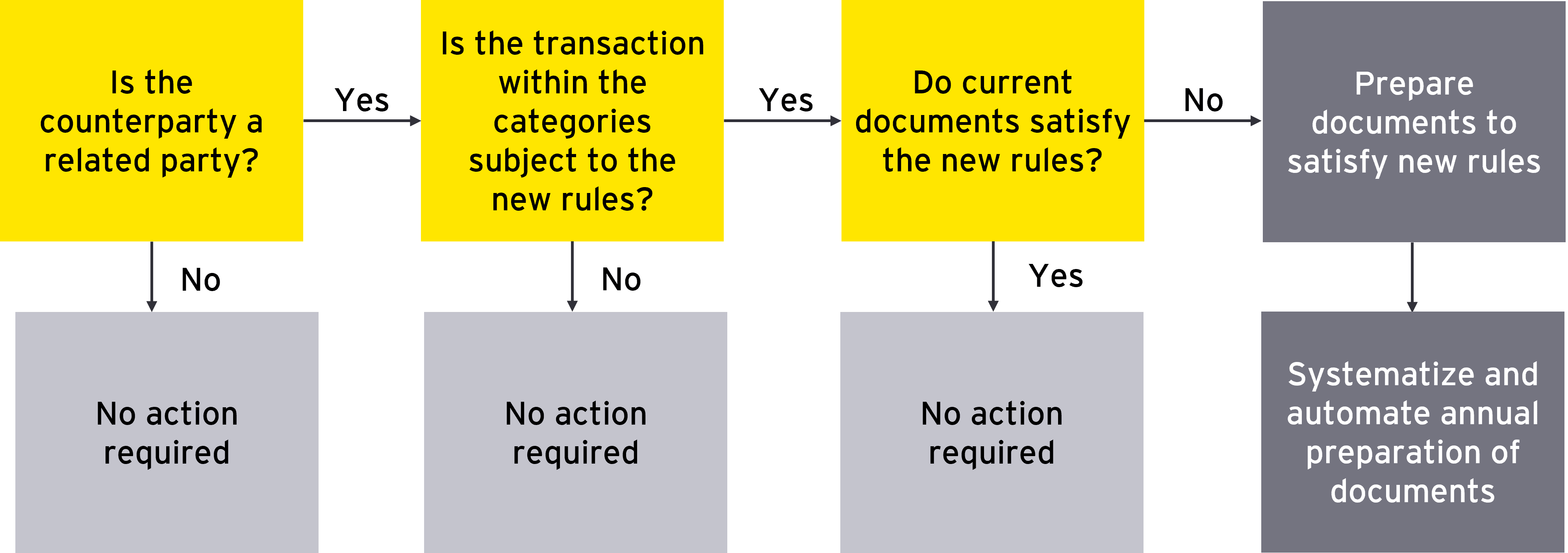
We recommend that companies first make an inventory of current related party transactions that are subject to the rules.
For the transactions identified, review the documentation presently available (e.g. invoices, purchase orders, intercompany agreements, transfer pricing documentation etc.) and confirm whether they satisfy the new rules.
While there is no exhaustive list of required information set out by the Japanese tax authorities, broadly the documentation should show:
- Why the Japanese corporation is making the payment to its related party,
- How the amount paid was calculated, with all inputs to the calculation explained and supported. For example:
- If there is an allocation made, the allocation key used, its calculation and the underlying rationale for using that allocation key
- If there is a royalty rate applied, how that rate was determined (e.g. a benchmarking study), and the determination of the base (e.g. sales) to which the royalty was applied
- If there is a mark-up on costs, how the mark-up was determined, and the components of the cost base
For subsidiaries of overseas headquartered companies much of this information may be held at regional or global headquarters, so the Japanese subsidiary may need to request and explain the reason for needing the information in Japan.
Finally, after understanding what they need to do to meet the new requirements, companies should consider how they can update systems to automate and systematize the process, rather than tackling it on a manual, ad-hoc basis each year.
For example, whether the:
- preparation of this documentation can be handled at the same time as the annual transfer pricing local file process, so the process and responsibility of maintaining it is clear
- company’s ERP system can be updated to include a detailed calculation of amounts charged automatically as an appendix to the intercompany invoice issued to the Japanese company, so the requirements are automatically met
The below flow chart sets out a recommended preparation process.
Finally, we recommend companies monitor their ongoing compliance, to ensure documentation requirements continue to be met and audit readiness does not slip over time.
Contact
Ernst & Young Tax Co.
Karl Gruendel Partner
Keith Thomas Associate Partner
Jonathan Perry Director
How EY can Help
-
EY Japan’s Inbound Services team helps multinational corporations establish and grow their business in Japan. We support businesses at every stage of their Japan journey. Our services include market entry, entity structuring, tax compliance, transfer pricing, and legal advisory.
Read more
Direct to your inbox
Stay up to date with our Editor's picks newsletter.
Tax
Our tax professionals offer services across all tax disciplines to help you thrive in this era of rapid change.