



EY refers to the global organization, and may refer to one or more, of the member firms of Ernst & Young Global Limited, each of which is a separate legal entity. Ernst & Young Global Limited, a UK company limited by guarantee, does not provide services to clients.
Recent Searches
Global Minimum Tax filing requirements for foreign-owned Japanese entities

I. Overview of Global Minimum Tax
Global Minimum Tax is a framework designed to ensure that multinational enterprise groups (MNE Groups) with annual consolidated revenues of EUR 750 million or more are subject to a minimum effective tax rate of 15% in each jurisdiction with respect to a portion of their income.
In Japan, in line with international agreements, three rules have been introduced under the Global Minimum Tax framework: the Income Inclusion Rule (IIR), the Undertaxed Profits Rule (UTPR) and the Qualified Domestic Minimum Top-up Tax (QDMTT), as illustrated below. The IIR applies to Fiscal Years beginning on or after 1 April 2024, while the UTPR and QDMTT apply to Fiscal Years beginning on or after 1 April 2026.
Figure 1: Overview of Global Minimum Tax
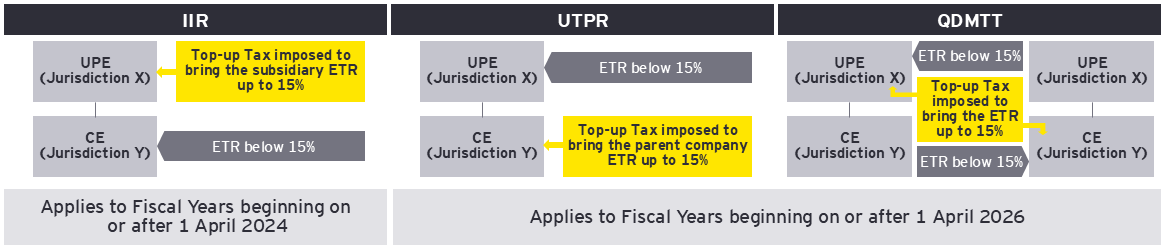
UPE: Ultimate Parent Entity CE: Constituent Entity
Source: EY
The first Fiscal Year to which the Global Minimum Tax rules under Japanese laws and regulations apply for foreign-owned Japanese entities is as follows.
Figure 2: First Fiscal Year subject to Global Minimum Tax under Japanese laws and regulations

Source: EY
II. Filings required in the first year of Global Minimum Tax
As part of the first-year compliance requirements for Global Minimum Tax, the following filings are required in Japan. The filings required may differ depending on the Global Minimum Tax position of each MNE Group, and are therefore discussed in greater detail in Section III.
- GloBE information return
- Notification for Ultimate Parent Entity of a MNE Group (GIR Notification)
- Corporate tax return relating to the IIR (IIR tax return)
1. GloBE information return (GIR)
(1) Overview of the GIR
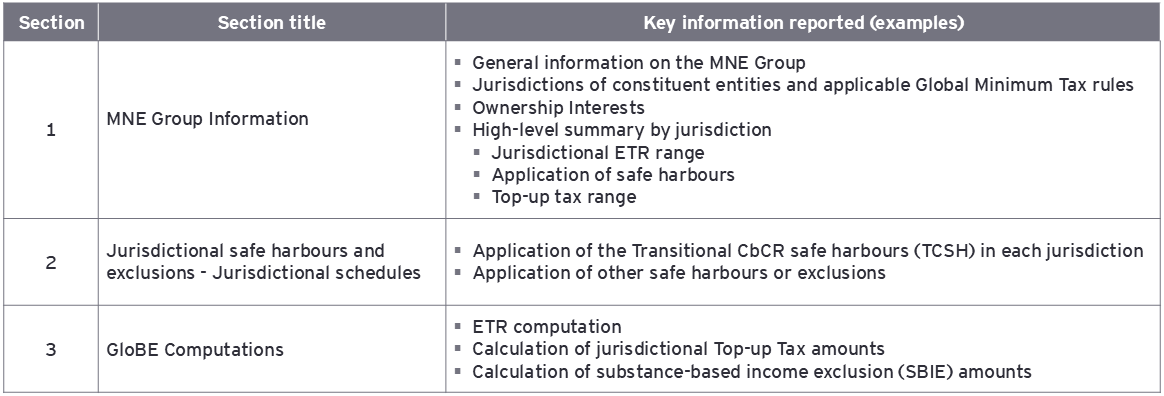
The GIR is required to be filed by all MNE Groups subject to the Global Minimum Tax framework. Its purpose is to provide tax authorities with the information necessary to perform a risk assessment and evaluate the correctness of a Constituent Entity’s Top-up Tax liability.
The GIR consists of three sections. The key information required to be reported in each section is outlined below.
Figure 3: Structure of the GIR
Source: EY
(2) GIR filing obligations and scope of information reported
In principle, each Constituent Entity of an MNE Group is required to file a GIR in the jurisdiction where it is located (local filing). Where multiple Constituent Entities in the same jurisdiction are subject to the filing requirement, the group may designate a representative filer, referred to as a Designated Local Entity.
To reduce the compliance burden on MNE Groups, however, a GIR may instead be filed with the tax authority in the jurisdiction of the Ultimate Parent Entity (UPE). Where an effective Multilateral Competent Authority Agreement (MCAA) is in place as of the GIR filing deadline, the tax authority receiving the GIR may exchange the information with tax authorities in other jurisdictions (central filing). In practice, where central filing is possible, MNE Groups would generally be expected to use this approach. An MNE Group may also designate a Designated Filing Entity (DFE) to file the GIR in the jurisdiction where the DFE is located.
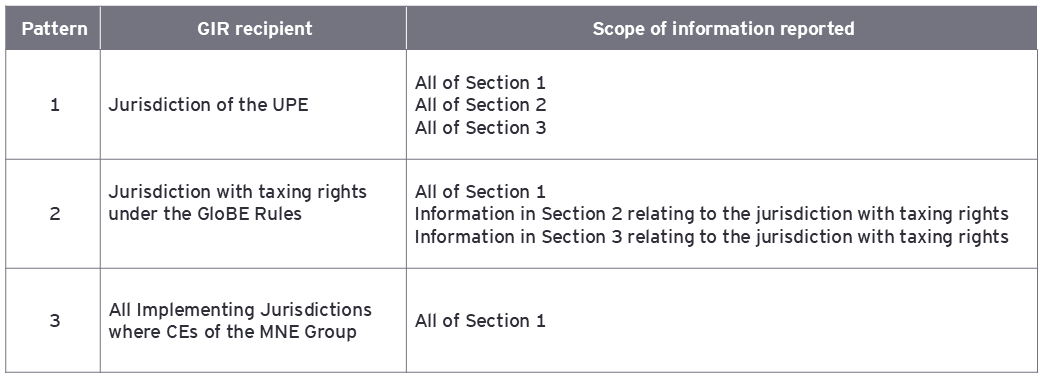
With respect to the scope of information reported in the GIR, the information to be provided varies depending on the recipient jurisdiction, based on the dissemination approach adopted in the GIR framework, which determines what information is shared with which jurisdictions. The categories of information provided are outlined below.
Figure 4: Scope of GIR information to be reported
Source: EY
For this purpose, a jurisdiction with taxing rights refers to a jurisdiction that is within the scope of the GloBE Rules for the MNE Group and is required to apply the GloBE Rules in accordance with the rule order, which determines which jurisdiction is entitled to collect Top-up Tax. This includes jurisdictions that have implemented QDMTT.
2. Notification for Ultimate Parent Entity of a MNE Group
Where an MNE Group files a GIR through central filing and both of the conditions in i) and ii) below are satisfied, a Constituent Entity is not obligated to file a GIR by submitting the Notification for Ultimate Parent Entity of a MNE Group (GIR Notification). In other words, the GIR Notification is submitted in lieu of the GIR in the jurisdiction where the subsidiary is located.
i) A GIR is filed in the jurisdiction of the UPE or DFE by the filing deadline
ii) An effective MCAA is in place between Japan and the jurisdiction of the UPE or DFE as of the GIR filing deadline of the local jurisdiction
As with the GIR, where multiple Constituent Entities are located in the same jurisdiction, a Designated Local Entity may be designated for purposes of the GIR Notification. Although the form is similar to the existing country-by-country reporting (CbCR Notification), it is a separate notification.
In addition, Japan has not prescribed any advance registration system for Global Minimum Tax.
3. Corporate tax return relating to the IIR (IIR tax return)
Where an MNE Group is liable for Top-up Tax in Japan, it is required to file a Corporate tax return relating to the IIR (the “IIR tax return”). However, if no Top-up Tax amount arises, the IIR tax return is not required to be filed, meaning that Japan does not require so-called nil filing.
4. Filing deadlines
For each of the filings described in 1. to 3. above, the filing deadline in Japan for the first Fiscal Year where the IIR applies is within one year and six months from the day following the end of the Fiscal Year, which refers to the UPE’s consolidated accounting period. Accordingly, for an MNE Group with a March year-end, the first filing deadline in Japan will be the end of September 2026, while for an MNE Group with a December year-end, the first filing deadline in Japan will be the end of June 2027.
For subsequent years, the filing deadline is within one year and three months from the day following the end of the Fiscal Year.
5. Penalties
Penalties are prescribed for filings and other procedures relating to Global Minimum Tax. For example, if a GIR is not filed by the deadline without justifiable grounds, the representative or other relevant person of the corporation may be subject to imprisonment for up to one year or a fine of up to JPY500,000.
III. Actions required for foreign-owned Japanese entities
For the first year where Global Minimum Tax applies in Japan, this section explains the filings required for Japanese Constituent Entities that belong to foreign-owned MNE Groups whose UPE is located outside Japan.
1. GIR/Notification for ultimate parent entity
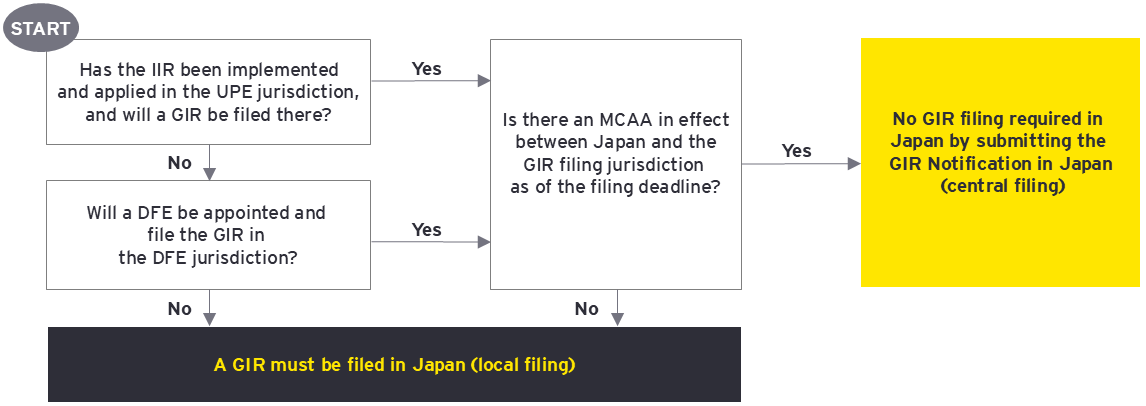
For foreign-owned MNE Groups, the application of the rules differs depending on whether the IIR has been implemented and applies in the UPE jurisdiction for each Fiscal Year.
Figure 5: Practical decision flow for GIR filing in Japan by foreign-owned MNE groups
Source: EY
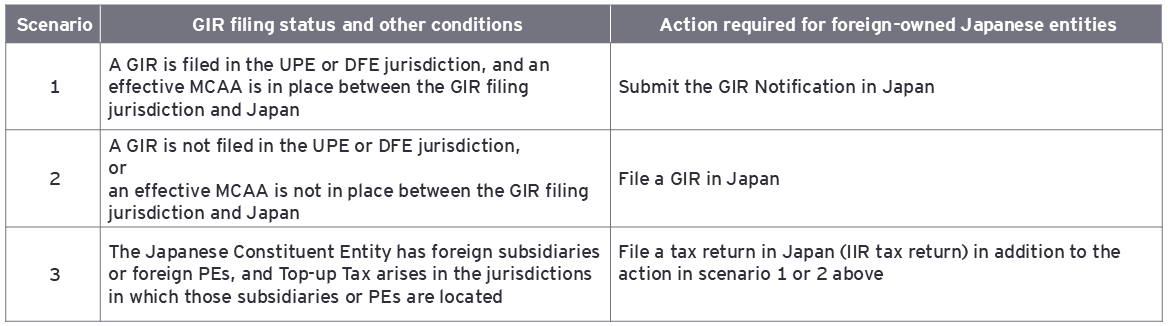
Where a GIR is filed in the jurisdiction of the UPE or DFE, and an effective MCAA is in place between Japan and that jurisdiction as of the filing deadline, the GIR is not required to be filed in Japan under the central filing approach, provided that the GIR Notification is submitted in Japan. In this case, if there are multiple Constituent Entities in Japan, a Designated Local Entity may be designated in the GIR Notification, so that the other Japanese Constituent Entities are not required to submit the notification.
On the other hand, if a GIR is not filed in any jurisdiction, or if there is no effective MCAA between Japan and the jurisdiction where the GIR is filed as of the GIR filing deadline, the default local filing approach applies and a GIR must be filed in Japan. In this case, if the Japanese Constituent Entity does not have any foreign subsidiaries or permanent establishments (PEs), only Section 1 of the GIR is required to be filed under Pattern 3 in Figure 4 above. However, if the Japanese Constituent Entity has foreign subsidiaries or PEs, and Japan has taxing rights under the IIR with respect to the jurisdictions where those subsidiaries or PEs are located, Pattern 2 in Figure 4 above applies. In this case, in addition to Section 1, information in Sections 2 and 3 relating to the jurisdictions with taxing rights must also be included in the GIR.
It should be noted that, in order for a GIR filing in the subsidiary jurisdiction to be discharged through central filing, the GIR must be filed by the UPE or DFE. Accordingly, if a GIR is not filed by the UPE or DFE, and instead an Intermediate Parent Entity files a GIR containing only information relating to the jurisdictions with taxing rights under its ownership chain, the central filing approach cannot be used. In such cases, local filing of the GIR would be required in the jurisdictions where the subsidiaries under that Intermediate Parent Entity are located.
In addition, as a recent development, the Side-by-Side Safe Harbour (the “SbS SH”) included in the Side-by-Side Package released by the OECD in January 2026, can be applied to the MNE Group whose UPE is located in the United States. Where the SbS SH applies, for the purpose of applying the IIR and UTPR, the Top-up Tax deemed to be zero with respect to all of the MNE Group’s Constituent Entities. However, because the SbS SH applies to Fiscal Years beginning on or after January 2026, a GIR will be required to be filed in the subsidiary jurisdictions that have implemented the IIR in the first year of application. In addition, even for Fiscal Years to which the SbS SH applies, it is considered that, as with other safe harbours, MNE Groups will be required to make an election in the GIR to apply the SbS SH. Accordingly, Japanese Constituent Entities that are part of US-headed MNE Groups should note that, in the first year of application, they will be required either to (i) file a GIR in Japan through local filing or (ii) submit the GIR Notification in Japan through central filing.
2. IIR tax return
Because Japan’s IIR does not apply to domestic Constituent Entities, where a Japanese Constituent Entity does not have any foreign subsidiaries or PEs, no Top-up Tax will arise in Japan under the IIR, and an IIR tax return will not be required in Japan. However, where a Japanese entity has foreign subsidiaries or PEs and Top-up Tax arises with respect to the jurisdictions where those subsidiaries or PEs are located, Japanese Constituent Entity that belongs to a foreign-owned MNE Group will be required to file an IIR tax return in Japan as an Intermediate Parent Entity or Partially-Owned Parent Entity (POPE).
In summary, the actions required for foreign-owned Japanese entities can be categorized into the following cases.
Figure 6: Foreign-owned Japanese entities: required actions by scenario
Source: EY
3. Filing deadline considerations
As noted above, the filing deadline for the GIR, the GIR Notification and IIR tax return in the first Fiscal Year of application in Japan is within one year and six months from the day following the end of the Fiscal Year.
For example, some foreign-owned MNE Groups with a December year-end may have already filed a GIR for FYE December 2024 in the jurisdiction of the UPE or DFE under the laws and regulations of another jurisdiction. In such cases, FYE December 2025 would be the second year of application in that other jurisdiction, and the local GIR filing deadline would be within one year and three months from the day following the end of the Fiscal Year, or the end of March 2027. In Japan, however, FYE December 2025 is the first year of application, so the filing deadline in Japan is within one year and six months, or the end of June 2027. Where the central filing approach is used, the GIR will have been filed in the jurisdiction of the UPE or DFE before the Japanese filing deadline. Therefore, the relevant requirements can be satisfied by submitting the GIR Notification in Japan by the filing deadline, subject to separate confirmation that an MCAA is in place.
IV. Filing requirements for Japanese branches of foreign corporations
Finally, this section supplements the discussion above by addressing Global Minimum Tax filing requirements for PEs of foreign corporations located in Japan, such as Japanese branches of foreign corporations. Under Japanese laws and regulations, the obligation to file the GIR and the GIR Notification under Japan’s IIR applies only to domestic corporations. Accordingly, Japanese branches of foreign corporations are not required to make these filings.
On the other hand, the UTPR and QDMTT also apply to PEs of foreign corporations. Therefore, for Japanese branches of foreign corporations that are part of an MNE Group, the GIR and the GIR Notification will be required for Fiscal Years beginning on or after 1 April 2026. In addition, if Top-up Tax arises, the relevant tax return will also need to be filed.
Contact
Ernst & Young Tax Co.
Ryuta Tosaki Partner
Hideki Ohori Associate Partner
Yuko Yamaguchi Associate Partner
How EY can Help
-
Getting ready for global minimum taxes: EY can help you evaluate the impact on your organization and develop a robust, actionable plan. Learn more.
Read more -
EY Japan’s Inbound Services team helps multinational corporations establish and grow their business in Japan. We support businesses at every stage of their Japan journey. Our services include market entry, entity structuring, tax compliance, transfer pricing, and legal advisory.
Read more
Direct to your inbox
Stay up to date with our Editor's picks newsletter.
Tax
Our globally connected tax network can help your tax function address complex issues, making sure you can operate confidently in today’s disruptive landscape.