








Agentic automation financial services

How agentic automation is shaping the future of financial services

Explore the shift from robotic to agentic automation in finance, where AI-driven systems enhance operations, compliance and customer engagement.


In brief

  • Financial institutions are moving beyond robotic process automation and intelligent automation toward agentic automation that can reason, decide and act across end-to-end processes.
  • AI-driven automation, supported by data platforms and modern architectures, is transforming automation in banking across operations, risk management and customer engagement.
  • To unlock sustainable value, organizations should align technology, governance and talent around trust, explainability and regulatory resilience.

A Luxembourg perspective

Can traditional operating models survive in an autonomous era?

From automation to autonomy, AI is redefining the financial industry and operating model. While the last decade focused on efficiency through rule based automation, the industry has now entered an augmentation phase, where AI and GenAI support human decision making by extracting insights, handling unstructured data and managing increasingly complex tasks. This shift is particularly pronounced in financial services, where rising asset complexity, fragmented data and higher client expectations are stretching traditional models. Looking ahead, the trajectory points toward autonomous operations: environments in which AI driven systems can interpret data, make decisions and execute actions end to end within defined governance frameworks, fundamentally moving operations away from execution and toward intelligent design.

This evolution is changing the basis of competition. AI native fintechs are raising the bar with scalable, adaptive and cost efficient operating models, challenging incumbents whose historical advantages were built on scale, footprint and client relationships. While these traditional strengths remain powerful and underpinned by trust, deep integration and high switching costs, they are no longer sufficient in isolation. Early signs of autonomy are already visible: agent based workflows, self resolving reconciliations, self service analytics and a reallocation of human effort toward oversight, governance and model risk management. To sustain relevance, financial institutions must complement legacy advantages with investments in data foundations, intelligent architecture and adaptive operating models, ensuring that trust and scale are reinforced, not eroded, in an AI driven future.

Never miss a Luxembourg perspective with our monthly newsletter, summarizing short expert commentaries with a local flavor, covering a range of sector-spanning themes. Subscribe now.

For over a decade, robotic process automation (RPA) has played a central role in process automation across banks, insurers and capital markets. These rule-based approaches delivered efficiency gains, but rising customer expectations and growing regulatory complexity are exposing their limitations.

The transition from RPA to agentic automation marks a move toward more adaptive systems. Agentic AI in banking and finance can understand context, set goals and adjust actions dynamically. This evolution signals a broader shift from cost-focused automation in banking toward intelligent process automation in financial services that supports higher-value outcomes.

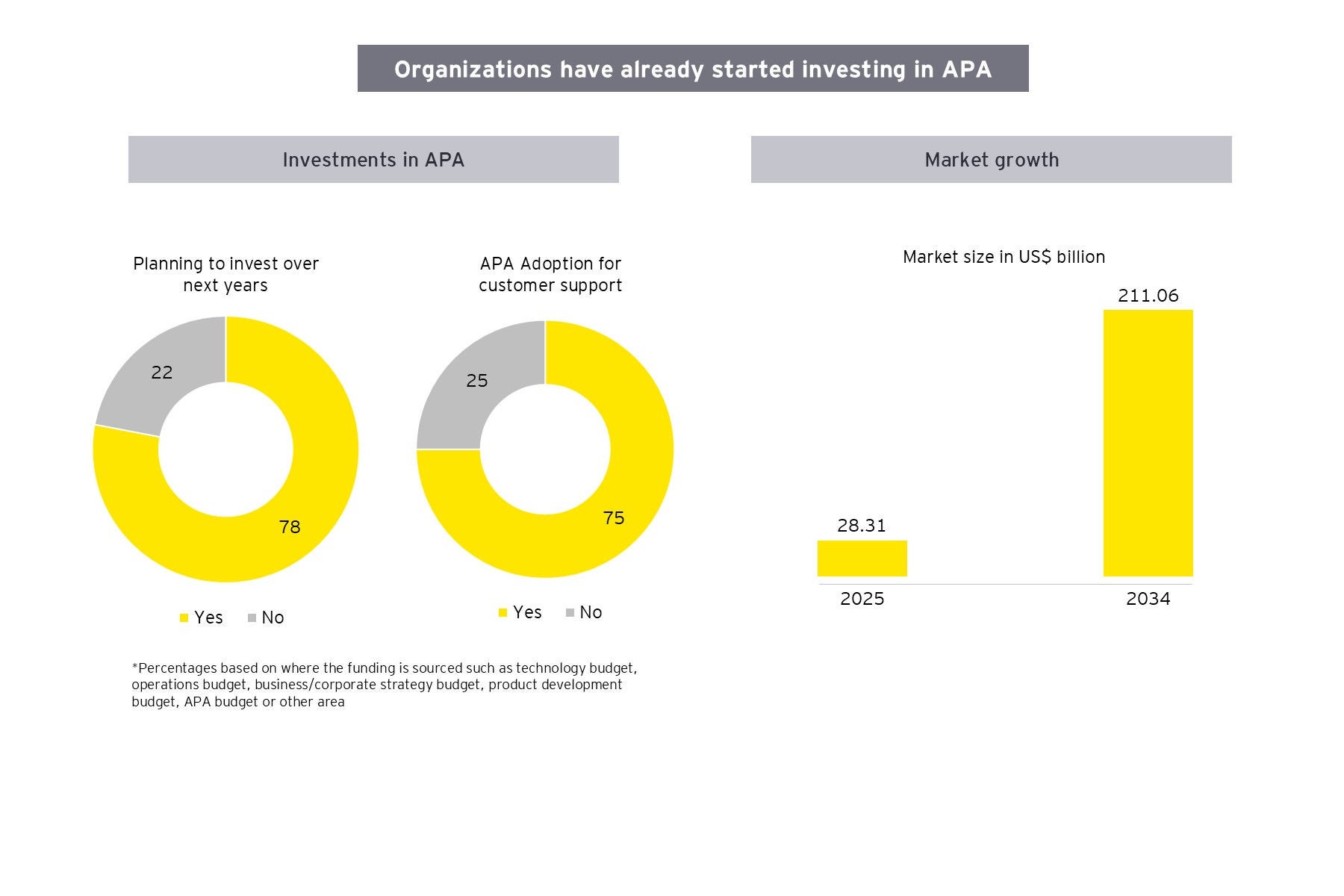
Organizations have already started investing in APA

From efficiency engines to intelligent operators

Traditional automation strategy emphasized task fragmentation. Agentic automation focuses on outcomes. Through Agentic AI for end-to-end process automation, intelligent agents can gather data from multiple systems, interpret unstructured information and collaborate with humans in real time.

These capabilities enable autonomous agents in financial services operations to support self-healing workflows and more responsive service models. Intelligent agents for financial operations also enhance decision support in finance and risk teams, moving them from reactive reporting toward more informed, proactive management.

Agentic AI fundamentally redefines automation by shifting from task execution to intent-driven decision-making. With Automation Anywhere, intelligence does not stop at insight; it takes action. This is the true evolution: from automated workflows to autonomous, intelligent operations.

Automated Reporting Tool (ART)

Automated Reporting Tool (ART) is an end-to-end regulatory reporting automation platform that simplifies financial reporting, enhances accuracy, and reduces compliance risks for banks, NBFCs, and insurers.

Know more

Data, platforms and trust

Realizing the value of agentic automation requires stronger foundations. High-quality data, modern platforms and cloud-native automation are critical enablers of reliable AI-driven automation at scale. Institutions that invest in these capabilities are better positioned to extend enterprise automation beyond isolated use cases.
 

Trust remains equally important. Governance and trust in agentic automation should be embedded into system design, with transparency, auditability and appropriate human oversight. These controls are essential to align autonomous process automation with regulatory expectations and organizational values.

LLM for transforming the BFSI sector: Unlocking innovation and efficiency

A specialized fine-tuned LLAMA 3.1-8B Instruct model, which aims at addressing the distinct challenges in customer care within India's BFSI sector.

Know more

Building an ecosystem for intelligent process automation

Progress in agentic automation depends on collaboration between financial institutions, technology providers, regulators and academia. Common standards for ethics, model risk management and interoperability will support the safer adoption of Agentic AI in banking and finance.
 

Talent evolution is also underway. As organizations move from robotic to agentic automation, skills are shifting from bot configuration toward orchestration, governance and stewardship of intelligent automation ecosystems.

Our agentic solutions are fundamentally different; they are designed for how AI agents work, enabling them to autonomously reason, solve problems and adapt to changes — delivering exponentially greater ROI.

C-level executives’ priorities

Senior leaders increasingly view the journey from RPA to agentic automation as a strategic transformation. Three priorities stand out:

  • Governance by design: Embedding risk and compliance into agentic architectures from the outset.
  • Investment in intelligence: Prioritizing data platforms, AI capabilities and scalable enterprise automation.
  • Human-agent collaboration: Redesigning roles so that people provide judgment and oversight while agents handle complexity.
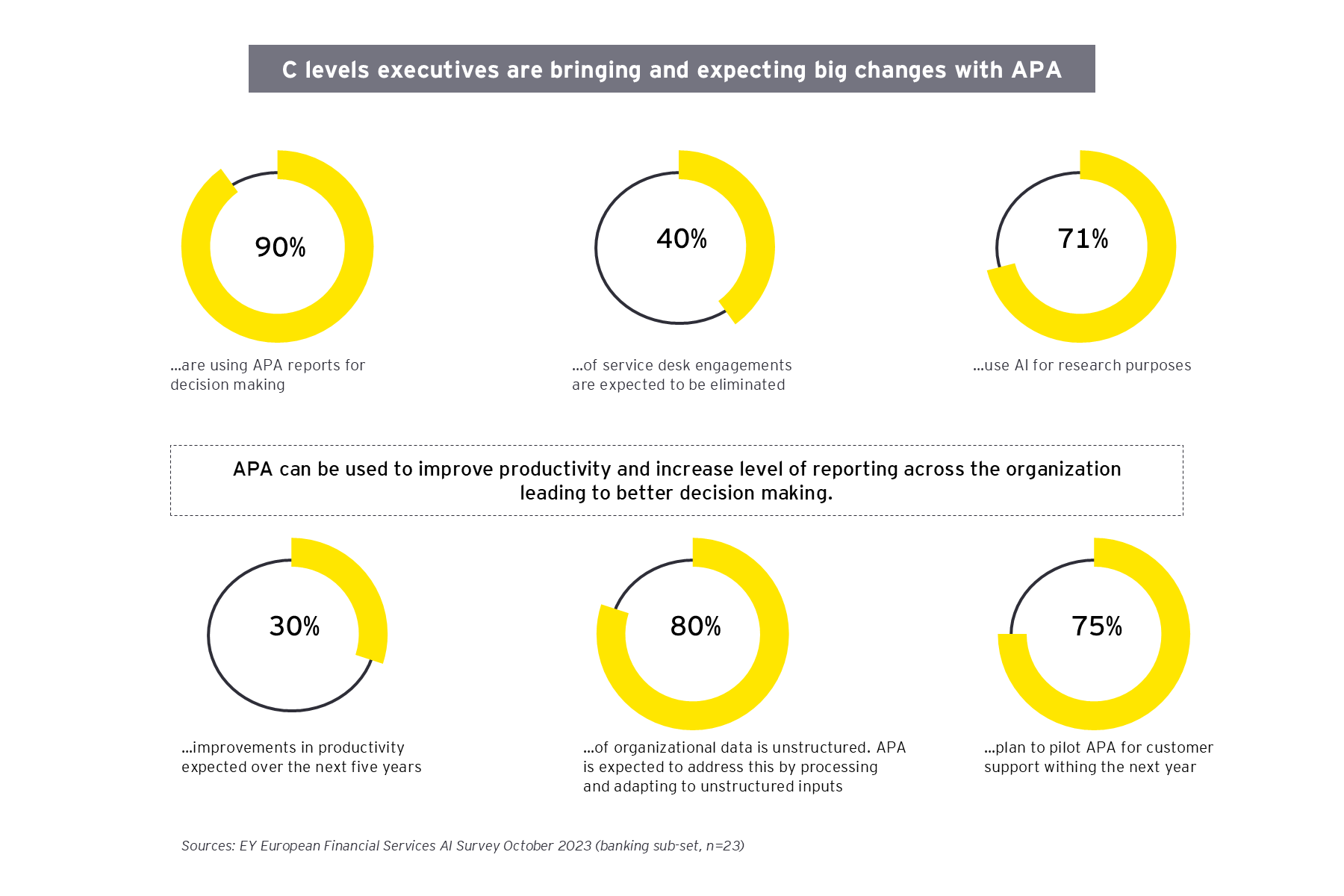
C levels executives are bringing and expecting big changes with APA

Key questions about agentic automation in financial services

Download the full pdf

Summary

The shift from robotic to agentic automation represents a new operating model for process automation in financial services. Institutions that adopt agentic automation can strengthen efficiency, resilience and customer relevance. By aligning automation strategy, technology, governance and talent, organizations can position autonomous process automation as a durable foundation for long-term performance.


Related articles

DORA Register of Information: Quality checks do not stop at submission 

In recent communications, the CSSF has reiterated both the importance and urgency of the Register of Information obligation, reminding financial entities that the RoI is a cornerstone of DORA’s oversight framework and a key input for EU‑level supervision.

AMLA’s approach takes shape: what the new EU AML standards mean for financial institutions

Europe’s long‑promised overhaul of anti‑money laundering supervision is moving from blueprint to reality.

How the EU AML package is transforming compliance for financial firms

Discover how new EU anti-money laundering rules reshape compliance, onboarding and risk management for financial institutions.


    About this article