








EY refers to the global organization, and may refer to one or more, of the member firms of Ernst & Young Global Limited, each of which is a separate legal entity. Ernst & Young Global Limited, a UK company limited by guarantee, does not provide services to clients.
Recent Searches

The CSSF has set out its supervisory priority agenda for 2026, signaling a year of intensified scrutiny for fund managers operating in Europe’s largest cross‑border fund domicile and pointing to a clear regulatory direction: supervision is moving decisively from policy design to operational reality.
Against a backdrop of geopolitical uncertainty, market volatility and accelerating financial innovation, the CSSF is sharpening its focus on the real‑world resilience of investment fund managers. Beyond documented policies, supervisors will increasingly test how frameworks operate in practice, under stress and at scale.
Governance and delegation: substance over form
Governance remains the cornerstone of the CSSF’s supervisory approach. In 2026, follow‑up work on ESMA’s Common Supervisory Actions covering compliance, internal audit and risk management will continue, complemented by a reinforced thematic focus on delegation, outsourcing and third‑party risk.
As delegation models grow more complex and globalized, regulators expect oversight to extend far beyond contractual arrangements. Delegation must be actively challenged, escalation mechanisms clearly defined and third‑party risks fully embedded within the overall risk management framework. Organizational charts are no longer sufficient: supervisors are looking for demonstrable evidence of effective control and accountability.
Reminder: AIFMD II and UCITS VI require more granular information about delegation arrangements, increasing both supervisory visibility and expectations around control. For more information, please refer to our brochure All you need to know about the new AIFMD and UCITS Directive | EY Luxembourg.
Digital resilience moves to the center stage
Technology risk has evolved from a peripheral concern into a central supervisory priority with the increasing adoption of AI tools only amplifying this trend. With DORA now reshaping expectations around ICT governance, the CSSF will closely monitor how IFMs implement digital resilience requirements, from incident reporting to dependency management on critical service providers.
For fund managers, ICT resilience should be seen not as a mere IT issue, but as a board‑level responsibility. Firms will be expected to demonstrate preparedness for cyber incidents, ability to respond, recover and communicate effectively under stress.
Liquidity and leverage under renewed scrutiny
Following the entry into application of AIFMD II and UCITS VI, new liquidity management requirements now apply, accompanied by specific CSSF expectations around documentation updates, governance adjustments and notification processes.
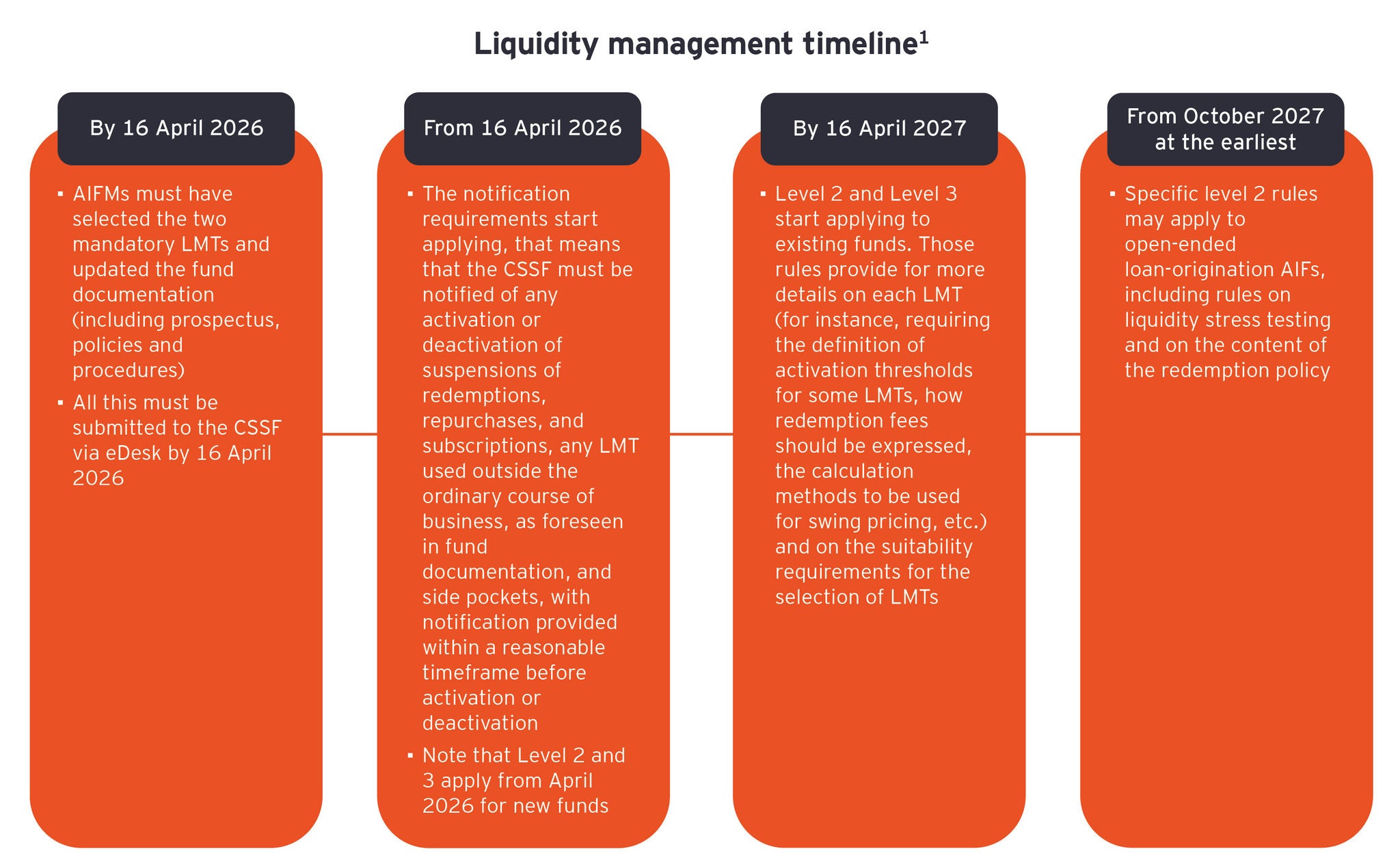
Against this backdrop and in light of the continued growth of open‑ended private asset funds and semi‑liquid strategies, the CSSF will deepen its thematic reviews of liquidity risk management frameworks in 2026. Particular attention will be paid to private debt, loan origination and leveraged strategies.
Liquidity management tools must move beyond a theoretical presence in fund documentation. They are expected to be operationally embedded within systems, governance and portfolio decision‑making. Stress testing, especially in the context of geopolitical shocks, margin dynamics and investor behavior, will play an increasingly central role.
Valuation: a persistent fault line
Recent supervisory exercises have once again highlighted recurring weaknesses in valuation practices. As illustrated in the graph below, these findings point to structural and operational gaps rather than isolated technical issues.
In this context, as assets under management in illiquid strategies continue to grow, valuation risk remains one of the most sensitive pressure points in the fund industry. The CSSF is therefore sustaining its strong focus on valuation governance, NAV accuracy and the effective independence of control functions.
From 2026, on-site inspections and thematic reviews will increasingly prioritize how valuation frameworks operate in practice, with particular attention to open-ended private asset funds and continuation vehicles. Supervisors will look beyond methodologies on paper, placing emphasis on governance effectiveness, challenge processes, escalation mechanisms and the consistent application of valuation policies throughout the valuation cycle.
Sustainable finance and investor value in the spotlight
Sustainable finance supervision is moving into a more mature phase. In 2026, the CSSF will focus less on the formal architecture of SFDR disclosures and more on their consistency, credibility and alignment with underlying investment processes. In this context, greenwashing risk, data quality and internal controls around ESG claims are expected to remain high on the supervisory agenda.
At the same time, costs and fees remain under close scrutiny. Building on ESMA’s work on value for money, the CSSF will continue to identify outliers and assess the fairness of performance fee models. Fund managers are expected to demonstrate a clear and documented alignment between fees charged, risks taken and value delivered to investors.
Reminder: AIFMD II and UCITS VI introduce enhanced transparency obligations on costs and fees, reinforcing supervisory expectations around investor outcomes. For more information, please refer to our brochure All you need to know about the new AIFMD and UCITS Directive | EY Luxembourg.
Preparing for a year of supervisory intensity
Taken together, the CSSF’s priorities portray a regulator intent on testing the operational robustness of the fund ecosystem. The common thread across governance, technology, liquidity, valuation and sustainability is execution.
Fund managers that invest early in strengthening controls, clarifying responsibilities and stress‑testing assumptions will be better positioned to withstand supervisory pressure. Those that rely on formal compliance without operational depth may find 2026 a far more challenging year.
How EY can help
EY supports fund managers across the full lifecycle of supervisory preparedness. Our teams combine deep regulatory insight with hands‑on operational expertise to help clients respond effectively to CSSF expectations. In particular, EY can support with:
CSSF supervisory readiness assessments, including gap analyses against 2026 priorities and upcoming AIFMD II / UCITS VI requirements
Governance, delegation and substance reviews, helping enhance oversight models, control functions and third‑party risk frameworks
DORA and digital resilience implementation, from ICT governance design to incident response testing and Register of Information support
Liquidity and leverage frameworks, including LMT implementation, stress‑testing design and regulatory notifications
Valuation governance enhancement, covering model oversight, independence of controls and NAV governance for complex and illiquid assets
SFDR and value‑for‑money reviews, aligning disclosures, processes and cost structures with evolving supervisory expectations
By combining regulatory, risk, technology and operational capabilities, EY helps fund managers move beyond compliance towards resilient, inspection‑ready operating models.
Summary
The CSSF has set out its supervisory priority agenda for 2026, signalling a year of intensified scrutiny for fund managers operating in Europe’s largest cross‑border fund domicile and pointing to a clear regulatory direction: supervision is moving decisively from policy design to operational reality.
Related articles
On 4 June 2046, the CSSF published a feedback report setting out its supervisory expectations regarding the valuation of less liquid and illiquid assets by IFMs. The report provides guidance, based on the applicable regulatory framework, on the implementation and maintenance of robust valuation policies, procedures and controls for the AIFs and UCITS managed by IFMs.
ELTIF’s moment: why Europe’s long‑term fund is becoming a strategic must‑have
For most of its first decade, the European Long‑Term Investment Fund (ELTIF) looked like a good idea trapped in a tight suit: a retail‑friendly wrapper for private markets but constrained by rigid portfolio rules and an unhelpful approach to liquidity. That chapter has now definitely closed.
How tax incentives are accelerating digital transformation in fund management
How tax incentives are accelerating digital transformation in fund management
Private credit’s liquidity reckoning: the real economy’s favorite financier meets market reality
Private credit has become one of Europe’s most important conduits of funding to the real economy, providing companies with loans, structuring bespoke facilities for growth and acquisition, and financing assets that rarely fit a public-market template.
Luxembourg’s fund industry has rarely lacked scale or sophistication. A world of persistent inflation surprises, fragmented liquidity, and geopolitics‑driven price gaps is colliding with supervisory expectations more and more focused on demonstrable risk governance.
ESMA CSA on compliance and internal audit functions: key takeaways for fund managers
On 11 May 2026, ESMA published its final report on the 2025 Common Supervisory Action (CSA) assessing the effectiveness of compliance and internal audit functions across UCITS management companies and AIFMs.