








EY refers to the global organization, and may refer to one or more, of the member firms of Ernst & Young Global Limited, each of which is a separate legal entity. Ernst & Young Global Limited, a UK company limited by guarantee, does not provide services to clients.
Recent Searches

For most of its first decade, the European Long‑Term Investment Fund (ELTIF) looked like a good idea trapped in a tight suit: a retail‑friendly wrapper for private markets but constrained by rigid portfolio rules and an unhelpful approach to liquidity. That chapter has now definitely closed.
Since the ELTIF 2.0 reform took effect in early 2024, the product has entered a different phase, not just more launches, but a visible shift in how fund managers are using it. Assets under management have risen sharply, passing EUR 20bn by end‑2024 and reaching roughly EUR 34bn by the end of 2025, according to industry estimates, with further growth expected as distribution ramps up across Europe. This matters less for what it says about regulation, and more for what it signals about demand.
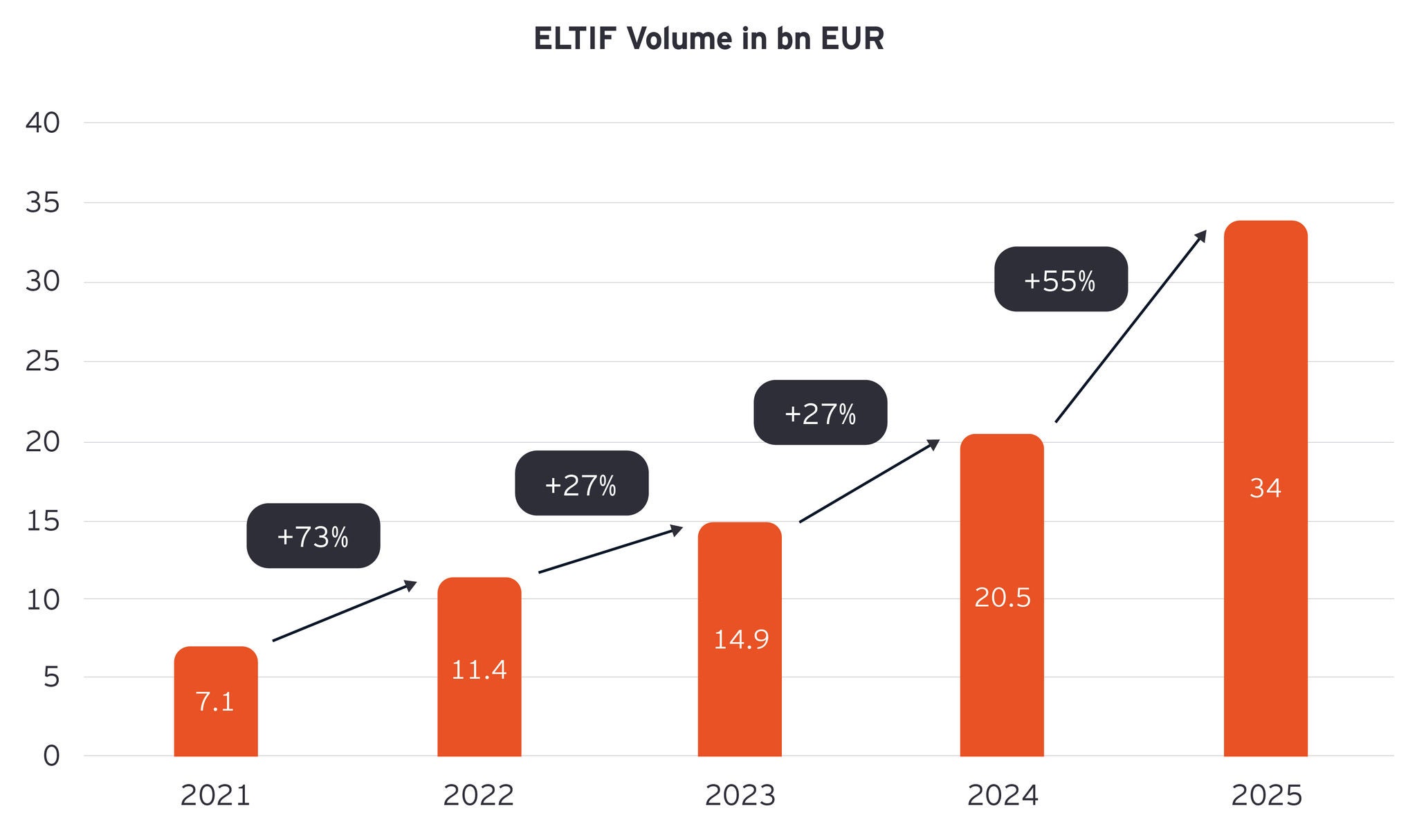
Source: Scope Group
Why fund managers should care
At its core, ELTIF now answers a question many managers are grappling with: how do you package private markets for a broader investor base without dismantling the economics of long‑term investing? Three developments explain why ELTIF has moved closer to that answer.
Put together, these factors explain why ELTIF has become a serious candidate for semi‑liquid strategies: it travels (passport), it sells (retail‑oriented regime), and it can be built efficiently (compartment possibility and tax efficiency).
Why ELTIF is increasingly viewed as a portfolio cornerstone
From a portfolio perspective, ELTIF has carved out a role that few European vehicles can genuinely replicate. It allows managers to expand their addressable investor base beyond institutions, without being pushed into UCITS‑style liquidity, daily dealing or mark‑to‑market constraints that sit uneasily with long‑term and private assets. This makes it possible to access private wealth capital while preserving the economic and investment logic of alternative strategies.
At the same time, ELTIF supports more predictable and durable capital formation. By formally anchoring longer holding periods while still offering a regulated framework for exits, it suits strategies such as private debt, infrastructure or hybrid private markets that benefit from patient capital but must still offer investors a credible path to liquidity over time. For managers, this reduces fundraising cyclicality and improves portfolio planning.
Crucially, ELTIF is not designed to replace existing institutional flagships, but to sit alongside them. It allows managers to run parallel strategies (institutional funds on one track, ELTIFs on another) targeting different investor segments without dilution. In that sense, ELTIF is a portfolio extension: a way to broaden distribution, diversify funding sources and future‑proof product ranges as private wealth continues to reshape capital markets.
Managing the semi‑liquid balance
The renewed momentum behind ELTIF does not remove complexity. Semi‑liquidity is appealing precisely because it occupies the space between two very different investment worlds, and it is within that middle ground that the main tensions arise.
Semi‑liquid structures require fund managers to reconcile two competing realities. On the one hand, the underlying assets are inherently long‑term and, in many cases, genuinely illiquid. On the other hand, investors are offered with the possibility of periodic dealing. Aligning those two elements is not a matter of product marketing; it is a question of portfolio construction, liquidity management and governance.
Early market experience has underlined this point. Instances where redemption pressure has triggered temporary suspensions or gating have highlighted that semi‑liquidity only works when liquidity promises are carefully calibrated to asset behavior, cash‑flow profiles and investor expectations.
This challenge, however, is manageable with proper liquidity management, robust governance frameworks and clear, transparent communication with investors. When executed thoughtfully, semi‑liquidity does not undermine long‑term investing; it strengthens it by setting realistic expectations and reinforcing trust.
Key recommendations for fund managers
To translate ELTIF’s potential into a scalable product, fund managers should focus on six concrete priorities:
- Design liquidity for stress, not for marketing: Set redemption frequencies, notice periods, gates and liquidity buffers that remain credible in adverse scenarios, not just in the base case.
- Build portfolios with cash‑flow visibility: Prioritize asset classes and structures where cash generation, amortization or secondary market options are realistic, particularly for private credit and core infrastructure strategies.
- Segment investors deliberately: Align ELTIF offerings with clearly defined investor groups rather than pursuing overly broad distribution from day one.
- Use ELTIF as a complementary track: Position ELTIFs alongside institutional funds, not as diluted versions of them, with tailored liquidity, reporting and communication frameworks.
- Leverage existing Luxembourg platforms: Where possible, launch ELTIFs through compartments within existing structures to accelerate time to market and control costs.
- Invest early in investor communication: Ensure distributors and end‑investors fully understand liquidity mechanics, valuation frequency and exit pathways (clarity upfront reduces friction later).
A strategic opportunity, not a regulatory experiment
ELTIF is no longer a regulatory experiment or a policy ambition in search of a market. It has reached a new phase: one in which managers are actively shaping it into a scalable route to private‑market capital. The question is no longer whether ELTIF can work, but who will make it work well.
For Luxembourg‑based fund managers in particular, the opportunity is tangible. The combination of a European retail passport, a flexible semi‑liquid framework and an established structuring ecosystem creates a platform that few other jurisdictions can match. Used thoughtfully, ELTIF allows managers to broaden distribution, diversify funding sources and respond to the steady re‑weighting of capital towards private wealth without compromising investment discipline.
Crucially, the next phase of ELTIF will not be defined by regulation, but by execution. Success will favor managers who treat ELTIF as an integrated proposition, aligning portfolio construction, liquidity design, governance and investor communication, rather than as a label applied at the end of the structuring process.
If the first ELTIF era was about proving the concept, the second is about leveraging it. Those who professionalize ELTIF strategies early, manage liquidity and communicate transparently may find that the regime offers something rare in European funds today: a commercially durable, cross‑border route to long‑term private capital at scale.
Summary
For most of its first decade, the European Long‑Term Investment Fund (ELTIF) looked like a good idea trapped in a tight suit: a retail‑friendly wrapper for private markets but constrained by rigid portfolio rules and an unhelpful approach to liquidity. That chapter has now definitely closed.
Related articles
On 4 June 2046, the CSSF published a feedback report setting out its supervisory expectations regarding the valuation of less liquid and illiquid assets by IFMs. The report provides guidance, based on the applicable regulatory framework, on the implementation and maintenance of robust valuation policies, procedures and controls for the AIFs and UCITS managed by IFMs.
How tax incentives are accelerating digital transformation in fund management
How tax incentives are accelerating digital transformation in fund management
Private credit’s liquidity reckoning: the real economy’s favorite financier meets market reality
Private credit has become one of Europe’s most important conduits of funding to the real economy, providing companies with loans, structuring bespoke facilities for growth and acquisition, and financing assets that rarely fit a public-market template.
Luxembourg’s fund industry has rarely lacked scale or sophistication. A world of persistent inflation surprises, fragmented liquidity, and geopolitics‑driven price gaps is colliding with supervisory expectations more and more focused on demonstrable risk governance.
CSSF 2026: Why operational resilience is the new supervisory standard
The CSSF has set out its supervisory priority agenda for 2026, signalling a year of intensified scrutiny for fund managers operating in Europe’s largest cross‑border fund domicile and pointing to a clear regulatory direction: supervision is moving decisively from policy design to operational reality.
ESMA CSA on compliance and internal audit functions: key takeaways for fund managers
On 11 May 2026, ESMA published its final report on the 2025 Common Supervisory Action (CSA) assessing the effectiveness of compliance and internal audit functions across UCITS management companies and AIFMs.