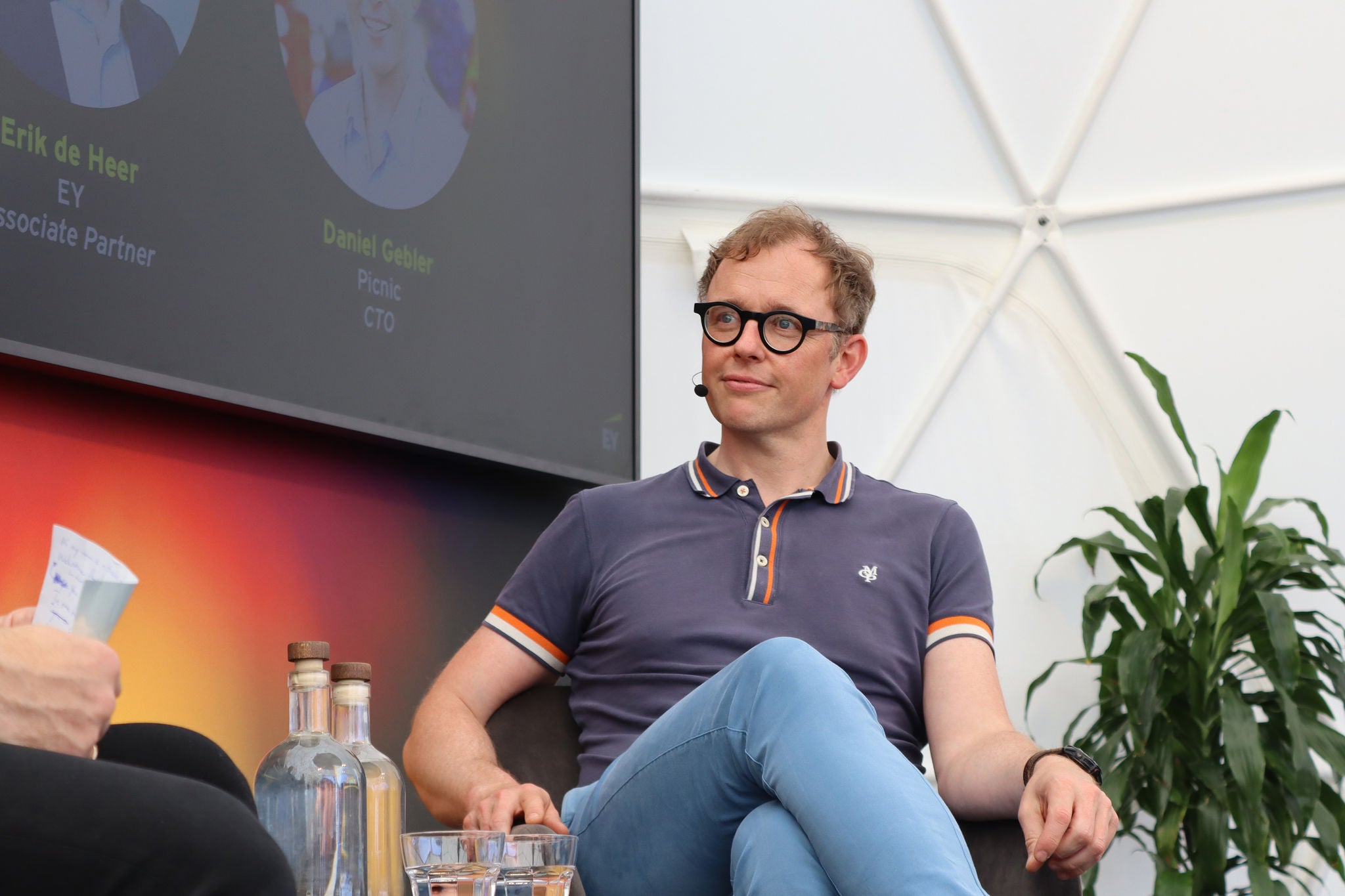


CTO Daniel Gebler, Picnic

How technology made Picnic the undisputed market leader


Picnic’s tech-first model transformed grocery shopping. Discover how innovation and AI drive its success.


In brief

  • Picnic scaled from one city to millions of customers with a data-driven, sustainable delivery model.
  • Custom electric vehicles and AI forecasting cut costs and boosted efficiency.
  • Innovation discipline ensures scalable impact and customer value.

No stress. No queues. No extra costs. That was Picnic’s promise when it entered the grocery market in 2015. Not your typical supermarket, but a radically different model: data-driven, logistically precise, and built for sustainability. In our interview at The Next Web, co-founder and CTO Daniel Gebler shares how technology propelled Picnic to the top of the online grocery game: from custom-designed electric vehicles to AI that matches supply and demand with pinpoint accuracy.

What attracted you to the online grocery market in 2015?

“No one wants to pay more for groceries online than in-store, and no one wants to wait long for a delivery,” Gebler summarizes the key insights from those early days. These two simple principles formed the foundation of the Picnic concept. Instead of promising speed, Picnic chose precision: deliveries within a 20-minute time slot, on fixed daily routes. “We ended up with a model that looked more like an ultra-efficient sustainable bus service than a typical quick-and-dirty taxi,” he says. Each street is visited only once a day, which increases efficiency and keeps costs low.

For every phase we had to find the ‘scalable core’: What works well enough at small scale such that it can efficiently grow at least tenfold.

How did you drive logistical innovatoin from a technical perspective?


“It’s easy to dream about a customer proposition, but if you can’t build a viable businessmodel and technology platform around it, you have nothing.” That’s why Picnic developed its own software to plan routes and streamline operational processes. “We started with a small team, few cars, and launched only in one single city. We started to scale just after we understood all the ins-and-outs of the customer and logistical aspects and were convinced that we could scale without problems by ten times or more.” New ideas are always tested first as Minimum Viable Product (MVP) on small scale to validate customer demand and logistical feasibility, then as Minimum Scalable Product (MSP) on medium scale to validate the ability to scale, and the as Maximum Impact Product (MIP) to create biggest customer impact.


What were the biggest challenges in scaling?


“Every phase has its own challenges. In the early days we focussed on proof of demand (for example do customers like what we offer), then we focussed on proof of scale (can our business scale with demand), and finally on proof of efficiency (is our business profitable at scale). For every phase we had to find the ‘scalable core’: What works well enough at small scale such that it can efficiently grow tenfold.”


Why did Picnic choose to design its own delivery vehicles?


“We tried existing electric delivery vans, but they didn’t meet our needs. They weren’t efficient enough, and loading and unloading took too much time. So we decided to design our own vehicle, allowing side-loading and unloading. That saves minutes per delivery and those minutes add up when you’re making thousands of deliveries a day.”

If you start something new, you have to stop something else. You need to be strict about what you continue to develop and what you deliberately let go.

Which innovations didn’t make it, and what does that mean for the future?

“We looked into autonomous vehicles, but the technology wasn’t yet mature enough. We would’ve loved to make it work, but the costs and limitations outweighed the benefits. We looked also into drones for warehouse use cases, but they didn’t make the cut. Great on paper, unreliable in practice. Still, we expect autonomous vehicles and drones to play a role in the future once the technology is mature enough. We’re watching those developments closely and are ready to act when it becomes viable and reliable.”

How does Picnic balance innovation with discipline?

“We don’t want to get stuck in small steps, we focus on high-impact break-through innovations. In order to realize that, you need the discipline to stop when something doesn’t work. With limited capacity, that means: if you start something new, you have to stop something else. You need to be strict about what you continue to develop and what you deliberately let go.”

What does the Picnic team look like, and what leadership lessons have you learned?

“Today, hundreds of engineers work at Picnic. While our customers know very well our Shopping App technology, there is even more technology behind the scenes. These systems cover logistics, warehouses, and route planning. When we started, the team was about 30 people, including 20 developers. Now we have more than 400 developers that work on dozens of applications used by a few million customers. In the beginning, it’s crucial to have a stable, mature team you can rely on. Everything is constantly changing, so you need something to hold on to. A good team complements each other and keeps evolving. As CTO, I don’t try to do everything myself, but I do want to stay involved in major projects. I want to understand what we’re building, where we’re heading to, and how the architecture fits together. Only then can you contribute meaningfully to the next step.”

How do you keep an organization moving?

“Every six to nine months, you really need to reassess your structure: what can go, what needs to be added? Growth also means letting go. That discipline prevents stagnation.”

What role does AI play in Picnic’s future?

“AI is playing an increasingly important role. Years ago, we started collecting data to improve forecasting. Since 2018, we’ve used machine learning to more accurately predict what we need in stock. That allowed us to drastically reduce our safety stock without disappointing customers. AI shouldn’t just recommend, it should also be accountable. We don’t want to automate blindly. Transparency is essential. That’s why we’ve built in a feedback mechanism. In addition, products are increasingly delivered with AI functionality by default. Our challenge is: how do we create products that get smarter through use?”

Do you see differences in customer preferences around AI?

“I expect that some customers prefer a human-only approach and some customers are more comfortable with AI-powered solutions. Our tech strategy strive to build the right solution for both customer types.”

What’s your most important advice for CTOs and founders?

“Don’t get distracted by hype. Stay close to your vision and be strict about what you build and why. With limited resources, you have to make choices. Use that as an advantage, not a limitation.”


About Picnic

Picnic is an innovative online supermarket founded in 2015 with the mission to make grocery shopping simple, stress-free, and cost-efficient. With a data-driven and sustainable approach, Picnic offers a wide range of products—from fresh vegetables to everyday essentials—easily ordered through a user-friendly app. Its unique delivery model, featuring 20-minute time slots and custom-designed electric vehicles, highlights Picnic’s commitment to reducing waste, maximizing customer satisfaction, and promoting environmental responsibility.


The EY.ai Lab

In the EY.ai Lab you can experience immersive, hands-on tailored workshops with your team that apply AI to core business processes. Guided by EY practitioners, you’ll explore real-world use cases, learn practical methods and tools, and shape solutions tailored to your needs.

EY.ai Lab promotional image


Summary

Picnic disrupted grocery shopping with a tech-first, sustainable model. Starting in 2015, the company focused on precision deliveries, custom electric vehicles, and AI-driven forecasting to match supply and demand. CTO Daniel Gebler explains how disciplined innovation, testing MVPs, scaling MSPs, and focusing on maximum impact, helped Picnic grow from a single city to millions of customers. Today, hundreds of engineers power systems behind logistics, route planning, and customer experience. Picnic’s story shows how technology, sustainability, and strategic choices can create market leadership.


About this article

Read more

How FrieslandCampina’s Data Platform paves the way for AI innovation

FrieslandCampina's data platform enables AI innovation and drives transformation from reporting to prediction and automation.

Transforming audit and finance: The AI revolution with Datasnipper

Discover Vidya Peters, CEO of DataSnipper, insights on AI’s impact in audit and finance, customer-first innovation, and the evolving role of auditor’s landscape.

Key insights from TNW Conference 2025

Explore insights from the TNW Conference 2025, where tech leaders discuss innovation, AI strategies, and the future of Europe's tech ecosystems.