




EY refers to the global organization, and may refer to one or more, of the member firms of Ernst & Young Global Limited, each of which is a separate legal entity. Ernst & Young Global Limited, a UK company limited by guarantee, does not provide services to clients.
Recent Searches
Press release
07 Apr 2026
Romanian M&A evolution during the first quarter of 2026
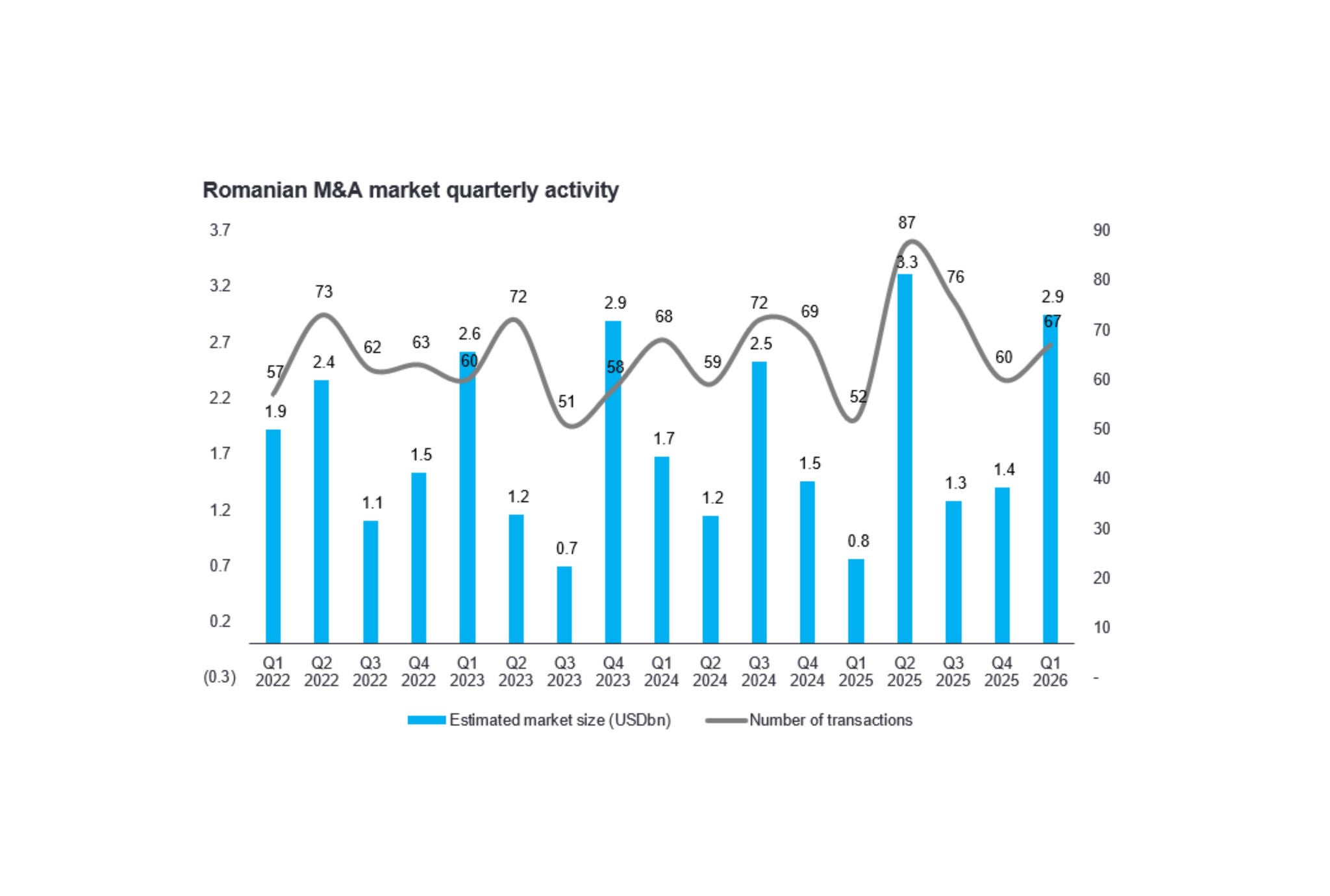
In the first three months of 2026, Romanian M&A recorded 67 transactions[1], representing a notable 29% increase in activity compared to the same quarter last year, when 52 deals were announced. This growth was driven by a much stronger January, while February and March deal volumes remained broadly in line with the prior year.
The first quarter also delivered a strong outcome by historical standards in terms of disclosed value, marking the highest Q1 level on record and reaching a total of USD 2.2bn (up from USD 157m in Q1 2025). This surge was largely driven by the quarter’s two largest disclosed transactions, which alone accounted for c. USD 1.7bn of the total aggregate value alone. Meanwhile, the estimated value of local M&A activity reached USD 2.9bn[2] in the first quarter, up from USD 765m in Q1 2025, and surpassing the previous high for Q1 set in 2023.
[1] EY’s M&A database for Romania excludes transactions with stakes acquired of less than 15%.
[2] Includes an estimate of the value of transactions where no data was formerly disclosed by the parties or is not available in third party databases and/or reported by media sources.
The largest transaction of Q1 2026 was the announced acquisition of Carrefour’s Romanian operations by local financial investor Paval Holding, the investment group linked to Dedeman, one of the most successful Romanian entrepreneurial businesses. The consideration was USD 977m, placing the deal just below the mega‑deal classification. The transaction ranks as the second largest retail deal on record, surpassed only by the sale of Profi Rom for USD 1.4bn in 2024. This follows Paval Holding’s 2025 acquisition of Praktiker Hellas, a major Greek DIY and home goods retailer, from the Canadian investment and insurance group Fairfax Financial Holdings Limited, for USD 151m.
The much‑anticipated sale of Garanti BBVA to Raiffeisen Bank International for USD 681m, announced at the very end of the quarter, brought a strong close to Q1 2026 and reflects continued dealmaking appetite and consolidation trend in the financial services sector.
Strategic investors continued to dominate Romanian M&A during Q1 2025, accounting for a notable 87% of transaction count. Financial investors activity represented 13% of deal volume, with dealmaking marked by large established players such as Paval Holding (2 acquisitions) and MidEuropa Partners (1). Furthermore, financial sponsor-backed acquirers accounted for around one‑fifth of transactions in Q1 2026.
The sharp increase in overall deal activity was driven entirely by inbound transactions, with volumes rising by 76% YoY to 37 deals in Q1 2026, highlighting sustained interest from foreign investors. Moreover, inbound acquisitions continued to outpace foreign-owned disposals (27 deals) in Q1 2026, reinforcing the market’s position as a net beneficiary of foreign investment. In contrast, domestic deal volumes held steady compared to Q1 2025, with 24 transactions, while still representing over a third of total announced activity.
Real Estate, Hospitality & Construction remained the most active sector by deal volume in Q1, with 19 transactions, marking a two‑fold increase compared to Q1 2025. Technology, Media & Telecommunications and Health & Life Sciences followed closely, recording 11 and 10 deals respectively, while Energy & Utilities and Advanced Manufacturing & Mobility each posted nine transactions.
The United States was the most active investor in Q1 2026 with four deals, followed by Hungary, Switzerland and Poland, each accounting for three transactions.
Q1 2026 also saw changes to the legal framework for foreign direct investment (FDI) screening in Romania, raising the notification threshold from EUR 2m to EUR 5m, clarifying the treatment of internal restructurings, and extending screening to certain asset acquisitions in sensitive sectors, including critical technologies, infrastructure, pharma, defense and agri‑food. While the changes bring greater clarity, they may increase scrutiny of asset‑based transactions, with potential implications for deal timing and execution.