




South Africa's youth unemployment paradox: why growth is no longer enough

South Africa's economy may be growing, but the link between growth and youth employment is weakening. Understanding why is key to building a more inclusive future.


In brief:

  • Growth remains essential, but its link to jobs for 15 to 24-year-olds appears weaker than before COVID-19.
  • Employment gains may increasingly favour workers with more experience, leaving first-time entrants behind.
  • Demand-led, employer-connected interventions can help turn growth into sustainable youth employment.

For decades, South Africa's unemployment challenge has largely been viewed through a single lens: economic growth.


The assumption has been straightforward. If the economy grows, businesses expand, investment increases and jobs follow.


Growth remains essential. But recent evidence suggests that growth alone may no longer be enough to create meaningful employment opportunities for South Africa's youngest jobseekers.


This is the uncomfortable reality at the heart of South Africa's youth unemployment paradox.

Despite periods of economic recovery and expansion, too many young South Africans remain excluded from the labour market. While this challenge is often attributed to low growth, skills shortages or structural constraints, there is another factor that warrants attention: the relationship between economic growth and employment creation appears to be changing.

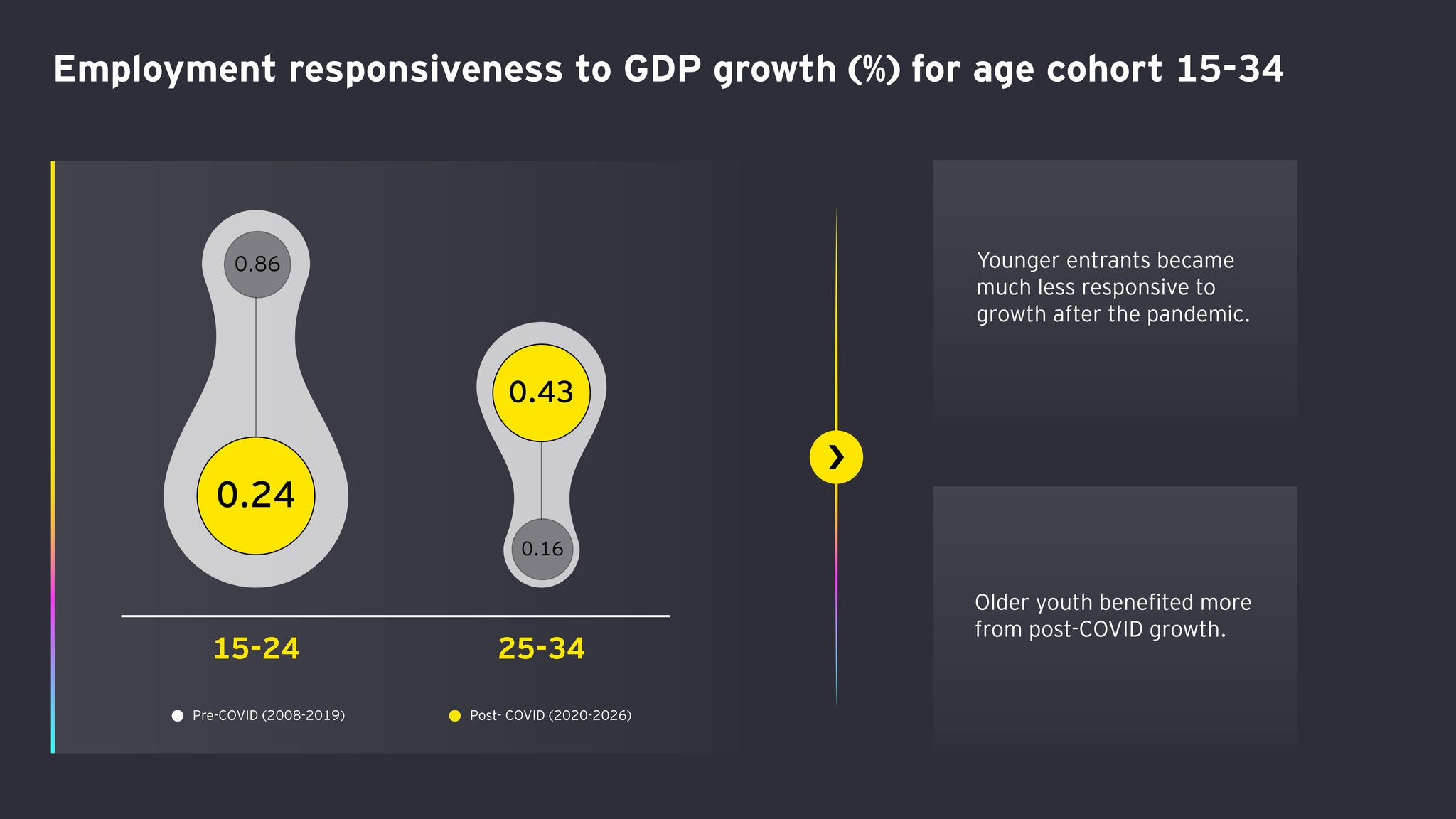
EY analysis suggests that before the COVID-19 pandemic, employment among 15 to 24-year-olds responded strongly to growth. A 1% increase in GDP was associated with close to 0.9% employment growth among younger workers. Since the pandemic, that responsiveness has weakened considerably, with the same level of economic growth associated with only around 0.2% employment growth for this age group.

Unemployment Article and Social Designs _V1
Source: Data - Quantec (2026) and EY analysis

At the same time, employment among workers aged 25 to 34 has become more responsive to growth, suggesting that economic recovery may increasingly favour those with greater experience and stronger labour market attachment.

The implications are significant.

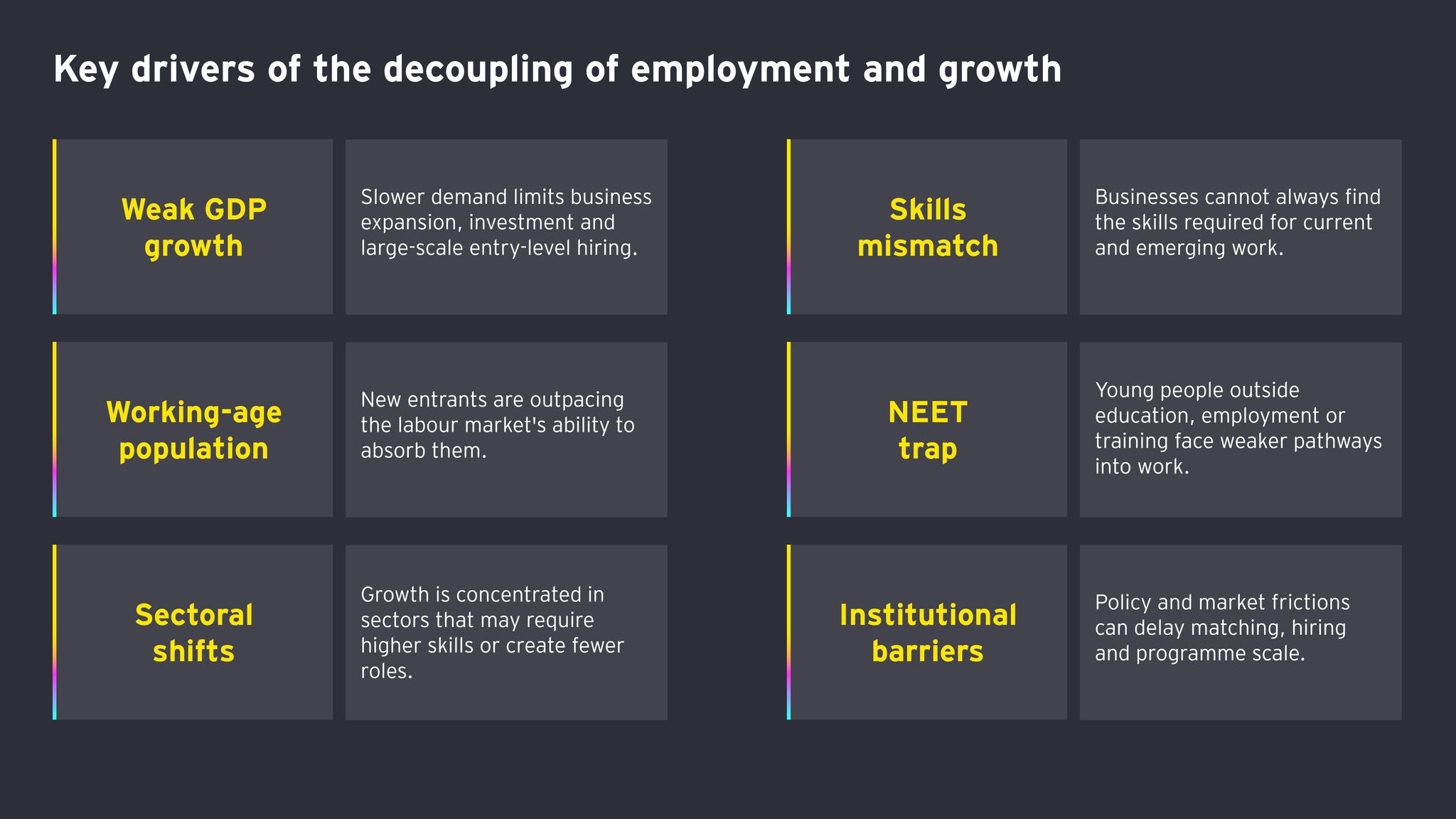
South Africa is facing a growing disconnect between economic growth and employment creation for first-time entrants into the labour market. While output may increase and certain sectors may perform well, the opportunities created by that growth are not necessarily reaching young people at the same rate as before.

Unemployment Article and Social Designs _V1

This matters because youth unemployment is not only a social challenge. It is an economic one.

When large numbers of young people remain outside the labour market, the country loses productive capacity, businesses face future talent shortages, and economic inequality becomes increasingly entrenched. At the same time, many employers continue to report difficulty finding the skills they need, highlighting a mismatch between labour market demand and the development of future talent pipelines.

The challenge is not that South Africa lacks initiatives aimed at addressing youth unemployment. Across government, business and civil society, there are numerous programmes focused on training, skills development, wage subsidies, entrepreneurship and employment support.

The greater challenge is ensuring that these efforts are coordinated, scaled and aligned to where labour demand is actually emerging.

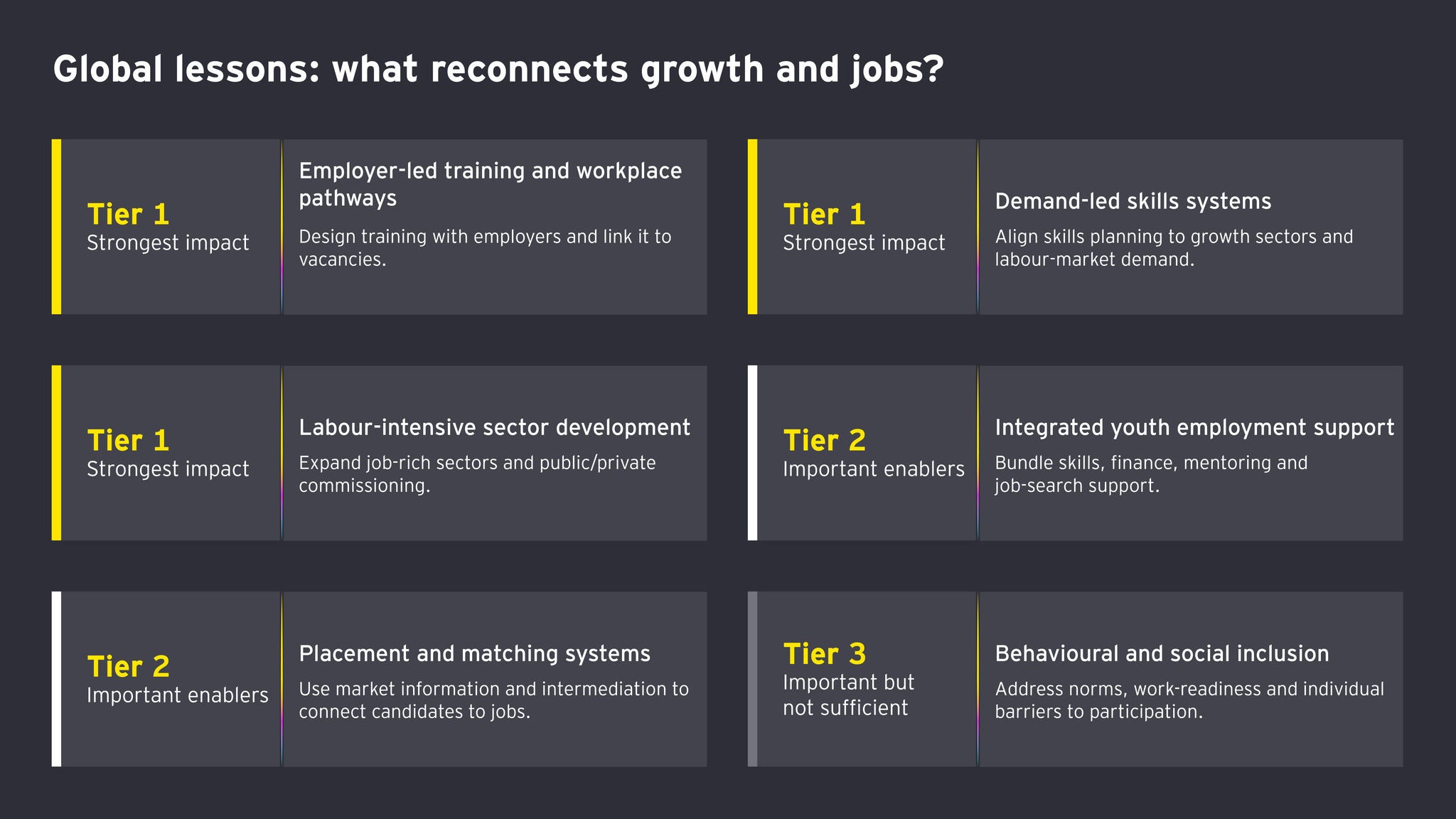
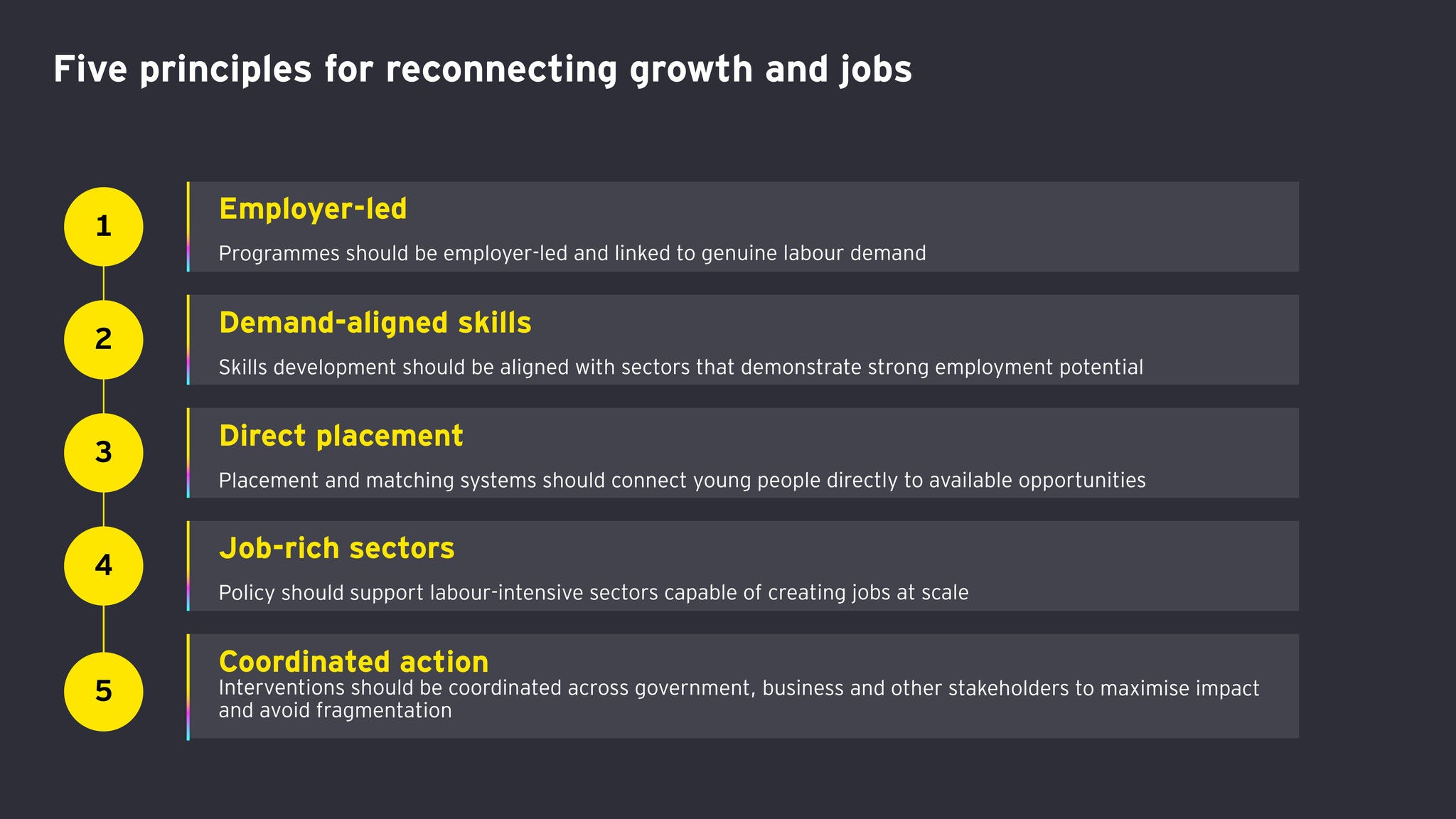
International experience shows that successful youth employment interventions tend to share common characteristics. They are employer-led, closely connected to labour market demand, and focused on creating clear pathways into sustainable employment. Training alone is rarely enough. Young people need opportunities to gain workplace experience, build practical skills and connect directly to growing industries.

Unemployment Article and Social Designs _V1
Source: (World Bank, 2026); Decoupling impacts reflects policy transferability to South Africa and is not an official indicator and EY analysis

This points to an increasingly important role for business.

Employers are uniquely positioned to help bridge the gap between education and employment through internships, apprenticeships, learnerships and structured entry-level opportunities. These interventions not only support young people entering the workforce, but also help organisations build the future talent they will require in an increasingly competitive and technology-enabled economy.

However, making meaningful progress requires more than good intentions. It requires a deeper understanding of how labour markets are evolving.

Which sectors have the greatest potential to absorb young workers? Which skills are becoming more valuable? Where are mismatches emerging? Which interventions are delivering measurable outcomes?

These are questions that demand evidence-based decision-making.

As South Africa navigates its next phase of economic growth, leaders across business and government will need to look beyond headline GDP figures and focus on the quality and inclusiveness of growth itself.

The goal should not simply be to grow the economy. It should be to ensure that growth creates opportunity.

If South Africa can reconnect economic growth with meaningful employment pathways, particularly for young people, it will unlock not only greater economic participation, but also a stronger foundation for long-term prosperity.

Unemployment Article and Social Designs _V1

In conclusion:

South Africa's youth unemployment challenge can no longer be addressed through growth alone. The article explores why employment creation for younger workers appears less responsive to GDP gains, and why demand-led, employer-connected interventions are needed to rebuild pathways into work.

With contributions from Leshern Devnarain

About this article