






GCC illustration Helicopters Aircraft Carrier

Five levers shaping the GCC resilience agenda

The GCC has built formidable capability. Resilience is the next priority — sustaining continuity, confidence and growth under pressure.


In brief

  • GCC countries are expanding the focus of defense and security planning to include resilience across economic and strategic systems.
  • Infrastructure, logistics, digital networks and industrial capabilities are increasingly central to sustained resilience and growth.
  • Five interconnected priorities provide a framework for enhancing readiness, recoverability and institutional effectiveness.

GCC member states have spent the past decade building a substantial foundation of defense capability through sustained investment, advanced operational systems, strategic partnerships and infrastructure development. Collectively, these investments have strengthened readiness across air, maritime, cyber and emerging technology domains, creating one of the most comprehensive defense and security platforms globally. The region therefore enters its next phase of development from a position of strength. The challenge ahead is not simply maintaining capability, but making sure that capability can be sustained, integrated and adapted in an increasingly complex operating environment.

The strategic context has evolved. Alongside traditional security considerations, GCC countries are focused on safeguarding the systems that underpin economic stability and national prosperity. Energy infrastructure, logistics networks, maritime corridors, financial systems, digital platforms and space-enabled services have become essential components of national resilience. The reliability and continuity of these systems influences not only operational effectiveness but also investor confidence, trade flows and long-term economic competitiveness. As a result, resilience is becoming an important element of national security planning.

The GCC defense and security strategic perspective 2026 report examines how GCC countries can strengthen resilience across their broader strategic and economic operating systems. It explores the region's existing strengths, including sustained investment, operational capability, interoperability and emerging sovereign capabilities. It also considers the increasing importance of infrastructure continuity, industrial depth, logistics resilience, cyber readiness and space-enabled services in supporting long-term stability and growth. The objective is to build upon the existing security priorities through a more integrated approach that strengthens continuity and recoverability across critical systems.

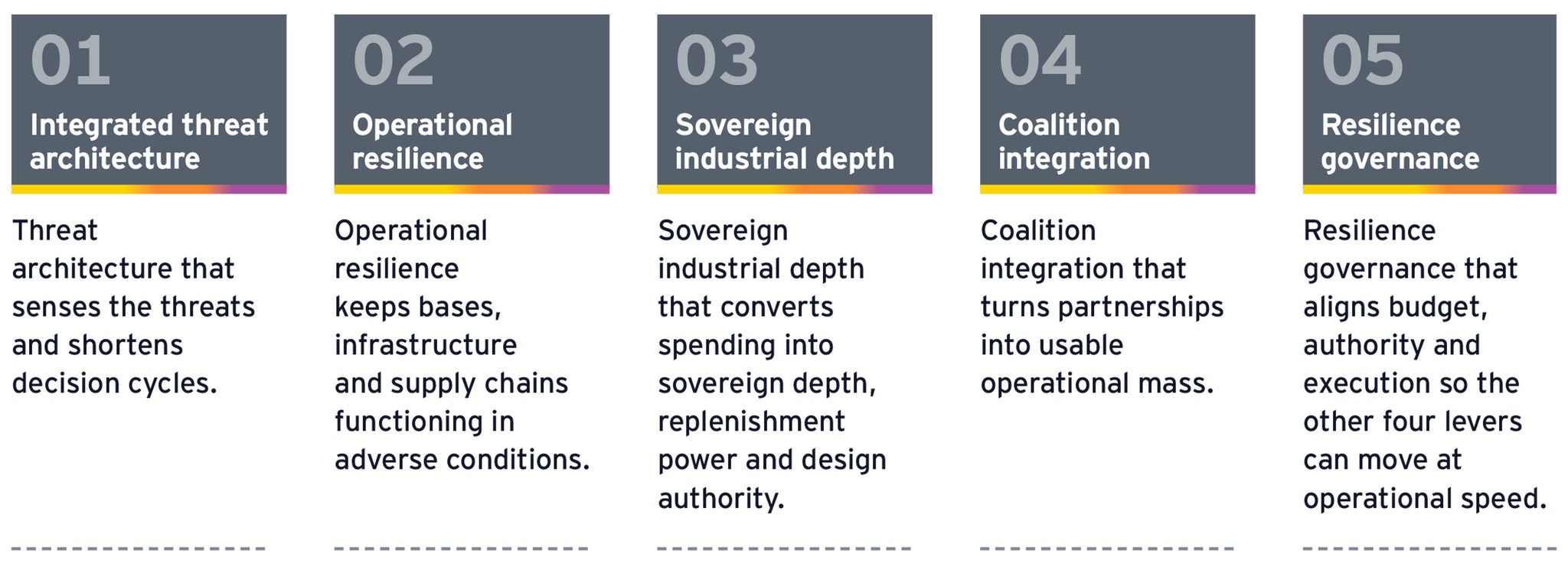
The report is structured around three themes. First, it highlights the strong foundation that GCC countries have established through investment, capability development and partnerships. Second, it examines the growing strategic significance of economic infrastructure and the interconnected systems that support national and regional prosperity. Third, it presents five mutually reinforcing levers that can help strengthen resilience over the short, medium and long term: integrated threat architecture, operational resilience, sovereign industrial depth, coalition integration and resilience governance. Together, these levers provide a framework for enhancing continuity, sustaining operational effectiveness and reinforcing long-term strategic as well as economic confidence across the GCC.

1. Building on a foundation of strength

GCC countries enter this next phase of resilience planning from a position of strength. Over the past decade, the region has sustained high levels of investment in defense capability, critical infrastructure, logistics readiness and strategic partnerships. Annual collective defense spending places the GCC among the world's leading defense investors on both a per-capita and per-GDP basis.

Defense investment
US$130b
US$130b
GCC countries collectively invest approximately US$130b annually in defense

This investment reflects long-term political commitment to security, continuity and preparedness. It has endured through several periods of economic and operational uncertainty, including oil-price volatility and the COVID-19 pandemic. The significance of this continuity is strategic: the GCC’s current challenge is not a lack of investment, but the need to convert scale into deeper resilience, readiness and sovereign sustainment.


Space-enabled services are also becoming increasingly important to resilience. Satellite communications, Earth observation, navigation, timing services and geospatial intelligence support infrastructure monitoring, maritime awareness and operational decision-making. Recent initiatives, including Qatar's Space Radio Monitoring Center and the UAE's GIQ geospatial intelligence platform and Arab Satellite 813 program, demonstrate the growing role of sovereign and partner-enabled space capabilities in supporting continuity across critical sectors.


Partnerships remain a powerful strategic multiplier. Decades of cooperation among GCC countries and international partners have strengthened interoperability across operational domains through joint exercises, coordination mechanisms and established support frameworks. These relationships provide an important foundation for collective preparedness and enhance operational flexibility, institutional coordination and continuity planning.


Human capital remains a long-term strategic priority. As capabilities become more technology-intensive, continued investment in specialist skills across cyber operations, autonomous systems, advanced engineering, logistics and space systems will be essential to sustaining capability development and strengthening sovereign expertise. The ability to build and retain technical talent will play an important role in supporting resilience over the coming decade.


Through investment, partnership and operational development, the GCC has established a substantial capability base. The next challenge is ensuring that these strengths can support continuity and sustained performance across multiple interconnected systems.


2. Economic infrastructure as the center of resilience


Critical economic infrastructure has become central to resilience across the GCC. Energy facilities, desalination plants, ports, airports, logistics corridors, financial systems, telecommunications networks, data infrastructure and space-enabled services are no longer peripheral to national preparedness. These systems support economic growth, service continuity, investor confidence and regional competitiveness.
The economic operating system of the GCC is highly interconnected. A disruption affecting one component can influence supply chains, financial confidence, transport reliability, service delivery and infrastructure operations across other sectors. This interdependence means resilience must be planned across systems rather than within individual assets alone.


2.1 Energy, logistics and maritime continuity


Maritime routes remain particularly important to the region's economic position. The Strait of Hormuz continues to be one of the world's most significant trade corridors, carrying approximately 25% of global seaborne oil trade and around 20% of global seaborne LNG trade. Ports, shipping routes and logistics networks therefore play a critical role in supporting economic continuity and regional connectivity. Strengthening flexibility, redundancy and operational continuity across these networks can help sustain trade flows and support market confidence.

Oil trade
25%
25%
of global seaborne oil trade transits through the Strait of Hormuz, highlighting its economic significance.

2.2 Cyber and digital continuity


Cyber and digital systems have become critical components of resilience. Critical infrastructure progressively depends on operational technology, data networks and digital platforms that enable coordination, monitoring and service delivery. Protecting these systems requires an integrated approach that combines physical infrastructure resilience with cyber resilience, data continuity and operational readiness.


2.3 Industrial depth and supply chain resilience


The scale of the challenge reinforces the importance of industrial depth. Resilience depends not only on frontline capability but also on the ability to sustain operations over time through reliable supply chains, maintenance capability, domestic production, stockpiles and replenishment mechanisms. Deepening sovereign industrial capability and strengthening supply chain resilience can help support continuity while contributing to economic diversification and long-term industrial development.


The report identifies six priority areas for continued focus: contested logistics, cross-domain integration, industrial depth, resilience by design, space continuity and spectrum assurance, and basing concentration. Addressing these priorities can contribute to greater continuity, flexibility and operational effectiveness across the broader economic operating system.


Ultimately, resilience is increasingly linked to the ability to sustain economic activity, maintain service continuity and preserve confidence across markets, institutions and critical sectors. Countries that strengthen these foundations will be better positioned to support stability, growth and long-term competitiveness.


3. Five levers for GCC resilience


To strengthen resilience across the GCC, the report identifies five mutually reinforcing levers that together form an integrated resilience architecture. These levers are not independent initiatives; their value lies in their interaction and their ability to support continuity, recoverability and long-term preparedness across interconnected systems. Together, they provide a framework for helping GCC countries absorb disruption, sustain operations, recover quickly and maintain confidence across critical sectors.

defense and security strategic perspective

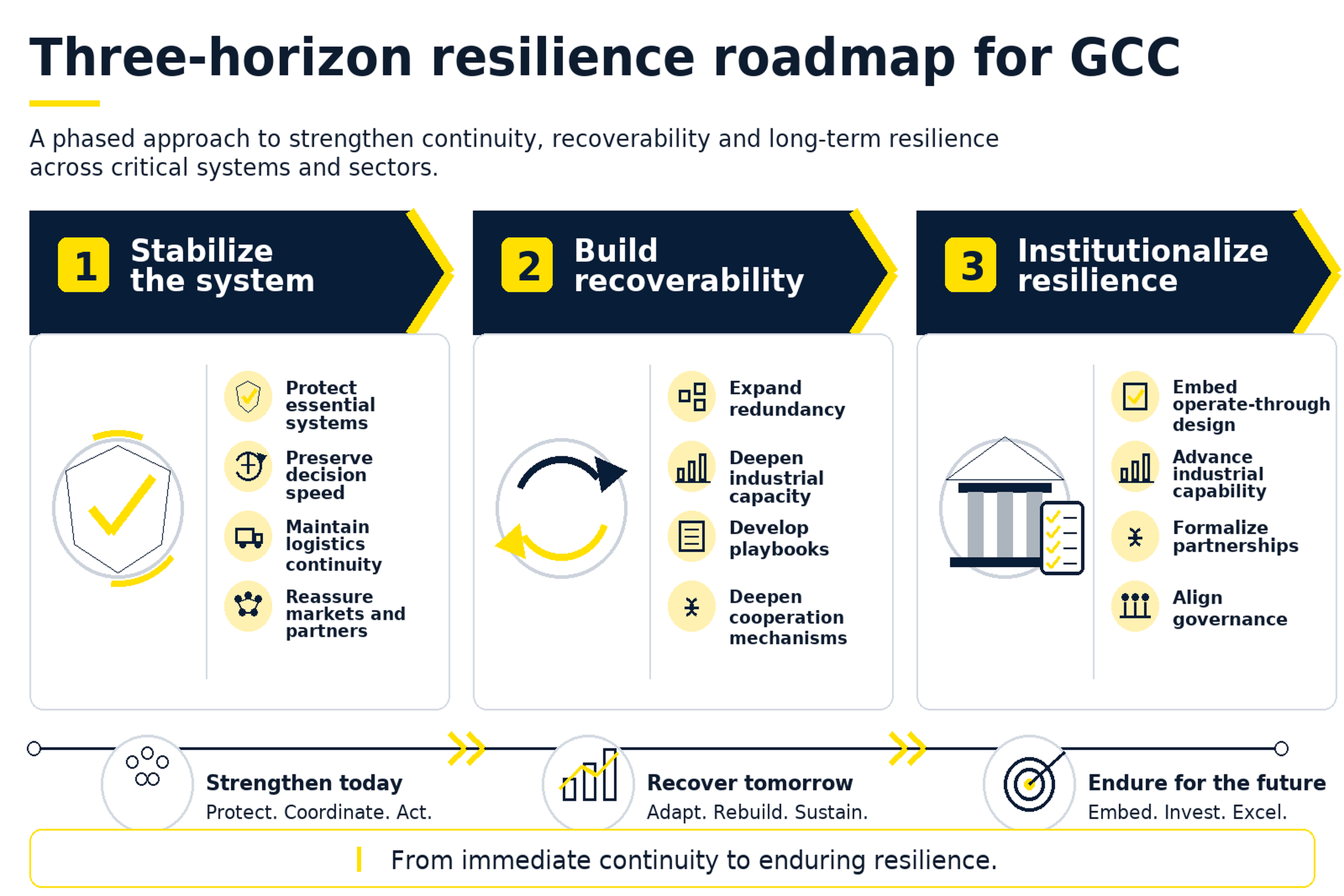
The report proposes implementing these levers through three practical horizons. The first horizon focuses on stabilizing critical systems and maintaining continuity. The second centers on strengthening recoverability through redundancy, industrial sustainment and established response mechanisms. The third institutionalizes resilience through governance, planning, infrastructure development and industrial capability, embedding resilience into long-term national strategies and investment priorities. Together, these horizons provide a roadmap for strengthening continuity, sustaining operational effectiveness and building long-term resilience across the GCC.

4. Implementation roadmap

The resilience agenda can be sequenced across three practical horizons: stabilizing the system, building recoverability and institutionalizing resilience.

resilience roadmap

5. Conclusion

The GCC has built a strong foundation through capability development, infrastructure investment and international partnerships. The next priority is to strengthen the ability of critical systems to continue operating, recover quickly and maintain confidence during periods of disruption. Resilience should be treated as an integrated strategic and economic agenda that connects infrastructure, industrial depth, digital systems, logistics, space-enabled services, partnerships and governance.

The five levers identified in the report provide a practical framework for this transition. Integrated threat architecture improves visibility and decision-making. Operational resilience supports continuity. Sovereign industrial depth strengthens endurance and economic value. Coalition integration adds scale and coordination. Resilience governance aligns authority, budget and execution. Together, these levers can help GCC countries strengthen preparedness and support long-term competitiveness.  

Summary

GCC countries are entering a new phase that places greater emphasis on resilience across the systems that support economic activity, service delivery and long-term competitiveness. Building on decades of investment in defense, infrastructure and strategic partnerships, the region is focused on strengthening continuity, recoverability and institutional coordination. As energy, logistics, digital, financial and space-enabled systems grow more interconnected, resilience is emerging as a key enabler of economic confidence and operational effectiveness. Five interconnected levers provide a practical framework spanning visibility, continuity, industrial depth, partnership and governance – supporting sustainable growth and long-term strategic advantage across the region.

Related articles

How can you redefine resilience for the next frontier of vulnerabilities?

An EY study found that 36% of assets in organizations are vulnerable to cybersecurity threats. Explore your sector’s strengths and weaknesses.

How can reimagining risk prepare you for an unpredictable world?

The 2025 EY Global Risk Transformation Study explores how Risk Strategists see disruption earlier, adapt faster and respond with more precision.

What if disruption isn't the challenge, but the chance?

Transform your business and thrive in the NAVI world of nonlinear, accelerated, volatile and interconnected change. Discover how.


About this article

Contributors