



EY refers to the global organization, and may refer to one or more, of the member firms of Ernst & Young Global Limited, each of which is a separate legal entity. Ernst & Young Global Limited, a UK company limited by guarantee, does not provide services to clients.
Recent Searches
Issuance of Administrative Guidelines on new documentation requirements for certain IP transactions and intra-group services

What has been issued
The new Corporation Tax Law Enforcement Regulations (“CTLER”) Article 59-2 came into effect for years on or after 1 April 2026, requiring taxpayers to prepare and retain prescribed information about certain intercompany IP and service transactions (the “new rules”). An overview of the content of this Article is set out in this EY Japan Tax Alert, New documentation requirements for IP transactions and intra-group services, dated 29 May 2026.1
On 30 June 2026, the National Tax Agency (“NTA”) issued Administrative Guidelines2 (below, the “Guidelines”) on the enforcement of the new rules which provides some further detail on the requirements for taxpayers. On the same day, the NTA issued amendments to the Corporation Tax Law Basic Circular (the “Circular”), for example giving further examples of the types of transactions subject to the new rules.
The Guidelines start with the tax authority perspective on the introduction of the new rules:
- Without appropriate documentation it may be difficult to understand the true nature of the transactions
- In transactions between companies that have a control relationship (intra-group transactions), detailed documents relating to the transactions are often not prepared
- Whereas conventional document preservation regulations require retention of all documents received or prepared in relation to transactions, the new rules require taxpayers to determine whether a transaction should be classified as a related-party transaction, confirm the information provided in the relevant existing documents, and, where necessary, obtain or prepare documents providing additional information
Link to deductibility of expenses
The Guidelines clarify that even if documentation is insufficient under the new rules, this is not an automatic reason to disallow the expense. The main mechanism for enforcing the new rule is therefore the threat of removing blue tax filer status.3
Revocation of blue tax filer status
The Guidelines state that if blue tax filer status is to be revoked following an audit, the examiner must state the facts that led to this outcome, how these link to the criteria for revocation,4 and the level of deficiency in information provided by the taxpayer. If the blue tax filer status is revoked, and the company later appeals the penalty and then provides the relevant documents, the original revocation will still stand for the affected tax years. See below for more detail on the consequences of revocation.
The Guidelines also note that revocation of blue tax filer status is not automatic; if the deficiency is minor, the examiner may dispense guidance on the improvements they expect.
Audits related to the new rules
If documentation is found to be insufficient in an audit, the examiners are required to explain the following:
- The reason a particular transaction is considered subject to the new rules (e.g. which of the transaction types set out in CTLER Article 59-2 it falls under)
- The additional information required to satisfy the new rules
- The level of insufficiency of information provided
The examiner must then request the taxpayer to provide the information within a reasonable period (as determined by the examiner). The taxpayer will therefore be given the opportunity to remedy deficiencies during an audit, rather than blue tax filer status being immediately revoked. However, we recommend that taxpayers aim to be compliant with the new rules in advance of an audit due to the difficulty of providing sufficient additional information within a possibly tight timeline, particularly where such information needs to be obtained from foreign related parties.
The Guidelines make clear that it is acceptable for information required under the new rules to be held overseas, but only to the extent that it can be promptly obtained in the event of an audit. If this cannot be done, the blue tax filer revocation penalty may apply.
The Guidelines and Circular provide no comment on proportionality; whether the scale of the transaction for which documentation is insufficient has an impact on whether the blue filer revocation penalty will be implemented. Therefore it is not clear if a taxpayer could lose blue tax filer status in relation to a transaction which accounts for e.g. less than 1% of the entity’s total costs or revenue.
Information required
The Guidelines state that every case should be considered on its own merits when considering the level of detail required. Therefore, taxpayers will need to exercise judgment when attempting to satisfy the new rules. An acid test is whether the documentation taxpayers maintain is sufficient to explain to a third party the rationale for a transaction, the benefits received by the Japanese corporation, how the consideration was calculated in sufficient detail, and how the consideration amount can be reconciled to accounting records. The Guidelines give the example that where documents received or prepared in relation to transactions with related parties are insufficient to understand the substance of the transaction, for example, where consideration is indicated only as a lump sum or where the nature of the transaction is only described in a non-specific manner, such documents alone cannot be regarded as satisfying the requirements of the new rules. The Guidelines clarify that it is acceptable to provide information satisfying the new rules as part of the transfer pricing Local File.5
Specific information required for each transaction type
The new rules apply specifically to related party transactions (including domestic related party transactions) involving either certain types of IP or the provision of services. The Guidelines provide limited additional detail on the information required for each type of transaction as follows:
IP transactions
Documentation should show the nature, scope and duration of IP rights granted, the manner of their use in the Japanese corporation’s (licensee) business, and information on the amount and calculation method of consideration paid by the Japanese corporation.
Services transactions
- Shared service arrangements: Documentation should show the nature, method, location and frequency of services, the benefits received by the Japanese corporation, and method of calculating costs borne by the Japanese corporation.
- Management services: Documentation should show specific activities performed, manner of provision, location and frequency of services provided, and method of calculating consideration paid by the Japanese corporation.
- Other similar services: Documentation should show timing, location, duration and frequency of services, specific activities performed, details and method of calculating consideration paid by the Japanese corporation.
Examples of each type of transaction
The Circular provides further comments on each type of transaction and examples of services considered to fall under certain transaction categories
IP transactions (Circular 17-3-4)
IP transactions subject to the new rules are the transfer or lease of industrial property, production methods using special technology, and similar rights. The Circular reiterates the existing definition of such rights,6 and adds that items not typically considered to constitute such rights may nevertheless be treated as services subject to the new rules if they are provided pursuant to an agreement and are performed in a matter that benefits the Japanese corporation.7 Taxpayers should take care not to misinterpret the term “industrial property rights” as only referring to technological intangible assets, as the definition is also considered to cover marketing intangible assets such as trademarks, brands and designs.
Shared service arrangements (Circular 17-3-9)
- Advertising, sales promotion, market analysis and other activities carried out to maintain or enhance the value of trade names, brands, or trademarks common to both the Japanese corporation and related parties
- Activities relating to development of new products or technologies, improvement of existing products, and other R&D activities using technical or professional expertise and know-how
- Activities for providing, maintaining or managing assets such as information systems and databases shared within a group
- Business activities for providing, maintaining or managing buildings, facilities or assets shared within a group
Management services (Circular 17-3-10)
- Providing advice on business planning, performance management or internal controls
- Providing human resources, legal, finance, labor or other operational specialized support
- Regularly providing information that regularly or systematically contributes to business operations
The Circular also notes that it is the substance of transactions which determines how they are viewed, not how they are invoiced (e.g. collectively or separately) or described in invoices.
Further details on the documentation required
The Circular explains that it is not necessary to include all details of a transaction, as long as the information required by the new rules is included (Circular 17-3-6). Further, if it is possible to provide the information required by aggregating multiple existing documents related to the transaction, this approach is also acceptable (Circular 17-3-7). Services which are provided repeatedly or continuously, and can be shown to maintain the same transaction conditions and service content, can be covered by a single document (Circular 17-3-8). However, where such repeated or continuous transactions are conducted over two business years, the new rules will be applied separately based on the date on which services or IP were provided (Circular 17-3-5).
Consequences of losing blue filer return status
While it is not covered in the new Guidelines or Circular, it is worth revisiting the actual consequences of blue tax filer status revocation, and the period of revocation. Blue tax filer status is a gateway condition for a number of special tax reliefs and attributes. The majority of these are unlikely to apply to all taxpayers (for example, access to R&D credits, which is contingent on blue tax filer status, naturally only affects companies conducting R&D, which in our experience is a minority of inbound companies). However, blue tax filer status allows the generation of losses which can be carried forward; an attribute which is likely to be relevant to most companies at some point. We set out below the possible consequences of losing blue tax filer status with an example.
The Japanese tax authorities commence an audit of ABC Japan Co., Ltd. (“ABC Japan”), a company with fiscal year ending (“FYE”) 31 March, in July 2029. The audit covers FYE March 2027, 2028 and 2029. In each of those years, the examiner finds that documentation of intra-group service transactions subject to the new legislation was insufficient, and ABC Japan fails to provide additional documentation to prove the substance of the transactions during the audit, so blue tax filer status is revoked. The notification of revocation is received on 15 November 2029.
Blue tax filer revocation applies not from the date of notification, but retroactively from the date in which the circumstances arose which gave rise to the revocation;8 in this case FYE 31 March 2027.9
Following revocation, the company can re-apply for blue tax return status if the relevant conditions are met.10 However, the tax authorities may reject any application made within a year of a revocation;11 therefore, in this case study, if ABC Japan wants to ensure its reapplication is not rejected out of hand, it is likely to only reapply for blue tax filer status after 15 November 2030. Blue filer status will then be valid from the start of the following fiscal year; i.e. in FYE 31 March 2032, and any losses generated thenceforth may be carried forward.
The below diagram summarizes the impact of the revocation.
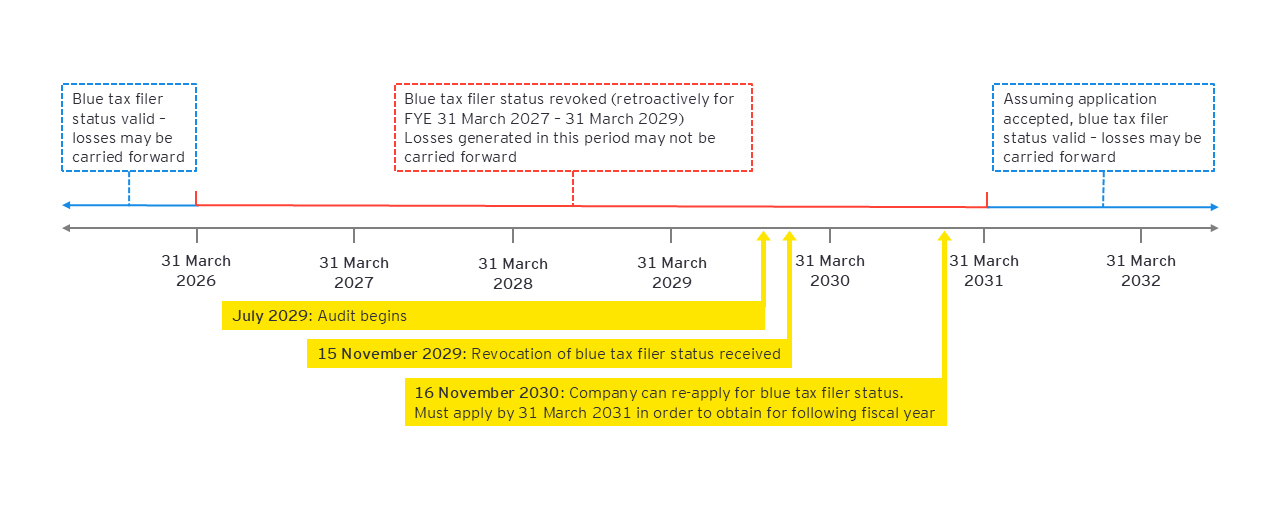
Therefore, from this single audit, the company loses the ability to carry forward losses from five consecutive fiscal years. Any losses arising in these years are, effectively, wasted. Any other reliefs or benefits the taxpayer avails itself of as a blue tax filer, such as R&D reliefs, will be similarly squandered.
Note that the losses which arose in FYE March 2026 could be used in any of the following five fiscal years when the company’s blue tax filer status had been revoked; blue tax filer status is a condition for creating losses which can be carried forward; not for using them.
Summary and conclusions
The Guidelines and Circular provide more information on the new rules; however, uncertainty still exists around how the new rules will be implemented. Taxpayers should exercise judgment in attempting to abide by the new rules, and approach it through the lens of explaining subject transactions to a third party, in order to evaluate the level of risk in the event of an audit. Taxpayers should review whether what is in place is sufficient and, if not, then how to supplement prior to an audit, or respond quickly if there is an audit. Taxpayers may be at particular risk if prior audits have resulted in guidance from examiners stating that information on intra-group transactions now subject to the new rules was insufficient; such companies could be prioritized for audit under the new rules.
Making efforts to satisfy the new rules is important because the potential penalty of removal of the blue return status could be significant, and once the decision is taken to remove the status, it is not possible to reverse the impact by providing supplemental information subsequently. Taxpayers should bear in mind that the new rules cover domestic transactions which may not be covered at all by the Local Files, because the Japanese transfer pricing rules only apply to cross-border transactions. Taxpayers may also wish to consider this an opportunity to investigate transactions subject to the new rules, and improve processes and governance surrounding such transactions.
Endnotes
- Article 59-2 is relevant for companies who hold blue tax return status. Article 67-2 also comes into effect to require the same for companies without blue tax return status.
- Administrative Guidelines are issued to tax authority personnel to provide practical guidelines on how to implement and apply Japanese tax legislation. While they do not have the status of Laws or Regulations, broadly speaking the tax authorities are expected to follow them and therefore such Guidelines have similar force to ordinary regulations and ordinances.
- Blue tax filer status is a privileged tax filing status for taxpayers who maintain double entry accounting records, journals, general ledger and other necessary books detailing all transactions. This status grants access to loss carryforwards and certain special tax regimes (e.g. R&D incentives).
- As set out in Article 127(1)(i) of the Corporation Tax Law (“CTL”), “Revocation of Approval for Filing Blue Returns”
- Requirements for the content of the transfer pricing local file are set out in Paragraph 6 of Article 22-10 of the Special Taxation Measures Law Enforcement Regulations.
- The existing definition of such rights still stands, and is as follows: industrial property rights, other rights related to technology, production methods based on special technologies or similar items, copyrights (including publication rights, neighboring rights, and similar rights), or programs as defined in Article 2, Paragraph 1, Item 10-2 (Definitions) of the Copyright Act. Further explanation of this definition is found in the NTA’s commentary on the CTL Circular 16-3-43, which states that industrial property rights and other rights includes patents, utility models, designs and trademarks, as well as other creations developed to the point that they may be repeatedly used in production or operations, even if they are not the subject of such rights, such as special raw materials, formulas, machinery, instruments, production processes using unique ideas and methods, equivalent confidential methods, trade secrets, other knowledge or designs with special technical value, production systems embodied in designs or blueprints for machinery or equipment.
Furthermore, the Paris Convention for the Protection of Industrial Property of March 20, 1883 states that service marks, trade names, indications of source, and similar rights also constitute industrial property rights (Horitsu yogo jiten (Dictionary of Legal Terminology), Horei yogo kenkyukai (Legal Terminology Study Group) p.337, 4th edition, Yuhikaku, 2012). - The Circular gives the following examples of items which are generally not considered industrial property rights but which could constitute services: information on overseas technology trends, distribution channels, production volumes of specific products, appraisals or performance investigations of machinery, equipment or raw materials inspections or similar items.
- Article 127(1) of the CTL
- Even if the audit covered earlier years and the same deficiency was found, the blue tax filer status could not be revoked for years starting before 1 April 2026, as this is the date the new rules came into force.
- As set out in Article 126 of the CTL, but broadly speaking the requirement to keep accounting books and records, produce financial statements, and preserve such records for seven years
- Article 123(3) of the CTL
Contact
Ernst & Young Tax Co.
Karl Gruendel, Partner
Keith Thomas, Associate Partner
Allen Wang, Director
Jonathan Perry, Director
How EY can Help
-
EY Japan’s Inbound Services team helps multinational corporations establish and grow their business in Japan. We support businesses at every stage of their Japan journey. Our services include market entry, entity structuring, tax compliance, transfer pricing, and legal advisory.
Read more
Direct to your inbox
Stay up to date with our Editor's picks newsletter.
Tax
Our tax professionals offer services across all tax disciplines to help you thrive in this era of rapid change.