



EY refers to the global organisation, and may refer to one or more, of the member firms of Ernst & Young Global Limited, each of which is a separate legal entity. Ernst & Young Global Limited, a UK company limited by guarantee, does not provide services to clients.
Recent Searches
Retailers hold the key to shifting AI perceptions, by making the invisible visible and showing how tech enhances everyday experiences.
In brief:
- Australians engage most with AI through retail, yet often don’t recognise it, thereby creating a trust gap that retailers can help close.
- Clear, benefit-led messaging and human-centred narratives can reframe AI from a threat to a helpful assistant.
- Retail’s low-risk, high-reward AI interactions offer a fast lane to national mindset change and competitive advantage.
Just 38% of Australians are excited about the future of artificial intelligence – miles behind frontrunners like India and China. But here’s the twist: the sector that could help turn the tide isn’t tech or government. It’s retail.
The 2025 EY AI Sentiment Index paints a clear picture. While AI investment surges globally, Australians are among the world’s most sceptical about its benefits. For a nation that competes on ideas, services and innovation, that scepticism is a competitive risk.
But retail is one domain where Australians are actively engaging with AI – and often appreciating the results, even if they don’t recognise the technology behind them.
And this suggests retailers could step up to help shift Australia’s mindset.
Scanning, but not seeing
More than half of Australians (58%) say they’ve deliberately used AI in a customer experience setting – well above education and learning (47%), in their professional lives (39%), engaging with government (30%), or managing their finances (25%).
This tells us that Australians are already interacting with AI most actively as consumers. But here’s the catch: they don’t know what counts as AI.
The chart below shows that just 8% of Australians realise their online carts are being auto-filled by AI and 6% realise it’s helping them with product recommendations.
The invisible assistant: How Australian customers are using AI
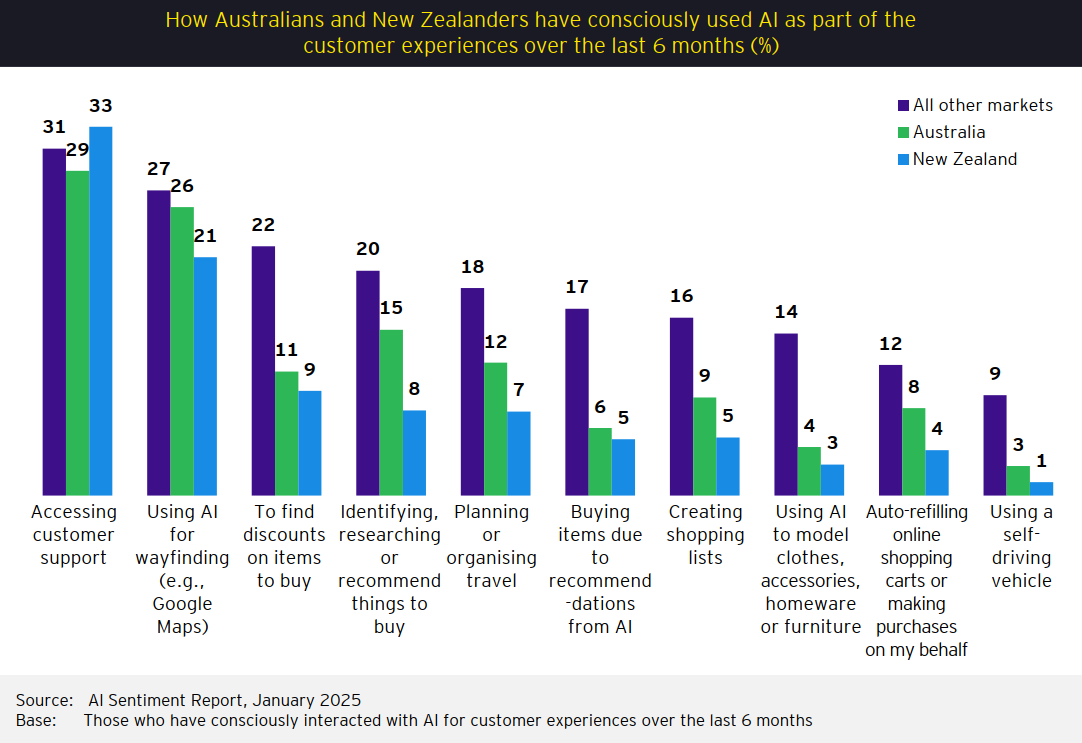
Yet these tools are embedded in nearly every major e-commerce platform. AI is triaging service requests, flagging fraud, predicting inventory needs – but because it’s invisible, it isn’t building trust.
From showroom to engine room
AI is already embedded in the retail engine room. But to unlock its full value – and help move the national conversation – retailers need to bring customers into the fold.
Start with clear, benefit-led messaging that highlights how AI enhances the customer experience – and how humans play a role at every step. Think: “AI sped up your delivery, but it was our people who made it happen.”
Retailers don’t need to explain the backend. They need to highlight outcomes – faster service, better stock availability, fairer pricing – and reinforce the human element that surrounds and steers the technology.
Retail’s fast lane to AI buy-in
Retail offers low-risk, high-benefit interactions. Every personalised promotion or seamless delivery builds confidence and reframes perceptions from “AI is risky” to “AI is helpful”. That’s how we shift the story from “the robots are coming” to “thank goodness the robots are here.”
Where Australians fear job losses or surveillance in other sectors, retail can showcase AI as a practical assistant – not a threat.
With AI moving at record pace, Australia can’t afford to hesitate while other countries scale up at speed.
Fit for the future, led by retail
Soon, customers will expect to upload a photo and receive personalised recommendations from an AI stylist, complete with curated shopping list, fit advice and styling tips.
Through a natural conversation, they’ll ask: “Do you have this in linen?” or “Will this suit my body type?” or “Will this match with other items in my wardrobe?” and get fast, tailored responses. Free tools already do this. The challenge for retailers isn’t imagining the future. It’s moving fast enough to meet it.
Consumer-facing companies sit at the frontier of AI adoption. They have an unrivalled opportunity to build the public’s understanding of what’s possible – and build margin at the same time. Get it right, and retailers won’t just win at the checkout. They will help change how the country sees AI – from something to fear, to something that works.
Summary
Retail is uniquely positioned to lead Australia’s AI transformation. By making AI’s benefits visible and relatable, retailers can shift public sentiment from skepticism to confidence. From personalised promotions to faster deliveries, these everyday interactions build trust and demonstrate AI’s value. The challenge isn’t imagining what’s next - it’s moving fast enough to keep up with the change. As consumer-facing brands sit at the frontier of adoption, they have the power to redefine AI’s role in society. By blending technology with human touchpoints, retailers won’t just win customer loyalty - they’ll help Australia embrace a future where AI works for everyone.
This article is the sixth in the new EY AI Sentiment Index series, discusses how retailers can reshape Australia’s AI narrative by highlighting practical, human-centred benefits that build trust and drive consumer confidence. Next up, EY Regional Market Segment Leader, Government and Health Sciences, Oceania, Dean Yates and EY New Zealand Government Technology Leader, Gary Baird, discuss how governments can build public trust in AI by leading with transparency, human-centred design, and targeted success in trusted domains..

Related articles
Australia’s Risk-Averse Institutions Lead in AI
Discover how Australia’s cautious institutions are leading AI adoption. Learn how to build confidence and drive change. Read the full article now.
AI Education: Empowering Oceania’s Future Workforce
Discover how AI education can unlock career potential across Oceania. Learn why leaders must act now to build an AI-ready workforce.